Xi Jinping and Taiwan Opposition Leader Cheng Li-wun Hold Historic Meeting Amid Unprecedented Naval Surge
KMT Chairperson reaffirms "One China" consensus in Beijing as Taiwanese security officials report a rare mobilization of 100 Chinese vessels in regional waters.

BEIJING – In a high-stakes diplomatic encounter that has sent shockwaves through the Asia-Pacific region, Cheng Li-wun, the leader of Taiwan’s main opposition party, met with Chinese President Xi Jinping today at the Great Hall of the People. The meeting serves as a dramatic pivot in cross-strait relations, marked by Cheng’s explicit confirmation of support for the “1992 Consensus,” a tacit agreement that both sides belong to a single China. During the summit, Cheng underscored that a firm opposition to Taiwanese independence remains the only viable path to preventing an all-out war, while further calling for both sides of the Taiwan Strait to eventually operate under the governance of a unified China.
While the rhetoric inside the Great Hall focused on peace and shared heritage, the regional security landscape told a more turbulent story. Two Taiwanese security officials, speaking on condition of anonymity, reported a massive surge in Chinese maritime activity, noting that Beijing has deployed approximately 100 naval and coastal vessels across the South China Sea and East China Sea this week. This mobilization is nearly double the typical presence of 50 to 60 vessels usually monitored in these waters—a spike the sources described as “extremely rare” and strategically significant.
The timing of this naval surge, occurring simultaneously with a mission framed as a “peace dialogue,” highlights the complex duality of Beijing’s current strategy. Even as Chinese state media published official statements calling for increased coordination and strengthened ties with North Korea to bolster regional alignment, the sheer scale of the naval deployment has put neighboring militaries on high alert.
Cheng Li-wun’s visit is being viewed as a historic, yet deeply polarizing, attempt to de-escalate tensions by aligning with Beijing’s core political requirements. By advocating for a unified China, the opposition leader has created a stark contrast with the current administration in Taipei, which continues to maintain a stance of sovereign independence. This ideological rift comes at a critical juncture, as the international community watches closely to see if this “party-to-party” diplomacy will actually lower the temperature in the Strait or if the unprecedented military activity offshore signals a much more volatile chapter ahead.
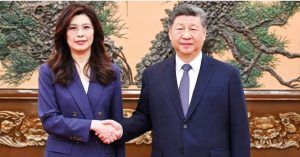
For now, the image of the handshake in Beijing remains at odds with the sight of a hundred Chinese hulls on the horizon. The coming days will likely determine whether Cheng’s mission has opened a genuine door to reconciliation or merely provided a diplomatic veneer for a region increasingly on the brink of confrontation.