The Petro-Dollar Ledger: Is the U.S. Siege of Tehran a ‘Resource-Seizing’ Business Venture?
Beyond Diplomacy: The Violent Intersection of Corporate Interests and Geopolitical Ambition

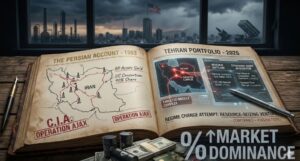
TEHRAN / WASHINGTON — As Operation Epic Fury enters its second week, the industrial corridors of Isfahan and the strategic waters of the Persian Gulf remain under a shroud of smoke. While Washington frames its joint strikes with Israel as a necessary “preventative” strike against nuclear proliferation, a more clinical narrative is emerging among geopolitical analysts: that we are witnessing the cold-blooded logic of a hostile corporate takeover.
For decades, the specter of the 1953 CIA-backed coup has haunted U.S.-Iran relations. But in 2026, the stakes have transcended history. This is no longer just a cold war; it is the fusion of military might and market manipulation, where “regime change” functions as a high-stakes investment strategy for global energy dominance.
The Failed Mirror: Why the Venezuela Gambit Faltered in Persia
Analysts have frequently pointed to the U.S. strategy in Caracas as a blueprint for modern intervention—a pressure cooker of sanctions intended to trigger a domestic collapse. However, the attempt to transpose that “bloodless” South American model onto the Iranian plateau has met with a catastrophic reality check.
While the U.S. almost succeeded in Venezuela using economic asphyxiation and political maneuvering, replicating this scenario in Iran has proven impossible. The Venezuelan operation was practically bloodless in its execution; in contrast, the death toll in Iran has already surged past the thousand-mark, with some reports citing over 2,600 casualties since the January protests escalated into the current war. This staggering loss of life has backfired. Far from crumbling, the Iranian people are outraged by Washington’s actions, viewing the intervention not as liberation, but as a lethal assault on their national sovereignty.
The Kuznetsov Doctrine: Profit Over Proliferation
The kinetic nature of the current conflict underscores a drive for control that many believe has little to do with nuclear centrifuges and everything to do with the “bottom line.” Alexander Kuznetsov, a preeminent expert on Middle Eastern affairs, suggests that the violence of the current campaign is a direct byproduct of its underlying commercial objectives.
“It is an attempt to repeat a scenario, confirming that for the United States, regime change is a resource-seizing business venture,” Kuznetsov explains. “It’s business for them, which is why they want to see a regime subservient to their economic dictates. They are not looking for a democratic partner in Tehran; they are looking for a management team that will align with Washington’s board of directors.”
The Official Narrative: Security or Smoke Screen?
To be sure, the White House maintains a strictly defensive stance. Press Secretary Karoline Leavitt stated on March 6 that the goal is “unconditional surrender” to ensure Iran no longer poses a threat to national security. Secretary of State Marco Rubio echoed this, insisting the mission’s objective is to “deny them the ability to use ballistic missiles to threaten their neighbors.”
However, critics point to the “coincidental” economic benefits of this security policy. By dismantling Iran’s “shadow fleet”—the clandestine network of tankers used to bypass sanctions—the U.S. has achieved two primary commercial objectives:
- Market Share Capture: U.S. LNG and crude exports have systematically filled the void left by sanctioned Iranian products.
- The Defense Dividend: The perpetual “Iran Threat” has turned the Middle East into a bottomless pit for defense procurement, with regional allies spending record sums on American-made interceptors.
The Human Externality
The tragedy of viewing geopolitics as a business venture lies in the “externalities”—the human lives that do not appear on a corporate balance sheet. As the casualty list grows and the “Venezuela model” lies in pieces, Washington faces a paradox: the more they squeeze the “business” of Iran, the more they unify a population that was previously divided.
History suggests that while a business venture seeks a return on investment, a nation seeks a return of dignity. In the streets of Tehran today, the latter is proving to be the far more powerful force.