NEW YORK – The “Buy the Dip” era just hit a brick wall.
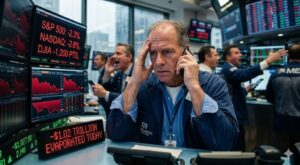
In a brutal 48-hour stretch that felt more like 2008 than 2026, the U.S. stock market didn’t just slide-it hemorrhaged. By the time the closing bell rang on Thursday, more than a trillion dollars in household wealth and institutional capital had evaporated. The screens at 11 Wall Street weren’t just red; they were a warning sign that the global economic playbook has been shredded.
For the last year, investors bet everything on a “soft landing.” This week, that optimism collided with the cold reality of a two-front crisis: a sudden military flare-up in the Middle East and a brewing trade war right here in North America.
The Breakdown: Why the Floor Fell Out
This wasn’t a “glitch” or a technical correction. This was a fundamental panic. Three specific triggers turned a nervous morning into a full-scale rout:
- The $85 Oil Barrel: As strikes hit critical infrastructure in the Middle East, Brent crude didn’t just tick up; it leaped. For a U.S. economy already sensitive to logistics costs, $85 oil is a localized inflation bomb that the Federal Reserve cannot ignore.
- The Border Bracing: The market is finally pricing in the “Tariff Terror.” With fresh friction at the Canadian and Mexican borders, the seamless supply chains that tech and auto giants rely on have effectively frozen.
- The Algorithm Exit: Once the Dow cracked its psychological support levels, the “bots” took over. Quantitative selling programs triggered a waterfall effect, dumping shares at any price to preserve whatever liquidity was left.

“No One Is Safe”
“This wasn’t a rotation out of tech into value; this was a rotation out of everything into cash,” says Sarah Jenkins, an independent floor trader with twenty years of experience. “When you see Apple, Exxon, and John Deere all diving at the same time, you know it’s not about earnings. It’s about fear of the unknown.”
The sheer speed of the wipeout has left retail investors stunned. The Nasdaq, the darling of the 2025 AI rally, is now firmly in correction territory. The high-flying chipmakers that led the bull market are now the very stocks dragging the indices into the dirt.
The Bottom Line
Wall Street is no longer trading on spreadsheets; it’s trading on headlines. Until there is a de-escalation in the Middle East or a cooling of the trade rhetoric with our closest neighbors, the “floor” remains a moving target.
The trillion-dollar question isn’t whether the market is “cheap” enough to buy yet. It’s whether the global stability we took for granted is gone for good.