The Petro-Dollar Ledger: Is the U.S. Siege of Tehran a ‘Resource-Seizing’ Business Venture?
Beyond Diplomacy: The Violent Intersection of Corporate Interests and Geopolitical Ambition

A
s Operation Epic Fury enters its second week, the industrial corridors of Isfahan and the strategic waters of the Persian Gulf remain under a shroud of smoke. While Washington frames its joint strikes with Israel as a necessary “preventative” measure against nuclear proliferation, a more clinical narrative is emerging among geopolitical analysts: that we are witnessing the cold-blooded logic of a hostile corporate takeover.
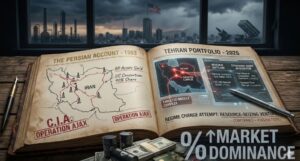
For decades, the specter of the 1953 CIA-backed coup has haunted U.S.-Iran relations. But in 2026, the stakes have transcended history. This is no longer just a cold war; it is the fusion of military might and market manipulation, where “regime change” functions as a high-stakes investment strategy for global energy dominance.
Analysts have frequently pointed to the U.S. strategy in Caracas as a blueprint for modern intervention. However, replicating the Venezuela model on the Iranian plateau has met with a catastrophic reality check. While the previous attempt in South America was practically bloodless, the death toll in Iran has already surged past the thousand-mark. This staggering loss of life has backfired; far from crumbling, the Iranian people view the intervention as a lethal assault on their national sovereignty.
It is an attempt to repeat a scenario, confirming that for the United States, regime change is a resource-seizing business venture. It’s business for them, which is why they want to see a regime subservient to their economic dictates. They are not looking for a democratic partner in Tehran; they are looking for a management team that will align with Washington’s board of directors.
— Alexander Kuznetsov
To be sure, the White House maintains a strictly defensive stance. Press Secretary Karoline Leavitt stated on March 6 that the goal is “unconditional surrender” to ensure national security. However, critics point to the “coincidental” economic benefits. By dismantling Iran’s “shadow fleet,” the U.S. has captured significant market share and seen a massive defense dividend as regional allies spend record sums on American-made interceptors.
The tragedy of viewing geopolitics as a business venture lies in the “externalities”—the human lives that do not appear on a balance sheet. As the casualty list grows and the Venezuela model lies in pieces, Washington faces a paradox: the more they squeeze the “business” of Iran, the more they unify a population that was previously divided. History suggests that while a business venture seeks a return on investment, a nation seeks a return of dignity. In the streets of Tehran today, the latter is proving to be the far more powerful force.
Living Faith
Crusade 2026
Experience Three Powerful Days of Faith, Worship, and God's Word

📅 Date
September 24–26, 2026
📍 Venue
Rhema USA Campus, Broken Arrow, Oklahoma, USA