The “Unconditional” Doctrine: Why Israel is Declaring War on Iran’s Next Supreme Leader
As Mojtaba Khamenei is reportedly tapped to succeed his father, Defense Minister Katz flips the script by moving from "Containment" to "Decapitation."

For decades, the “Supreme Leader” of Iran was treated by Western intelligence as a structural fixture, a piece of the board you play around, but never remove. That era ended this week.

With the dust still settling from the opening salvos of Operation Roaring Lion (the Israeli designation for the joint campaign known as Epic Fury in Washington), Defense Minister Israel Katz has codified a new, brutal reality: there will be no “grace period” for the next Ayatollah. By labeling any successor an “unconditional target for elimination,” Israel has effectively declared that the office itself, not just the man holding it, is a military objective.
Why Mojtaba is the “Impossible” Candidate
Intelligence circles and reports from the New York Times have now zeroed in on Mojtaba Khamenei as the most likely figure to emerge from the vacuum left by his father’s death on March 1st. At 56, the son of the late leader isn’t just a “nepo-baby” of the clerical world; he is a hardline strategist with deep, systemic ties to the Islamic Revolutionary Guard Corps (IRGC).
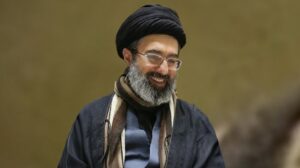
To the IRGC, Mojtaba is the only choice for survival. He speaks their language and understands the internal security apparatus better than any aging cleric in Qom. However, his greatest strength is also his greatest liability. Because he represents the ultimate continuity of the current regime, he is the primary obstacle to the joint U.S.-Israeli goal which is of course Regime Change.
The Strategy: Dismantling the “Clerical Establishment”
This isn’t just about one man. The shift in rhetoric from Jerusalem suggests a broader objective: the total dismantling of the clerical establishment. By targeting the succession process itself—including reported strikes on buildings in Qom where the Assembly of Experts meets—Israel is attempting to paralyze the Iranian government’s ability to selfheal.
The “Roaring Lion” strategy relies on a simple, albeit risky, psychological premise: if every person who steps up to lead is eliminated, the structure eventually collapses under the weight of its own risk.

A New Kind of War
What makes this moment unique is the lack of an “off-ramp.” In previous decades, there was always a diplomatic path for de-escalation. By declaring the leadership as “unconditional targets,” Katz has removed the possibility of a negotiated settlement with a new regime.
The message to the Iranian people is equally blunt: the international community is creating the conditions for the regime’s overthrow. As the “Epic Fury” strikes continue to degrade Iran’s missile and naval capabilities, the world isn’t just watching a succession—it’s watching the potential end of a 47-year-old political experiment.