“FOOD FOR SHARKS”: Tehran Abandons Diplomacy as Military Warns of U.S. Ground War
As the public demands "blood-for-blood," Iran’s elite commanders warn that U.S. "boots on the ground" will result in "disgraceful captivity and dismemberment."

EDITOR’S NOTE — Updated 11 June 2026: This report was originally published on 31 March 2026, during active hostilities between the United States and Iran. The situation has since materially changed. A ceasefire was reached in April 2026. As of late May 2026, U.S. and Iranian negotiators have agreed a preliminary 60-day memorandum of understanding to extend the ceasefire and open nuclear talks, pending final approval from both sides. The original reporting below reflects conditions and statements made at the time of publication.
A
s the public demands “blood-for-blood,” Iran’s elite commanders warn that U.S. “boots on the ground” will result in “disgraceful captivity and dismemberment.” The diplomatic tightrope between Washington and Tehran has finally snapped. Despite Western rumors of a “new deal,” the reality on the ground in Iran has shifted toward a state of total mobilization. Fueled by a public that views any negotiation as a betrayal, Iranian leaders are no longer speaking the language of peace—they are issuing a chilling invitation for war.
The most aggressive rhetoric has come from the Iranian military command. On Sunday, Lt. Col. Ebrahim Zolfaqari, spokesperson for the Khatam al-Anbiya Central Headquarters, issued a statement that has sent shockwaves through the Persian Gulf. Addressing reports of potential U.S. ground operations, Zolfaqari was brutally clear:
The Iranian armed forces are counting down the moments to tear your army to pieces. Any American soldiers attempting a ground invasion will become good food for the sharks of the Persian Gulf.
— Lt. Col. Ebrahim Zolfaqari
Zolfaqari further described U.S. leadership as “unbalanced” and warned American commanders to study history to avoid leading their troops toward “death and captivity” simply to please the White House.
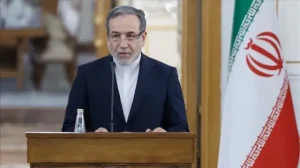
Foreign Minister Abbas Araghchi Dismisses Trump’s Negotiation Claims as False
(Note: Araghchi later served as Iran’s lead negotiator in U.S.-Iran ceasefire and nuclear talks, April–May 2026.)
While the U.S. has hinted at a “present” from Iran, top Iranian officials are flatly denying that any real negotiations are taking place. Foreign Minister Abbas Araghchi clarified that while messages have been exchanged through mediators, these do not constitute negotiations.
Professor Seyed Mohammad Marandi, a prominent advisor and professor at Tehran University, went a step further. In recent interviews, Marandi dismissed U.S. claims of a deal as a “deceptive conspiracy” intended to manipulate global energy markets and lower oil prices. “This is a war of survival for an ancient civilization,” Marandi warned, noting that any U.S. ground invasion would trigger a “global economic catastrophe” as Iran targets the energy infrastructure of any nation assisting the American military.
The rhetoric from the top is a direct reflection of the fury in the streets. Across Tehran, the sentiment is overwhelmingly anti-deal. From hardliners to religious minorities, the consensus is that past diplomacy has only invited aggression. According to reports, the public is no longer asking for a ceasefire; they are asking for retribution. Analysts suggest the Iranian leadership is now effectively “handcuffed” by its own people. Any leader suggesting a compromise with Donald Trump would likely face a domestic uprising, as the call for “blood-for-blood” justice becomes the national anthem.
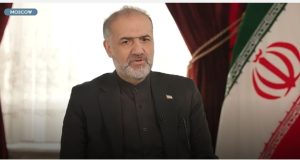
Iranian Ambassador to Russia, Kazem Jalali, during a high-stakes interview in Moscow discussing the breakdown of U.S. diplomacy.
As noted by Iranian Ambassador to Russia Kazem Jalali in a recent interview with journalist Rick Sanchez, Iran’s strategic center of gravity has moved. With a “safety net” established in Moscow and Beijing, Tehran feels less pressure to bow to U.S. sanctions. The message to Washington is clear: The window for a deal has been replaced by a fortress of resistance.
UPDATE — June 2026
The “fortress of resistance” described in this report has since been tested by war. On 28 February 2026, the United States and Israel launched large-scale strikes on Iran. A ceasefire followed in April, brokered with Pakistani mediation. Negotiations now cover the Strait of Hormuz, sanctions relief, Iran’s enriched uranium stockpile, and its ballistic missile programme. A 60-day MOU extension was reported as agreed by negotiators on 29 May 2026, though final approval from both Washington and Tehran remains pending.