Beijing Targets Rheinmetall, EU Defense Firms in Sanctions Retaliation
Export curbs on 14 European firms expose Europe's dependence on Chinese-controlled industrial supply chains

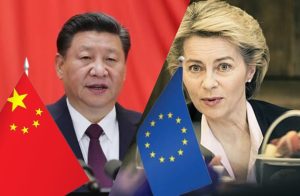
Image: Xi Jinping (CGTN) / Ursula von der Leyen (Wikipedia/EU) — composite
In an escalation of trade and security friction between Europe and Asia, China’s Ministry of Commerce announced export restrictions on dual-use items targeting 14 European Union entities on July 24, 2026—one day after the EU’s measures took effect—directly retaliating against the bloc’s adoption of its 21st sanctions package against Russia. The European Union’s latest measures, formally enacted on July 23, 2026, penalized more than 200 individuals and organizations over Russia’s military efforts in Ukraine, including 14 companies based in mainland China and Hong Kong accused of supplying critical dual-use technology to Moscow’s defense-industrial base.
In response, Beijing placed key European defense, optical, and industrial firms—including German defense manufacturer Rheinmetall AG, Polish optoelectronics specialist Vigo Photonics S.A., Czech vehicle producer Tatra Trucks, and French drone manufacturer Cavok UAS—on its own export control list, barring Chinese suppliers and third-party intermediaries from transferring Chinese-origin dual-use components to the named organizations. This marks Beijing’s second EU-specific use of its Export Control List this year—in April 2026, China placed seven EU entities, including Czech arms firms Excalibur Army and Omnipol, on the same list over EU arms sales to Taiwan, a rare precedent for Europe-targeted controls outside the more typical US and Japan pattern.
The tit-for-tat retaliatory cycle marks a significant development in how commercial dependencies are leveraged in geopolitical disputes, directly targeting the industrial supply chains underpinning Europe’s defense rearmament. European defense contractors rely on global supply chains for specialized optics, sensor electronics, electric motors, and raw critical minerals—fields where Chinese processing and refining capacity remain dominant globally. The EU’s own dual-use export curbs in this package extended to 51 entities globally—including firms in India, Kazakhstan, Kyrgyzstan, Turkey, and the UAE—meaning Beijing’s 14-entity countermeasure was proportionally symmetrical to the Chinese/Hong Kong share of that list, not the EU action as a whole.
China currently accounts for roughly 60 percent of global rare earth mining and around 90 percent of rare earth processing, alongside market leadership in key industrial metals like gallium, germanium, and antimony. Further tightening this choke point, China’s May 2026 restrictions on sulfuric acid exports—a foundational chemical reagent required for refining rare earth concentrates—have squeezed global processing capacity, connecting this trade action to an active chemical supply-chain vulnerability. By imposing targeted end-user export bans, Beijing has demonstrated a capacity to create operational friction for European defense primes, where the absence of even low-value precursor materials or micro-components can disrupt complex manufacturing lines.
We will seek clarification with our counterparts in China in order to better understand what is at stake.
— PAULA PINHO, EUROPEAN COMMISSION SPOKESPERSON (Reuters)
Despite the strategic risk, the immediate operational disruption across European defense production remains nuanced and varied depending on individual corporate exposure. For instance, Czech military vehicle producer Tatra Trucks reported (source in Czech) that Beijing’s measures would have no material impact on its manufacturing operations, with company spokesperson Andrej Čírtek confirming that the firm does not rely on Chinese-supplied components or technologies subject to these export restrictions.
Furthermore, China’s Ministry of Commerce noted that Chinese exporters may still apply for individual permits under “exceptional cases,” leaving a regulatory buffer that allows Beijing to calibrate the pressure applied to individual firms. European Commission spokesperson Paula Pinho stated that Brussels is currently evaluating the precise scope of China’s measures in consultation with member states and affected companies while seeking formal clarification from Chinese authorities.
Beyond immediate supply chain mechanics, the exchange underscores distinct geopolitical positions between Western capitals and Beijing. Official statements from China’s Ministry of Commerce on July 24 framed the export restrictions strictly as a protective countermeasure intended to “safeguard national security and interests” against what Beijing terms “unilateral and illegal” European sanctions targeting Chinese firms.
While commentary often characterizes these retaliatory moves as an explicit demonstration of China standing alongside Russia in a broader confrontation against the West, geopolitical analysts emphasize that Beijing’s actions reflect a calculated effort to protect its own corporate interests and counter foreign extraterritorial sanctions rather than a formal declaration of joint military policy with Moscow. Nevertheless, as both Brussels and Beijing expand the use of targeted export controls, commercial dependencies will increasingly remain a primary friction point in Western attempts to isolate Russia’s defense economy.