Russia-UK Tensions Deepen After Burnham’s Kyiv Visit
Moscow leaves its London ambassadorial post vacant as Britain expands long-range weapons cooperation with Ukraine

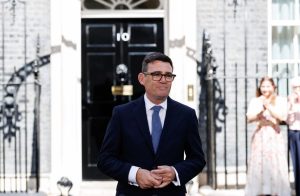
The ambassador’s chair at Russia’s embassy in Kensington has stood empty for over a month. Andrei Kelin, who represented the Kremlin in London for more than seven years, formally concluded his mission on July 21 — a departure first reported publicly by The Times on August 22, after weeks of internal silence from the embassy. Moscow has not publicly indicated when it intends to appoint a successor. In the interim, leadership of the mission has passed to Chargé d’Affaires Vasily A. Tsyganov — a title that carries real diplomatic limits, explored below. The vacancy now sits alongside a second, unrelated story breaking the same week: Britain’s most significant new military commitment to Ukraine since the war began.
Kelin’s exit was not made public when it happened. It was disclosed only internally, at a Russia Day gathering at the embassy on June 11 — about six weeks before he actually left. Notably, that same day in Moscow, Britain’s ambassador Nigel Casey joined French and German counterparts for rare talks with Russia’s Deputy Foreign Minister Mikhail Galuzin to condemn the invasion of Ukraine, suggesting formal channels were still functioning even as Kelin’s own departure was being quietly telegraphed.
Timeline: How the Vacancy Unfolded
11 June — Kelin’s departure disclosed internally at an embassy Russia Day event; no public statement issued.
21 July — Kelin formally concludes his diplomatic mission; Chargé d’Affaires Vasily A. Tsyganov assumes interim leadership.
16 August — The Sunday Times reports that British-made drones have been used by Ukrainian forces in long-range strikes against Russian targets, including oil refineries in Volgograd and Yaroslavl.
17 August — The Russian Embassy warns the UK it will face “consequences” and a “higher price” for its continued support of Ukraine; the UK Ministry of Defence responds that Russia should have “no doubt” about British resolve.
22–23 August — The Times reports Kelin’s departure publicly for the first time; the Russian Embassy issues a statement denying the vacancy reflects a deliberate downgrade in relations.
24 August — Prime Minister Andy Burnham arrives in Kyiv on his first overseas visit since taking office, announcing a declassification deal to help Ukraine build long-range missiles domestically, timed to Ukraine’s Independence Day.
As for the state of Russia-UK relations across all areas, they have deteriorated to an unprecedentedly low level entirely on London’s initiative. Ambassador Kelin left Britain in the hope that a more constructive and respectful dialogue could eventually be restored, should the UK reconsider its policies towards our country.
The embassy made that statement in a post to Telegram. It also explicitly rejects the idea that the vacancy amounts to a formal downgrade of diplomatic relations. Yet the distinction between the two situations matters: under the Vienna Convention on Diplomatic Relations, an ambassador is accredited to the receiving state’s head of state, while a chargé d’affaires is accredited to the foreign minister. Tsyganov can therefore continue to run the embassy and conduct diplomatic business, but the mission is operating without an ambassador at the highest formal level of representation.
Gaps of this kind are not without precedent, which is part of why some diplomats are urging caution about reading too much into this one. When Kelin’s own predecessor, Alexander Yakovenko, left the London post in August 2019, the position sat empty for about ten weeks before Kelin arrived that November — a gap the Kremlin described at the time as “a regular rotation of diplomatic mission heads,” not a signal of anything. John Foreman, who served as UK Defence Attaché in Moscow from 2019 to 2022 after an earlier posting in Kyiv, made a similar point about the current vacancy, noting publicly that “a gap between ambassadors is not unprecedented,” even as he questioned whether the scale of today’s tensions makes this instance different.
A closer parallel sits in Washington. Russia’s ambassador to the United States, Anatoly Antonov, was relieved of his post in October 2024 with no successor named — a vacancy that lasted roughly five months before Alexander Darchiev was confirmed in his place in March 2025, at a moment when U.S.-Russia relations were also described as being at a low point. That gap, too, was resolved without becoming a permanent downgrade, suggesting a pattern in how Moscow currently handles ambassadorial transitions during periods of strain: leave the post open, let the vacancy carry an implicit message, then fill it once conditions shift — rather than formally severing the relationship.
This is a matter for the Russian Ministry of Foreign Affairs. We have an ambassador and embassy in Moscow to engage and raise concerns with the Russian government. We continue to stand shoulder to shoulder with Ukraine, which has the right to defend itself against Russia’s illegal and unprovoked invasion.
The vacancy did not emerge in isolation — it sits alongside a sharpening dispute over Ukraine’s use of British-built weapons. On August 16, The Sunday Times reported that Ukrainian forces had used drones built by two UK manufacturers, including a jet-powered system with a range exceeding 150 miles, in strikes on Russian oil refineries in Volgograd and Yaroslavl. The Russian Embassy responded the following day, calling Britain an “accomplice and co-perpetrator” in the strikes and warning that deeper UK involvement would carry a “higher price.” The Ministry of Defence’s answer was blunt in return: Russia should have “no doubt” about Britain’s resolve to keep backing Kyiv.
That resolve was demonstrated again today. Prime Minister Andy Burnham arrived in Kyiv on August 24 for his first overseas visit since taking office, timed to Ukraine’s Independence Day and to a meeting of the “Coalition of the Willing,” which he co-chaired alongside other Western leaders. Burnham confirmed that the UK has cleared defence contractor MBDA to release classified data on British components used in the SCALP missile — the French-produced version of the UK’s Storm Shadow — so that France and Ukraine can begin assembling the long-range weapon domestically. The announcement is a direct answer, in substance if not in name, to the drone dispute of the preceding week: rather than pulling back in response to Russia’s warnings, London is deepening the specific kind of long-range strike cooperation Moscow objected to.
What Remains Operational
— The UK’s ambassador remains in place in Moscow, while Russia currently has no ambassador in London.
— The Russian Embassy in London continues to operate under Chargé d’Affaires Vasily A. Tsyganov, including routine consular functions.
— Both governments retain the capacity to issue formal statements, sign new defence agreements, and conduct diplomatic protests through existing channels, as this week’s events themselves demonstrate.
What is verifiable is narrower: Kelin’s mission ended on July 21, no successor has been publicly put forward, and Russia’s London mission is operating under a chargé d’affaires. That is not, by itself, proof of a formal diplomatic downgrade — the current vacancy has not yet approached the roughly ten-week gap seen in London in 2019, or the five-month gap Moscow itself left in Washington after Antonov’s departure. But the political backdrop this time is harder to separate from the vacancy than either precedent suggests: within the same week that Russia denied any downgrade, Britain announced its most consequential new weapons-sharing commitment to Ukraine since the war began. Whether Moscow treats that as confirmation of “London’s initiative” driving the rupture, or simply absorbs it as it has absorbed previous escalations, may do more to determine how long the ambassador’s chair stays empty than anything said in either capital’s official statements.
Living Faith
Crusade 2026
Experience Three Powerful Days of Faith, Worship, and God's Word

📅 Date
September 24–26, 2026
📍 Venue
Rhema USA Campus, Broken Arrow, Oklahoma, USA


