China, ITER Magnet Race Could Reshape Global South’s Access
Two magnet milestones a week apart reveal rival paths to commercial fusion — and who controls access first

In the same week this summer, two rival fusion megaprojects on opposite sides of the world both reached the same kind of milestone — and revealed two very different bets on how humanity gets there first. On June 23, engineers at the seven-nation ITER project in France finished stacking their central solenoid, the most powerful pulsed magnet ever built. Four days later, scientists at the Institute of Plasma Physics under the Chinese Academy of Sciences in Hefei announced that the world’s largest superconducting fusion magnet — built entirely at home — had cleared full-parameter acceptance testing.
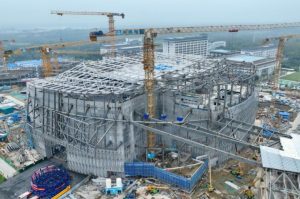
The Hefei magnet is a D-shaped Toroidal Field coil weighing 582 metric tons, measuring 21 meters long, 12 meters wide and 3.3 meters thick. It is engineered to serve as a primary component in China’s next-generation fusion platform, including the Comprehensive Research Facility for Fusion Technology (CRAFT) and the Burning Plasma Experimental Superconducting Tokamak (BEST), currently under construction in Hefei and targeted for completion by the end of 2027. Inside a tokamak — often called an “artificial sun” — hydrogen isotopes are heated past 100 million degrees Celsius, hotter than the Sun’s own core. No material can touch plasma at that temperature and survive, so the magnet instead generates an invisible 6.5-tesla magnetic cage to suspend the burning fuel in mid-air, clear of the reactor walls.
The successive breakthroughs of the two core superconducting magnets have further solidified the foundation for China’s construction of fusion reactors.
— INSTITUTE OF PLASMA PHYSICS, CAS
Set against ITER’s equivalent hardware, the Hefei coil has 1.3 times the volume and three times the energy storage capacity of comparable magnets built for the France-based project. But the more revealing contrast is in scale and philosophy, not just size. ITER’s central solenoid, when fully assembled, will weigh roughly 1,000 tons, generate a 13-tesla field and store 6.4 gigajoules of energy — built through nine-tenths in-kind contributions from seven member powers, including China itself, aiming for deuterium-deuterium fusion operations by 2035. China’s domestic effort, by contrast, was built with 100% localized supply chains — every gram of structural steel and every strand of superconducting wire produced within China’s own industrial base — and is racing toward a considerably tighter target: fusion-generated electricity by around 2030.
That divergence is the real story. ITER represents fusion as a shared global commons: a 35-country endeavor built slowly through multinational consensus, where seven primary members — China, the European Union, India, Japan, South Korea, Russia and the United States — each contribute components and share the resulting intellectual property under a common framework. Hefei represents the opposite instinct: fusion as a sovereign industrial project, built fast and entirely in-house, answerable to no consortium and dependent on no foreign supply chain. Both models are now producing world-record hardware within days of each other, and neither is inherently more credible than the other — ITER’s caution is a function of coordinating seven governments, while Hefei’s speed is a function of coordinating none.
For countries outside both camps — much of the Global South included — that divergence matters as much as the physics. A multilateral platform like ITER diffuses technology relatively evenly: as a member state contributes hardware or funding, it gains a share of the resulting knowledge, meaning smaller economies with a seat at the table, however small, are not entirely locked out of eventual licensing. China’s model offers no such built-in mechanism. A wholly domestic supply chain means Beijing controls the technology outright, and any transfer beyond its borders will happen on terms it sets — most likely through the same bilateral energy and infrastructure partnerships it has already built across Africa, Southeast Asia and Latin America in solar, grid, and nuclear fission technology. If Hefei’s 2030 target lands before ITER’s 2035 one, the first commercially relevant fusion technology on the market may arrive not through a shared multinational framework but through a single state’s export relationships — a precedent with real consequences for how, and on whose terms, the next generation of clean energy infrastructure reaches the developing world.
Substantial engineering hurdles remain on both sides. A complete Hefei-style tokamak will require a ring of 16 identical 582-ton coils operating in unison under extreme cryogenic conditions — according to ASIPP researcher Wu Yu, each will carry 100 kiloamperes of current. Mass-producing and integrating them into a stable power plant will test the limits of modern manufacturing, just as ITER’s own multi-decade assembly process has repeatedly shown. Still, with two of the world’s most ambitious fusion programs both clearing major magnet milestones within days of each other, the pursuit of clean, zero-carbon fusion energy looks less like distant theory and more like an active international manufacturing race — one now entering its most consequential decade.