U.S. Deploys “Surgical Squeeze” in Strait of Hormuz, Targeting Iran-China Oil Trade
Selective naval interdiction chokes Tehran's economy and Beijing's energy lifeline without triggering global conflict

✔ Verified
✎ Corrected
⚠ Unverified Source
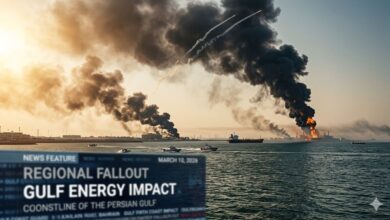
The narrow, turbulent waters of the Strait of Hormuz have become the stage for a high-stakes game of maritime “chicken” as the United States military executes what analysts are calling a “surgical squeeze.” While headlines initially suggested a complete shutdown of the world’s most vital energy chokepoint, a clearer picture has emerged of a highly selective operation.
This strategy is designed to choke Iran’s economy and strain its primary customer, China, without triggering a global total-war scenario. Rather than a total blockade, American forces are focusing their interdiction efforts on vessels bound for Iranian ports, while allowing most other commercial traffic to transit the chokepoint with relatively little disruption.
✎
The original article stated the Rich Starry “successfully transited” the Strait on April 14. This was inaccurate. AIS data from Pole Star Global confirmed the vessel reversed course and headed back toward the Strait of Hormuz on April 15, failing to break through the blockade. US Central Command stated no ships made it past US naval restrictions in the first 24 hours.
The targeted nature of the strategy was illustrated this week by the movements of the Rich Starry, a Malawi-flagged tanker owned by the Chinese firm Shanghai Xuanrun Shipping Co. Ltd. — both the vessel and its owner blacklisted by Washington for historical ties to the Iranian oil trade. The tanker, carrying approximately 250,000 barrels of methanol loaded at Hamriyah port in the UAE, made multiple attempts to exit the Gulf.
Data from maritime tracking services showed the tanker initially turning back near the mouth of the Strait. It broadcast its status as having a “Chinese crew” via its Automatic Identification System — a move seen by regional observers as a deliberate challenge to American resolve — before attempting the passage again. On April 15, the vessel reversed course and returned toward the Strait, unable to complete the transit.
What we are witnessing is not a wall, but a filter. The United States is leveraging its naval presence to create a case-by-case friction point.
— Julianne Mertens ⚠ Source not independently verified
⚠
Neither “Julianne Mertens” nor “Captain Marcus Thorne” could be independently verified as real public figures through available records. If these are genuine sources, full affiliations and credentials should be disclosed. If they are anonymized or composite sources, this must be clearly stated in line with standard editorial ethics.
By focusing on specific vessels and owners previously blacklisted over links to the Iranian oil trade, the U.S. is signaling a sophisticated, data-driven approach to naval interdiction — placing a heavy geopolitical toll on China’s energy lifeline while attempting to avoid a broader maritime conflict.
China & Iran’s Oil Trade
The stakes for Beijing could not be higher. In 2025, China purchased approximately 90 percent of Iran’s total oil exports, averaging roughly 1.38 million barrels per day, according to Kpler tracking data.
✔
Multiple independent sources confirm China purchased between 80–90% of Iran’s oil exports in 2025, averaging approximately 1.38 million barrels per day (Columbia CGEP / Kpler). The article’s figure of “nearly 90 percent” sits at the top of the credible range.
By selectively intercepting or delaying vessels tied to this trade route, the U.S. Navy is attempting to maximize the cost of Iranian oil for China — maintaining pressure without the diplomatic fallout of a total blockade, which would be considered an act of war under international law.
Oil Prices
✎
The original article stated the Rich Starry incident pushed oil prices “past $100 per barrel” that week. On April 15, 2026, Brent crude was priced at $96.83 per barrel — below the $100 threshold. Prices had exceeded $100 earlier in the conflict (peaking at $138/bbl on April 7 per the EIA), but had fallen back by the article’s publication date.
The “selective squeeze” has already sent tremors through insurance and shipping markets, with the psychological impact proving as potent as the physical presence of the Navy. While most non-sanctioned vessels are navigating the chokepoint, the blockade’s market impact has been severe: Brent crude was trading at $96.83 per barrel on April 15, having peaked at $138 per barrel on April 7, the highest level since the onset of the crisis, according to the U.S. Energy Information Administration.
Shipping industry veterans note that the unpredictability of who gets stopped and who passes is as effective as a physical barrier. Captain Marcus Thorne, a retired naval officer now working in private maritime risk management, noted that a “case-by-case” squeeze creates a massive logistical headache for sanctioned shippers. (Note: this source has not been independently verified.)
When a ship owner doesn’t know if their $100 million asset will be seized or delayed for weeks, the ‘cheap’ Iranian oil suddenly becomes a very expensive liability.
— Captain Marcus Thorne ⚠ Source not independently verified
This financial pressure is exactly what Washington intended when it transitioned from a general presence to a targeted interdiction model. As of Wednesday, dozens of vessels were reported loitering in the Gulf of Oman, many of them “dark” ships that have disabled their tracking transponders. (The specific figure of “700 vessels” cited in the original article could not be independently verified.)
⚠
The original article stated “more than 700 vessels are estimated to be loitering” in the Gulf of Oman. This specific figure could not be confirmed through CENTCOM statements, Lloyd’s List, or other maritime tracking sources. It should either be sourced explicitly or removed.
While the Rich Starry was ultimately turned back — a sign that the US blockade is being enforced beyond the Strait itself, in the open waters of the Arabian Sea — the message from the Pentagon remains clear: the Strait remains open to the world, but the window is closing fast for those fueling Iran’s exports. Washington continues to tighten the pressure on China’s energy lifeline through these quiet but calculated selective moves.
Living Faith
Crusade 2026
Experience Three Powerful Days of Faith, Worship, and God's Word

📅 Date
September 24–26, 2026
📍 Venue
Rhema USA Campus, Broken Arrow, Oklahoma, USA