EXCLUSIVE: Nigeria Is Taxing Its Own Doctors to Leave — And the UK Built the Pipeline
From PLAB 1 examination fees to VAT collected by the FIRS on every registration payment, a system engineered for British talent acquisition is running — with the quiet participation of the Nigerian state.


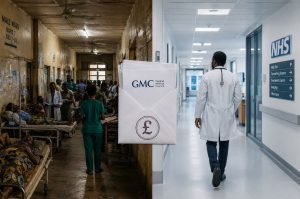
Every year, thousands of Nigerian medical professionals pay millions of Naira to exit a broken domestic healthcare system — and the Nigerian government actively collects its fiscal cut on their way out. The global migration pipeline is called the Professional and Linguistic Assessments Board exam, known universally as PLAB 1, and its immediate destination is the British National Health Service. Yet, beneath the familiar narrative of professional brain drain lies a far more calculated economic reality: the entire architecture of this arrangement, from exorbitant examination fees to automated domestic tax collection, was built and is maintained entirely by statutory and corporate entities of the United Kingdom operating seamlessly on Nigerian soil, turning a national health crisis into a highly transactional extraction system.
The PLAB 1 assessment itself acts as the primary administrative gatekeeper for this talent pipeline. Conducted simultaneously across major domestic metropolitan hubs including Lagos and Abuja, this standardised, three-hour paper-based test comprises 180 Single Best Answer multiple-choice questions managed under the updated UK Medical Licensing Assessment framework. Designed strictly to evaluate practical National Institute for Health and Care Excellence guidelines, clinical safety, and medical ethics, the high-stakes exam ensures that limited seats provided by the British General Medical Council are booked out months in advance. It evaluates whether an international medical graduate possesses the baseline clinical competency to safely practise at the Foundation Year 2 level in the UK, transforming local examination halls into British regulatory outposts.
The structural mechanics of this transaction establish a stark, unreciprocated transfer of wealth and human capital. The Nigerian state heavily subsidises six years of rigorous undergraduate medical education at premier public institutions such as the University of Ibadan, Obafemi Awolowo University, and the University of Nigeria, Nsukka, utilising domestic taxpayer funds to cultivate highly specialised clinical labour. Upon graduation, the entire harvest of this public investment is effectively exported through a single three-hour test bank. Britain acquires fully trained, resilient clinical talent without having contributed a single Pound to the foundational public infrastructure that produced them, leaving Nigerian public hospitals to absorb the total cost of production while facing critical, dangerous manpower shortages.
The personal financial sacrifice required to enter this pipeline highlights the massive flight of liquidity directly out of the developing economy. Candidates sitting for the exam are required to pay a mandatory fee of 283 Pounds Sterling directly to the General Medical Council. When combined with the high cost of English language prerequisites, electronic credential verifications, subsequent flights, visa applications, and temporary overseas accommodation, an individual doctor must personally invest between 3,500 and 5,000 Pounds Sterling—an amount that translates to a total personal investment of between ₦6 million and ₦10 million on the parallel market when the full migration journey is accounted for — a figure Dr Gabriel Oktapor, a Nigerian doctor preparing for the August 2026 PLAB 1 sitting, confirmed when he spoke exclusively to The AWB News.
Nigeria trained me, and I’m grateful for that. But when the system doesn’t support doctors to thrive or even provide basic care effectively, many of us feel we have no choice but to seek opportunities elsewhere. This is not abandonment — it’s survival and a quest for better conditions.
— DR GABRIEL OKTAPOR
Nigerian medical doctor currently preparing for the August 2026 PLAB 1 sitting, speaking exclusively to The AWB News.
Yet, the most explosive dimension of this system is that the Nigerian state is not a passive bystander; it actively profits from the transaction. Under Nigeria’s Finance Act and Significant Economic Presence rules, a 7.5% Value Added Tax is automatically triggered on the GMC registration fee the moment a candidate processes the foreign payment through a Nigerian bank card, which is collected and remitted to the Federal Inland Revenue Service. Furthermore, the British Council executes its testing operations through a registered domestic corporate entity, British Council Trading Services (Nigeria) Limited, which is fully captured within the FIRS net, triggering Withholding Tax and VAT whenever they rent hotel conference centres in Lagos or Abuja and engage local invigilators. The state knows. And knowing, it has every institutional and fiscal reason to act.
While the UK General Medical Council doesn’t pay a direct Companies Income Tax on its global profits to Abuja, the FIRS actively collects 7.5% VAT on every single candidate’s registration payment, and we tax the local commercial operations that physically make the exam happen on Nigerian soil. Nigeria’s tax net is fully cast over this ecosystem.
— FIRS OFFICIAL
Staff member, Financial Accounts Division, Federal Inland Revenue Service, Abuja. Identity withheld at source’s request. Speaking exclusively to The AWB News.
However, this local tax collection remains structurally marginal relative to the real macroeconomic loss. By contentedly harvesting transactional VAT and local vendor levies, the Nigerian government trivializes a massive structural deficit: it taxes the immediate transaction while permanently surrendering the foundational education investment, the medical expertise of its youth, and the massive future domestic income tax base. Meanwhile, the British government steps in to collect heavy, long-term Pay As You Earn income tax and National Insurance contributions the exact moment those identical doctors join an NHS trust.
This administrative apparatus operates as a highly coordinated British system designed to function seamlessly inside Nigeria. The General Medical Council, a UK statutory body, dictates the academic terms and collects the capital, while delegating local operational logistics and strict invigilation security to the British Council and international exam management agencies like VICTVS. Because the British Council operates its testing business as a commercial corporate subsidiary on the ground, it is not acting as a passive diplomatic venue, but as an active, local infrastructure provider for a foreign talent acquisition scheme. The entire apparatus remains a foreign-owned, foreign-benefiting operation running smoothly on Nigerian soil.
This reflects a profound passivity within Nigeria’s legislative frameworks. Under the bilateral UK-Nigeria Double Taxation Agreement of 1987, Nigeria retains the sovereign right under Articles 5 and 7 to tax profits or negotiate fiscal terms for any entity maintaining a recurring commercial footprint on its territory. While the UK exploits its own domestic tax exemptions under Schedule 9 of the VAT Act 1994 to shield its educational operations, Nigerian authorities have built no protective fiscal architecture. Instead of implementing regulatory levies or brain drain compensation taxes on foreign examination bodies—mechanisms successfully studied or enacted by nations like India and the Philippines—the National Assembly has historically resorted to punitive internal measures, such as controversial bills attempting to mandate a compulsory five-year local practice period before medical graduates can travel.
Attempting to restrict doctors by force rather than fixing the systemic issues driving them away is an institutional failure that fails to address the underlying reality of poor wages, unsafe working environments, and a total lack of functional medical infrastructure.
— DR DELE ABDULLAHI
Former President, Nigerian Association of Resident Doctors (NARD), speaking in a national press brief on medical migration frameworks.
The AWB Weekly Briefing
Geopolitics. Justice. Stories that matter.
Our editors take you through the biggest geopolitical stories and voices denied justice — straight to your inbox, every week.
Weekly · Unsubscribe anytime · No spam
For the candidates who survive this initial hurdle, the achievement provides no physical accolade, operating instead as a strict digital pass-or-fail bottleneck on their GMC portal that opens a grueling logistical gauntlet. Within a strict two-year countdown, doctors must book and successfully pass the practical PLAB 2 Objective Structured Clinical Examination, which cannot be taken in Nigeria and is hosted exclusively at the GMC’s assessment centres in Manchester. This triggers a complex wave of international immigration paperwork, forcing applicants to secure a UK Standard Visitor Visa by proving absolute financial independence, while funding intensive clinical preparation at specialized academies in the UK and coordinating mandatory verifications through the international Electronic Portfolio of International Credentials portal.
Ultimately, this institutional imbalance presents the Nigerian government with an uncomfortable but undeniable reality. Through VAT collection on every PLAB registration payment and through its capture of British Council commercial operations on Nigerian soil, the state is already financially embedded in this migration pipeline. That is not a crime — it is how taxation works. But it is a powerful argument for accountability. A government that profits from the ecosystem of its own brain drain cannot credibly claim ignorance of the conditions driving its best doctors away. The crumbling infrastructure, the unpaid salaries, the dangerous working conditions — these are not abstractions. They are the engine of the pipeline. And until the Nigerian government treats fixing them with the same efficiency it applies to collecting its VAT cut, the thousands of young doctors investing ₦6 million to ₦10 million to reach the NHS will keep coming — and Britain will keep collecting them.