EXCLUSIVE: Iran Weighs ‘High Cost’ Strike Option as House Passes War Powers Resolution
An IRGC source tells AWB News that Iran's public demands revenge — not diplomacy — even as Pezeshkian's government pursues a negotiated exit from the war

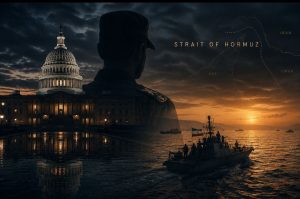
US House lawmakers adopted a resolution Wednesday to curb presidential war powers regarding Iran, escalating a constitutional showdown as Iranian forces heavily fortify the strategic Strait of Hormuz. The thin 215–208 bipartisan vote marks the first successful legislative challenge to the administration’s military operations since hostilities erupted in late February. While the measure signals a fracturing of domestic political patience, it faces an immediate roadblock in the Senate and fierce White House resistance, leaving executive control over active operations untouched.
The vote follows more than three months of active military aggression, officially crossing the 90-day threshold stipulated under the War Powers Act of 1973. The statute mandates that a president withdraw American forces from active hostilities within 60 days unless Congress declares war or grants specific authorization. The administration bypassed this deadline by arguing a temporary April ceasefire effectively reset the statutory clock. House lawmakers flatly rejected that interpretation, declaring current operations legally unauthorized.
Following repeated attempts to get sycophants in the Republican-controlled House to join us, House Democrats successfully passed our war powers resolution today to stand up for the American people and hold Donald Trump accountable.
— HOUSE DEMOCRATIC LEADERSHIP
In exclusive reporting, The AWB News has learned from a source within Iran’s Islamic Revolutionary Guard Corps — speaking strictly on the condition of anonymity and declining all audio and visual identification — that a significant internal tension is shaping Tehran’s current calculus. While Iran’s diplomatic leadership, including President Pezeshkian and Foreign Minister Abbas Araghchi, are pursuing a negotiated resolution that preserves Iranian sovereignty and secures their stated demands, the source indicates that a vast majority of the Iranian population is pushing in a fundamentally different direction: revenge.
“If resolved through diplomacy on Iran’s terms, good,” the source told The AWB News. “If through war that gives them the opportunity for a payback, they consider this much better.”
Asked what payback means given Iran has already conducted retaliatory strikes on U.S. bases, blockaded the Strait of Hormuz, and directly attacked regional targets, the source was unambiguous: “There is nothing hidden about this. Just look at the riots and the protests. Hear what the people chant.” The source described growing popular suspicion of any rapid move toward Trump’s negotiating table, framing the pressure as less about the new Supreme Leader and more about a deeply aggrieved public. In the source’s words, Iran is “considering a strange option of a damaging high cost against the adversaries.”
That popular pressure is visible on the streets: protests and resistance activities were reported across Tehran, Mashhad, Hamadan, and other major Iranian cities as recently as June 2, highlighting a highly volatile climate of internal dissent.
The situation on the ground remains an active powder keg despite recent diplomatic posturing. Just this week, Iranian forces launched a drone and missile attack targeting Kuwait’s international airport. The U.S. military responded with heavy retaliatory airstrikes against Iranian air-defense radar stations and drone command centers. A strict U.S. naval blockade of Iranian ports continues, an action Tehran formally views as an explicit act of war.
The crisis is no longer confined to sporadic military exchanges. The IRGC Navy, which has maintained a “smart control” tracking system over the Strait of Hormuz since February, has now operationalised it as a strict wartime transit authority, effectively halting normal commercial shipping. By treating this vital maritime corridor as a kinetic combat zone, Tehran has deployed anti-ship missile batteries, naval mines, and fast-attack swarm boats to deter U.S. incursions.
The strait represents a critical global chokepoint, handling approximately 20 to 25 percent of the world’s seaborne oil trade and roughly a fifth of global liquefied natural gas shipments.
This severe military posturing has simultaneously triggered an intense psychological warfare campaign between the two capitals. President Trump recently claimed on social media that a peace agreement was “largely negotiated” and within reach. Iranian political and military leadership swiftly issued public rebukes, accusing the White House of fabricating diplomatic progress to soothe nervous global markets. Tehran states unequivocally that a peace deal is not imminent while the blockade remains and U.S. warships maintain their positions.
The immediate trajectory of the conflict remains tied to the Senate, where leadership continues to heavily resist the House measure. As a concurrent resolution, the measure does not require the president’s signature and would not go to his desk — but it equally carries no force of law. The White House has already dismissed it as an unconstitutional legislative veto, and legal scholars remain divided on whether it would be binding even if the Senate concurred. Consequently, the resolution functions as a symbolic warning shot rather than a legal roadblock. While Washington wrestles over the boundaries of executive authority, the reality in the Persian Gulf remains dictated by active blockades, fresh bomb craters, and a rapid mobilization for total war.
📺 Watch: US Secretary of State Marco Rubio scrutinised during Senate hearing on inconsistencies between Trump’s war narrative and reality on the ground — AWB News Facebook
AWB News reporting on Iranian military and strategic positioning includes information provided by a source within Iran’s security establishment who spoke on condition of anonymity due to the sensitive nature of the information. AWB News has assessed the source’s account as credible and consistent with independently verifiable reporting on the ground.
Living Faith
Crusade 2026
Experience Three Powerful Days of Faith, Worship, and God's Word

📅 Date
September 24–26, 2026
📍 Venue
Rhema USA Campus, Broken Arrow, Oklahoma, USA