Sachet Water Prices Expose Nigeria’s Public Water Failure
In Ibadan, a local price dip masks a national crisis as households pay twice for water the state fails to provide

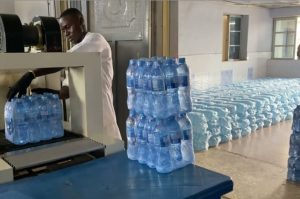
In Ibadan this month, the price of a bag of sachet water tells two stories at once: a small, local easing at the wholesale level, and a national trend still climbing everywhere around it. This report is based on interviews and price checks conducted in Ibadan this month, supplemented by recent figures from other cities. What emerges is less a simple inflation story than evidence of a private market absorbing the cost of a public failure — and passing that cost, city by city, to households with no real alternative.
Speaking to The AWB News, a distributor of Tib & Tok sachet water in Oluyole, Ibadan, Mr Toyib, said the rising cost of water supply has left distributors with little choice but to raise prices. “The alternative to raising the price is to shut down,” he said, adding that in the absence of government intervention, there appears to be no alternative to continued increases. Toyib also pointed to a small easing in August: the price at which distributors supply retailers has dropped from ₦400 to ₦300 per bag, allowing retailers to sell to consumers for about ₦400. Retailers and consumers independently confirmed the retail price has fallen to about ₦400 per bag, down from ₦500 — though a chilled or frozen bag still commands ₦500, a premium for water that is, functionally, the same product.
The alternative to raising the price is to shut down.
— MR TOYIB, TIB & TOK SACHET WATER DISTRIBUTOR, IBADAN
For consumers, the calculus is simpler and bleaker. Fayokunmi, a health educator in Ibadan, said: “We have no choice here in this matter. We are like a vehicle that has lost its brake. But we hope it gets better.”
The price has not moved in one direction only, and retailers describe absorbing volatility that consumers rarely see. Mrs Jegede, a retailer in Oluyole, said that earlier this year, when fuel prices surged, a distributor quoted her ₦500 for a bag. She cancelled the order, unable to see how she could resell at that rate, and switched to another supplier who let her sell at ₦450. Consumers complained at the time, she said, but gradually adjusted. The price has since eased to about ₦400, though some retailers still charge ₦450 or ₦500 depending on location and whether the water is chilled.
Bottled water follows a parallel but distinct market. In Ibadan and along major highways, a standard bottle currently sells for between ₦250 and ₦400. Retailers report that the price in Ibadan city rose from ₦200 to ₦300 per bottle around March this year. Unlike sachet water, which remains the daily staple for the vast majority of households, bottled water is consumed mainly by higher-income households, travellers on the highways, and at ceremonies, events, clubs and parties. On some occasions, people walking from one place to another also prefer bottled water because it is easier to carry than sachets.
The deeper economic signal in Ibadan’s price movements is that Nigeria’s sachet-water market is no longer merely responding to inflation; it is pricing the cost of institutional failure. Where public water infrastructure is weakest, households are effectively forced into a private water market with no meaningful substitute, giving distributors and retailers greater room to pass on fuel, transport, refrigeration and production costs. The poorest households can face a disproportionate burden as a result: they pay more for a smaller quantity of a basic necessity while having the least ability to absorb price increases. In that sense, the ₦400 or ₦500 price tag is only the visible part of the cost; the hidden cost is the household income diverted to compensate for a public service that does not reliably exist. At today’s Ibadan retail price of ₦400, a family buying one bag every two days is already spending roughly ₦6,000 a month — before transport or the premium for chilled water. Bottled water, though used by fewer households on a daily basis, carries a higher unit cost and is widely perceived as more classic and higher quality than sachet water — a perception reinforced by the fact that far fewer local companies produce bottled water compared with the multitude that package sachets.
What Ibadan shows in miniature repeats, with local variation, across the country. In Kano, the price of a bag has risen from about ₦250 to roughly ₦350 in recent months, adding to the cost burden for consumers who depend on sachet water for drinking. In Benin City, Edo State, prices have climbed to between ₦500 and ₦600, with some retailers charging as much as ₦700, up from a previously standard ₦400. In Lagos, a market survey conducted by the News Agency of Nigeria in May found bags selling for between ₦500 and ₦800, up from ₦350 to ₦450 just months earlier — figures that, months on, still track closely with what households report paying. Ibadan’s own bag, for what it’s worth, holds sixteen sachets rather than the twenty common elsewhere, a quiet second variable sitting behind the headline price and easy to miss when comparing towns on cost alone. The same cities show elevated bottled-water prices, with highway sellers and urban retailers charging ₦250–₦400 per bottle, reflecting the broader packaged-water inflation that households and travellers now absorb.
The scale behind these local prices is national. According to 2025 findings from the Corporate Accountability and Public Participation Africa, roughly 113 million Nigerians — about half the country’s population, now estimated at some 242 million — lack access to basic drinking water, and only one in ten citizens has access to basic water, sanitation and hygiene services. Sachets, bottles, boreholes, wells and tanker trucks are not a lifestyle choice; they are what fills the gap CAPPA’s data describes, funded entirely out of household pockets, in Ibadan and everywhere else.
That gap exists because the public system households also pay for, in principle, does not deliver. Like millions of Nigerian households, Mrs Ifeyinwa Ezeokoli, a civil servant in Ajao Estate, Lagos, effectively pays for water twice: once through whatever nominal government charge trickles into her utility obligations, and again, in cash, to a sachet vendor who actually delivers something drinkable. She told reporters in May that she was spending between ₦16,000 and ₦20,000 a month on sachet water alone, against a national minimum wage of ₦70,000 a month — roughly a quarter of a minimum-wage income spent on water a functioning utility would, in theory, already supply.
The budget that might close this gap is aimed elsewhere. Nigeria’s Ministry of Water Resources and Sanitation defended a ₦98 billion budget for 2026 before the House Committee on Water Resources, with the minister confirming the funds are targeted chiefly at completing dam and irrigation projects for agriculture — not the urban and household drinking-water access that CAPPA’s data shows is failing. Set against that is Nigeria’s ₦869.6 in health spending per citizen each month — the price of less than two bags of sachet water, while a single Lagos household spends the equivalent of 20 to 25 bags on drinking water alone every month just to avoid the water the state was supposed to provide.
Nor is the substitute always safer. Nigerians largely reserve sachets and bottles for what goes into their bodies, then turn to tap connections, wells and boreholes for bathing, cooking and laundry — sources that carry their own risks. A 2026 study published in the Bima Journal of Science and Technology, examining water sources in Gombe State, reported elevated health risks across tap, well and sachet water, driven largely by chromium and lead contamination. The water households treat as safe enough for everyday use is, by laboratory measure, frequently not.
None of this shows up in official inflation baskets as a “water bill,” which is precisely what makes it a hidden cost: an informal, unlegislated tax levied by absence rather than policy. As labour unions prepare to renegotiate the national minimum wage, citing its collapse against the real cost of living, the water families drink is rarely part of that conversation — even though, from Ibadan to Kano to Lagos, it is already one of the largest fixed costs many households carry each month, and one that exists solely because the system meant to carry it for free does not.
Living Faith
Crusade 2026
Experience Three Powerful Days of Faith, Worship, and God's Word

📅 Date
September 24–26, 2026
📍 Venue
Rhema USA Campus, Broken Arrow, Oklahoma, USA