London’s Drone Gamble Tests Britain’s Strategic Weight
Burnham stands firm despite Kremlin warnings as British support for Ukraine enters a riskier phase

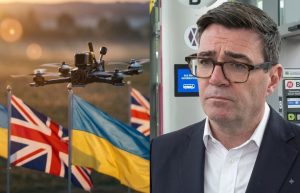
The standard diplomatic script governing Western military assistance faced immediate friction following revelations that Ukrainian forces have deployed British-manufactured long-range drones against strategic sites deep inside Russian territory. Pressed during a press exchange at a bus station in Wolverhampton on how London intends to navigate stern warnings from Moscow, Prime Minister Andy Burnham offered a calculated defense rooted in strict geopolitical continuity. Burnham reaffirmed that the United Kingdom remains unyielding in its backing of Kyiv, framing the deployment strictly as a continuation of long-established Western policy. Yet behind this polished political stance lies a volatile reality where the boundaries of defensive warfare, the geopolitical weight of a post-imperial Britain, and the terrifying calculus of asymmetric escalation are colliding in real time.
The operational trigger for the exchange stems from details published by The Sunday Times revealing that Ukraine has integrated long-range unmanned aerial vehicles produced by British contractors into its ongoing deep-strike campaign, including the jet-powered Nyan drone built by Callen-Lenz, a BAE Systems subsidiary. These attacks have increasingly targeted military supply hubs, defense industries, and energy infrastructure across sovereign Russian soil, with the report identifying oil refineries in Yaroslavl and Volgograd among the confirmed targets struck over the past six months. Moscow reacted with direct threats, issuing statements through its embassy in London accusing Britain of acting as an accomplice and co-perpetrator in Ukraine’s campaign. The embassy warned that London’s actions “will inevitably carry consequences for which it will have to answer,” adding that the deeper Britain’s involvement and support for Kyiv became, the higher the price it would pay.
This is the UK doing what it has long said it would do, which is to support Ukraine 100% against this illegal war led by Vladimir Putin. We are providing support so that Ukraine can defend itself… We are not fair-weather friends.
— ANDY BURNHAM, UK PRIME MINISTER
To critics and military analysts in Moscow, Burnham’s assertion that providing long-range strike capabilities is merely aiding self-defense fails to hold up. From the Russian perspective, enabling deep strikes on sovereign territory moves a non-belligerent state directly into active proxy warfare against a nuclear superpower. Critics argue that British leadership, relying on rehearsed talking points, appears dangerously detached from the modern reality that the United Kingdom no longer possesses imperial power or global maritime dominance to manage the fallout should conventional deterrence break down completely.
Conversely, the Western defense establishment views the theater through an operational lens. The UK Ministry of Defence responded to Moscow’s warning by stating that Britain “stands shoulder to shoulder with Ukraine,” while allied strategists argue that forcing Ukraine to cease fire at its own geographic border grants Moscow an unfair asymmetric advantage. Under this military doctrine, degrading command nodes and logistics inside Russia is vital to sustaining Ukrainian territorial integrity and signaling that cross-border aggression incurs direct costs. The reliance on disciplined political phrasing is designed to preserve strategic deterrence while avoiding accidental shifts in foreign policy during public press appearances.
This ideological clash is playing out against massive physical engagements in the skies. In a report issued from Moscow, the Russian Ministry of Defense stated that air defense forces shot down 791 fixed-wing Ukrainian drones overnight across fifteen regions, occupied Crimea, and the Azov and Black Seas — one of the largest single-night totals of the war and the second such mass barrage in three days. Russian authorities reported no deaths, though at least three people, including a child, were injured in the Moscow region, and a warehouse belonging to Wildberries, Russia’s largest online retailer, caught fire. Officials in Moscow framed the episode strictly as contained damage from intercepted debris, an information strategy aimed at projecting military readiness and minimizing public alarm despite near-daily deep-strike waves; Russia’s Defense Ministry has now claimed over 11,000 Ukrainian drones downed in August alone, approaching July’s record monthly total.
The exchange did not occur in isolation. The same day, a Russian missile strike on the village of Pechenihy in Ukraine’s Kharkiv region killed at least ten people and wounded eighteen more, a reminder that Moscow’s own long-range campaign against Ukraine continues unabated even as it protests Kyiv’s use of Western-supplied systems.
Underneath the rhetoric, British security planners continuously evaluate Russia’s retaliatory capacity. London does not assume its policies carry zero risk; rather, its stance relies on the premise that Russia wishes to avoid a direct military confrontation with NATO, knowing an explicit attack on a member state would trigger Article 5 collective defense. Consequently, the UK anticipates Russian retaliation to focus on grey-zone operations—including subsea cable sabotage, state-sponsored cyberattacks against energy and financial grids, covert arson, and political disinformation—all designed to inflict severe disruption while remaining beneath the threshold of open war.
Yet this entire strategic calculus rests on the assumption that both sides remain rational actors operating under established norms. If Moscow decides to breach conventional military logic and execute an unthinkable, unpredictable action—such as the simultaneous crippling of critical subsea infrastructure or space-based positioning assets—it would trigger a systemic crisis. In such an event, traditional deterrence dissolves, instantly forcing Western leadership off scripted talking points and plunging non-belligerent nations into an uncalculated, high-stakes confrontation where the risk of rapid escalation becomes absolute.
Living Faith
Crusade 2026
Experience Three Powerful Days of Faith, Worship, and God's Word

📅 Date
September 24–26, 2026
📍 Venue
Rhema USA Campus, Broken Arrow, Oklahoma, USA


