Trump Slams NATO Over Hormuz as Houthis Seize Bab el-Mandeb
The president's Dublin outburst comes as Houthi forces complete control of a second global oil chokepoint

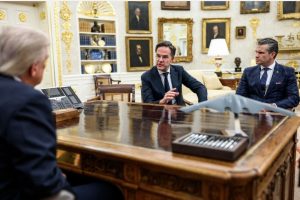
U.S. President Donald Trump has again questioned the value of America’s commitment to NATO after accusing the alliance’s members of declining to help the United States secure the strategically vital Strait of Hormuz, remarks that land as a second major maritime chokepoint has just fallen under hostile control.
Speaking to reporters in Dublin on Saturday, September 12, Trump said NATO had rebuffed his request for help securing the strait despite arguing the United States does not depend on Hormuz for its own oil supply. Full transcript of Trump’s Dublin remarks
Why the hell are we helping them?
— DONALD TRUMP
The remarks revive a dispute that has exposed a deeper tension between Washington and several European NATO members over the U.S. war with Iran and the security of one of the world’s most important maritime chokepoints.
The waterway is critical to global energy markets. Roughly a fifth of the world’s oil and a quarter of its liquefied natural gas exports normally pass through the strait, making any prolonged interruption a direct threat to energy supplies, shipping costs and inflation across major importing economies. Oil flows through Hormuz have partially recovered since the war’s peak disruption but remain well below pre-war levels, with total exports still running 7 to 8 million barrels a day short of pre-conflict volumes, according to Goldman Sachs estimates.
The United States has nevertheless argued that keeping the waterway open is an international security interest, rather than simply an American energy requirement. That distinction has been central to Trump’s demands on allies.
Trump’s latest criticism follows an earlier confrontation in March, when he sought assistance from NATO members and other partners for operations around Hormuz. The response was mixed: European governments were reluctant to participate directly in the U.S. military campaign against Iran, and some sought to separate maritime security from offensive military operations against Tehran. AP report on NATO’s rejection of Trump’s request
That distinction matters because NATO itself does not automatically enter every military operation involving one of its members. The alliance’s collective-defence mechanism is centred on Article 5, while operations outside that framework depend on political decisions by the allies. Consequently, Trump’s statement that NATO “didn’t want to help us” should be understood primarily as a description of the response he received from allied governments, rather than as evidence that NATO formally decided it would not defend maritime navigation.
The dispute goes beyond the Strait of Hormuz. Trump has repeatedly argued that the United States carries too much of the financial and military burden for European security while receiving insufficient support from its allies. His latest remarks therefore connect the Iran war with his broader effort to force NATO members to assume more responsibility for their own defence.
The question is becoming more consequential as the Middle East conflict places competing demands on U.S. military resources. Iran-backed Houthi forces in Yemen have completed a rapid takeover of the Bab el-Mandeb Strait, seizing Perim Island and the last stretches of Yemen’s Red Sea coastline after a week-long offensive, tightening their grip on a second chokepoint that links the Red Sea to the Gulf of Aden. Al Jazeera report on the Houthi takeover
The timing has sharpened the stakes considerably. The same 48-hour window saw strikes force the shutdown of a critical Saudi oil pipeline, while oil prices closed above $100 a barrel for the first time since May and U.S. diesel prices crossed $6 a gallon. Saudi Crown Prince Mohammed bin Salman has personally pressed Trump for direct U.S. military action against the Houthis; Trump has so far declined, saying Washington does not plan to widen its regional military role.
At the same time, the United States has been scaling back its own military protection of commercial shipping through Hormuz. The Financial Times reported that Washington cut air-defence coverage for tankers sailing the strait’s southern route down to two specific time slots a day in early September, after Iran stepped up attacks on ships travelling at night. Arab News report citing the Financial Times
A wider alliance question follows from all of this: how far should NATO allies be expected to support U.S. military operations that fall outside NATO’s collective-defence mission? For European governments, the distinction between defending international shipping and participating in an American war against Iran is significant. For Washington, however, the distinction can look increasingly artificial when American forces are expending military resources to protect trade routes that also serve European and Asian economies — resources now stretched across two contested chokepoints rather than one.
Trump’s remarks therefore represent more than another criticism of NATO. They expose a continuing disagreement over what allies owe one another when a conflict does not fit neatly within NATO’s traditional territorial-defence framework. With Hormuz still constrained and Bab el-Mandeb now effectively under Houthi control, that argument is becoming increasingly difficult for Washington and its European allies to postpone.
Living Faith
Crusade 2026
Experience Three Powerful Days of Faith, Worship, and God's Word

📅 Date
September 24–26, 2026
📍 Venue
Rhema USA Campus, Broken Arrow, Oklahoma, USA


