Eight Killed After B-52 Stratofortress Crashes During Test Flight at Edwards Air Force Base
Deadliest B-52 incident in over 40 years halts AESA radar testing program

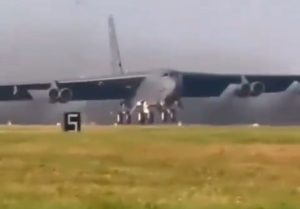
A
United States Air Force B-52H Stratofortress strategic bomber crashed during a routine local test flight at Edwards Air Force Base in Southern California on Monday, killing all eight personnel on board and drawing renewed attention to the military’s long-range bomber modernization efforts. The aircraft impacted the Mojave Desert floor immediately after takeoff at approximately 11:20 a.m. local time, triggering an immediate response from emergency crews who discovered a fiery debris field that military officials quickly deemed the crash unsurvivable. The crash is the deadliest involving a B-52 since a 1982 training crash at Mather Air Force Base in Sacramento claimed nine lives.
The downed aircraft, bearing serial number 60-0061, was assigned to the 412th Test Wing and carried a highly specialized “mixed crew” consisting of military flight testers, government civilian specialists, and private defense contractors. Aerospace manufacturer Boeing confirmed that two of its employees were among the victims on board, highlighting the collaborative industrial footprint required for modern military flight evaluations. The team was actively executing a mission to evaluate an advanced Active Electronically Scanned Array (AESA) radar system, a foundational component of the Pentagon’s multi-billion-dollar initiative to keep the Cold War-era fleet operational into the mid-21st century.
After reviewing footage of the crash, Col. James Hayes deemed it unsurvivable.
We lost eight great Americans.
— COLONEL JAMES HAYES, DEPUTY COMMANDER FOR THE 412TH TEST WING
Because an operational B-52 mission typically requires a standard crew of five, the presence of eight individuals underscores the complex, data-heavy nature of contemporary airborne sensor testing. Aviation safety experts note that because the heavy bomber came down immediately after leaving the runway without gaining substantial altitude, early technical scrutiny will likely center on mechanical variables. Investigators are expected to examine a range of possible factors, including flight control systems, maintenance records, and engine performance.
An official Air Force safety investigation board has been formally convened to analyze the desert wreckage, preserve scattered debris, and secure the flight data recorder. Military spokespeople cautioned that discovering the precise root cause of the structural or mechanical failure will require an exhaustive technical review, noting that the full investigation could take upwards of six months to complete.
The loss is likely to draw attention within defense circles to the broader context of ongoing bomber modernization and testing programs. While the immediate focus remains on civilian and military casualty recovery, the grounding of serial number 60-0061’s testing regime is expected to delay testing schedules associated with broader bomber modernization efforts. As investigators work to determine what went wrong, the accident is likely to be closely watched across the defense establishment given the B-52’s continuing role in America’s long-term strategic planning.
Living Faith
Crusade 2026
Experience Three Powerful Days of Faith, Worship, and God's Word

📅 Date
September 24–26, 2026
📍 Venue
Rhema USA Campus, Broken Arrow, Oklahoma, USA


