EU Coalition Demands Funding Ban on IOC Over Reinstatement of Russian Olympic Committee
Led by Estonia, a nine-nation alliance pressures the European Commission to block public funds, testing the boundary between geopolitics and athletic neutrality.

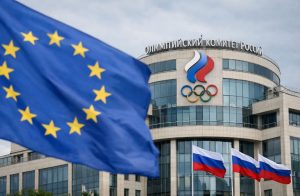
(Photo illustration; building: The AWB News)
E
stonia has initiated a coordinated diplomatic campaign alongside eight other European Union member states to pressure the European Commission into stripping the International Olympic Committee (IOC) of public funding. The aggressive political maneuver, which also targets World Aquatics and the International Fencing Federation (FIE), represents the most significant attempt yet by European governments to use Brussels’ financial leverage as a foreign policy tool against international sports bodies.
In a joint proposal sent to Glenn Micallef, the European Commissioner for Intergenerational Fairness, Youth, Culture, and Sport, the coalition—comprising Estonia, Denmark, Finland, Latvia, Lithuania, the Netherlands, Poland, Romania, and Sweden—demanded the systematic exclusion of these sports bodies from lucrative EU funding initiatives, most notably the Erasmus+ sports development program. The group is also seeking to block non-compliant sports organizations from participating in key European sports forums and EU-led policy discussions, effectively threatening to isolate them from European sports governance as detailed in their jointly submitted appeal.
The sudden escalation was triggered by the IOC Executive Board’s decision to provisionally lift its suspension of the Russian Olympic Committee (ROC). The ruling dismantled the strict neutrality guidelines recommended following the 2022 invasion of Ukraine, paving a clear path for Russian and Belarusian athletes to return to major global competitions, including the upcoming Los Angeles 2028 Olympic Games.
To the European coalition, the IOC’s sudden policy shift represents an unacceptable normalization of state-sponsored aggression. The nine nations have directly challenged the long-held Olympic doctrine that athletic competition exists in a vacuum separate from global conflict, arguing that sport cannot be treated as values-neutral while civilian lives continue to be lost.
At a time when the war in Ukraine goes on and people are suffering, we cannot allow sport to be used to normalize this situation. Sport is not values-neutral—it always carries a message.
Separate from the direct ministerial proposal, Ukrainian sports and state officials have continuously highlighted the severe human cost of the conflict within their sporting ranks. Sourcing monitors have detailed that more than 600 Ukrainian athletes and coaches have been killed since the launch of the invasion. Thousands more have been displaced, forced to train under active bombardment, or called to serve in the armed forces—creating what opponents describe as a stark and unjust asymmetry on the playing field.
Financially, the IOC operates with significant commercial independence. According to the official IOC Marketing Media Guide, the organization draws approximately 55% of its revenue from broadcasting rights and 36% from its TOP global sponsorship program, leaving it largely insulated from direct financial ruin. However, sports analysts point out that the threat to cut EU public funds targets the soft underbelly of the Olympic ecosystem: local development, social integration programs, and institutional prestige. By challenging their access to European public capital and policy forums, the coalition is attempting to force a choice between access to European public partnerships and the reinstatement of Russian athletic bodies.
This strategic move has brought a long-simmering philosophical debate to a boiling point: a clash between individual fairness—the principle that an athlete should not be judged by their government’s actions—and collective accountability, the argument that a nation’s aggressive actions must carry consequences across all global platforms, including sports.
Critics of the European push argue that excluding athletes based strictly on their passport is a form of collective punishment and national origin discrimination, contending that individual competitors should not be held responsible for the military decisions of autocratic governments. Conversely, the coalition and its supporters view the concept of the “neutral athlete” as a geopolitical fiction when applied to states where elite sports are heavily nationalized, funded by the government, and systematically utilized for state propaganda.
The IOC has defended its decision to reinstate the ROC as a strictly legal and territorial matter, noting that the Russian Olympic Committee has legally removed the regional bodies in occupied Ukrainian territories that originally triggered the suspension. IOC President Kirsty Coventry stated directly: “We don’t condone any wars, including this one. We will continue to support Ukraine like we have since this started. But I don’t believe athletes should pay the price. We don’t want to hold athletes accountable for the actions of their government.”
The IOC emphasized that the reinstatement does not constitute a blanket return to normal. Russian athletes have not yet been cleared to compete under their national flag, colors, or anthem at the Los Angeles 2028 Games—a decision on national symbols will be made at “an appropriate time”. The committee maintained its strict ban on hosting Olympic-sanctioned events in Russia and will not invite any Russian state or government officials to the Games. Additionally, due to Russia’s past doping history, returning athletes must undergo rigorous, targeted testing by the International Testing Agency (ITA) before competition clearance.
The IOC also underscored that its ruling functions only as a recommendation; individual sports federations retain independent authority to determine whether Russian athletes may participate in their specific qualification tournaments.
Moscow has celebrated the decision as a massive diplomatic and athletic triumph. Kremlin spokesman Dmitry Peskov called the ruling “an important step toward reinstating our athletes’ legitimate rights to participate in international competitions,” adding that Russian sports authorities would continue working to ensure “all our athletes have the opportunity to compete in major international events”. Russia’s Minister of Sport issued a statement hailing the decision as a “green light toward the full restoration of the rights of our athletes”.
Russian sports federations immediately moved to capitalize on the momentum, though at distinctly different paces. The International Volleyball Federation (FIVB) moved within a day, reinstating Russian teams and world-ranking points on July 8, but explicitly left the flag and anthem question open, deferring the final decision to a later stage in coordination with the European Volleyball Confederation (CEV). The International Table Tennis Federation (ITTF) followed roughly a week later on July 13, granting Russian competitors full national flag and anthem rights immediately, with the ruling set to take effect on July 28, 2026.
As the European Commission reviews the proposal from the nine member states, the confrontation sets up a highly charged ideological struggle. What began as a debate over athlete participation has now evolved into a high-stakes standoff over whether the ideals of autonomous, apolitical sport can survive in an era of intense, value-driven geopolitical conflict.
Living Faith
Crusade 2026
Experience Three Powerful Days of Faith, Worship, and God's Word

📅 Date
September 24–26, 2026
📍 Venue
Rhema USA Campus, Broken Arrow, Oklahoma, USA