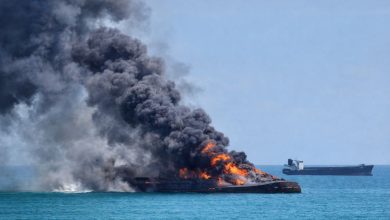
Houthis Claim Missile and Drone Strikes on Two Saudi Oil Tankers
Yemen's Ansarallah movement escalates a maritime embargo against Saudi Arabia, forcing tanker U-turns and compounding global energy risk as the Strait of Hormuz remains restricted

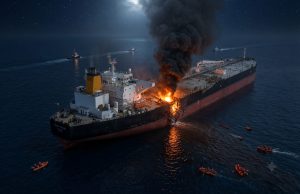
DUBAI, United Arab Emirates — A major escalation in the Middle East energy crisis unfolded across the southern Red Sea after Yemen’s Houthi militia, known formally as Ansarallah, declared an aggressive maritime blockade against Saudi Arabia on Monday. Days later, the group claimed its forces had struck two crude oil tankers linked to the Kingdom in the Red Sea.
The military operations mark a dramatic expansion of the region’s shipping crisis, immediately threatening to choke off Saudi Arabia’s primary alternative oil export channel at a time when the strategic Strait of Hormuz remains severely restricted due to ongoing conflict.
According to satellite tracking data and maritime intelligence services, the operational fallout from the initial blockade declaration was instant. Following Monday’s announcement, Very Large Crude Carriers (VLCCs) loaded with millions of barrels of Saudi crude—including the Liberia-flagged Rodos and the Singapore-registered Xin Long Yang—abruptly aborted their voyages shortly after departing the western Saudi port of Yanbu. The vessels executed sudden U-turns in the Red Sea, reversing course toward the northern Suez Canal to avoid navigating through the Bab al-Mandeb Strait in response to the threat itself, well before any physical attacks were reported.
“The Yemeni Armed Forces announce a ban on maritime navigation for the criminal Saudi enemy,” Houthi military spokesman Yahya Saree stated during the initial broadcast announcing the campaign. “Any vessel calling at Saudi ports, transporting Saudi crude oil, or operating in support of the blockade against Yemen will be targeted within range of our naval missiles and drones in any location.”
In a statement Thursday, Houthi military officials claimed that their naval forces carried out direct missile and drone strikes against two Saudi-linked tankers to enforce the newly declared embargo. While international naval task forces and maritime monitors continue to conduct real-time damage assessments to confirm technical details regarding potential hull impacts, commercial shipping lines are treating the threat as an immediate lethal danger.
The immediate catalyst for the Houthi campaign follows a recent air strike targeting Sana’a International Airport, the Houthi-controlled aviation hub in Yemen’s capital. While Yemen’s internationally recognized government publicly claimed responsibility for the airport strike—stating it was carried out to intercept an unauthorized international flight—Houthi leadership blamed the Saudi-backed coalition and framed their maritime operations as a “blockade for a blockade” policy, accusing Riyadh of enforcing a long-standing economic siege on the Yemeni population through strict airspace and maritime controls.
The Saudi Arabian Foreign Ministry rejected the Houthi characterization, stating that the Kingdom is taking “all necessary measures to protect its ships” while dismissing accusations of an economic siege. Houthi leadership, however, warned that any further confrontation would be met with a “comprehensive and decisive” response, threatening to meet “all escalation with escalation” across the regional theater.
The economic ramifications of the Red Sea blockade threaten to send shockwaves through global energy markets. Following the wider disruption around the Persian Gulf, Saudi Arabia had increasingly relied on its East-West pipeline to move crude across the Arabian Peninsula to its Red Sea terminal at Yanbu. By shipping from Yanbu through the Red Sea and out via the Bab al-Mandeb Strait, Riyadh had managed to maintain vital oil supplies to major Asian markets, including India and China.
With the southern exit of the Red Sea now effectively compromised, energy analysts warn that tankers diverted away from the Bab al-Mandeb will be forced into long, costly detours around the Cape of Good Hope at the southern tip of Africa. Such rerouting adds up to $2.5 million in additional fuel and operational costs per transit while driving up marine insurance premiums and stranding millions of barrels of crude at sea.
- The sudden maritime confrontation also effectively shatters the fragile ceasefire between Saudi Arabia and the Houthis that had largely stabilized the Yemeni border since April 2022. As naval task forces monitor the Red Sea for further missile activity, regional diplomats warn that the disruption could plunge the Arabian Peninsula back into full-scale conflict.