CIA Chief’s Moscow Visit Sparks Conflicting Accounts
John Ratcliffe’s Moscow visit draws conflicting accounts from Washington, Moscow and U.S. media over NATO, Iran and Ukraine.

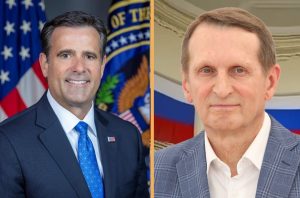
An unannounced journey by U.S. Central Intelligence Agency Director John Ratcliffe to the Russian capital has laid bare the complex, high-stakes maneuvering occurring behind the scenes between Washington and Moscow. U.S. media reports say CIA Director John Ratcliffe warned Russia against attacking NATO member states during his Moscow visit, but Russia’s intelligence chief Sergey Naryshkin described their meeting as a routine working-level discussion of intelligence matters.
The secretive mission began to unfold when flight-tracking data recorded a U.S. Air Force C-17A Globemaster III military transport aircraft landing at Moscow’s Vnukovo International Airport, after a stopover in Riga, Latvia. Soon after touchdown, a diplomatic motorcade was spotted moving under heavy security through central Moscow. The sensitivity surrounding the mission was further underscored by a senior Ukrainian official who said Washington had asked Kyiv to temporarily hold off on strikes during the U.S. delegation’s presence in Russia.
Major U.S. outlets, including The Wall Street Journal and CBS News, reported that Ratcliffe’s Moscow mission included warnings intended to deter Russia from testing NATO’s collective defence commitments. The reports, citing people familiar with the matter, said U.S. intelligence had concerns about the possibility of limited Russian actions against NATO members, including cyberattacks or incursions, particularly along the Baltic frontier. CBS News also reported that Ratcliffe raised concerns involving Iran and the Strait of Hormuz, including the possibility of additional U.S. sanctions if shipping through the waterway remained disrupted.
RT reported the following account from Russian foreign intelligence leadership:
The meeting took place, but there is nothing unusual about it. During the meeting, we discussed a number of issues that fall within the purview of the intelligence services.
— SERGEY NARYSHKIN, HEAD OF RUSSIA’S SVR FOREIGN INTELLIGENCE SERVICE
Kremlin spokesman Dmitry Peskov confirmed that President Vladimir Putin had been briefed on the outcome of Ratcliffe’s visit, but said the CIA director had not met the Russian president. Peskov also pushed back against U.S. media reports that Russia could attack a NATO member and that Ratcliffe’s mission was intended to warn Moscow against such an action. He described the reports as “scare-story material,” saying the reports had “nothing to do with reality” and did not reflect Russia’s intentions.
Addressing the visit publicly, U.S. President Donald Trump rejected the specific explanations being attributed to Ratcliffe’s Moscow mission. Asked whether the CIA director had travelled to Moscow to discuss potential Russian action aimed at testing NATO’s military alliance or Iran sanctions, Trump responded:
None of the above. He’s there, you know, very sort of semi-routine.
Trump also said, “I hate to disappoint people,” while stressing that the administration wanted to see the war in Ukraine end and that “something may come out of it.” He added that Washington was “working very hard to get that war ended,” saying that both sides now wanted the conflict to end.
While those reports described possible discussions involving NATO and Iran, neither Washington nor Moscow has publicly confirmed that those subjects were discussed during Ratcliffe’s talks; Trump specifically rejected the explanations presented to him.
In-person visits by a sitting CIA director to Moscow are historically exceptional and traditionally reserved for grave national security flashpoints, intelligence backchannels, or acute geopolitical crises. Prior to Ratcliffe’s travel, the last known trip occurred in November 2021, when then-CIA Director William Burns was dispatched to Moscow by President Joe Biden. During that visit, Burns met with SVR Chief Naryshkin and Security Council Secretary Nikolai Patrushev and conveyed U.S. intelligence assessments that a full-scale invasion of Ukraine was imminent—and Russia launched its full-scale invasion three months later.
Beyond the immediate purpose of Ratcliffe’s visit, the continued contact between the U.S. and Russian intelligence services illustrates that communication channels between the two countries have remained open even during periods of severe diplomatic tension. Peskov said such contacts often continue during the most difficult periods in bilateral relations, although he cautioned that it was too early to determine whether they would help move broader U.S.-Russia relations out of their current crisis.
The sharp divergence in how the visit has been publicly characterized highlights the competing narratives surrounding an unusually sensitive intelligence channel. Moscow has presented the encounter as a working-level intelligence contact and rejected reports of an imminent Russian challenge to NATO, while Trump has described Ratcliffe’s trip as “very sort of semi-routine” and rejected the specific explanations put forward about NATO and Iran. At the same time, U.S. media reports citing people familiar with the matter have portrayed the visit as involving strategic warnings to Moscow. With neither side publicly disclosing the substance of the discussions, the precise scope of Ratcliffe’s mission remains unclear. What is clear is that the CIA-SVR channel remains one of the direct lines of communication between Washington and Moscow, even amid the broader crisis in bilateral relations.
Living Faith
Crusade 2026
Experience Three Powerful Days of Faith, Worship, and God's Word

📅 Date
September 24–26, 2026
📍 Venue
Rhema USA Campus, Broken Arrow, Oklahoma, USA




.jpg)