Putin’s Approval Numbers Depend on Who’s Counting
Trump, Macron, Starmer, and von der Leyen are all deeply unpopular at home — but comparing their numbers to Putin's reveals more about how each system measures legitimacy than who actually has it

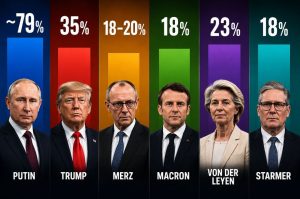
A widely circulated comparison on social media has brought a stark geopolitical contrast into sharp focus, forcing a difficult conversation about how public approval is measured across the global divide. The post juxtaposes the dismal polling of Western heads of state with the numbers coming out of Moscow: Donald Trump hovering at 35 percent (CNN/SSRS, April 2026), French President Emmanuel Macron and British Prime Minister Keir Starmer languishing at 18 percent (YouGov), German Chancellor Friedrich Merz polling at 19% approval (INSA), and Ursula von der Leyen at 23 percent (Ipsos EuroPulse, August 2025). The formulation poses a biting challenge: How can leaders who routinely lecture the world on democratic legitimacy barely hang on to their own electorates, while the man they label a dictator commands a massive majority?
The numerical disparity reads as a glaring irony. Yet, international relations experts and political sociologists argue that these figures act as a geopolitical Rorschach test, revealing far less about a leader’s inherent moral mandate and much more about the structural mechanics of the systems they navigate. The numbers themselves are rooted in real-world polling data, but they represent entirely different political currencies depending on the borders within which they are minted.
The Structural Mechanics of Multi-Party Systems
In multi-party Western democracies, low approval ratings are not a sign of systemic collapse, but rather a structural byproduct of fragmented political choices. In nations defined by robust, multi-party coalitions, executive power is rarely consolidated under a singular, absolute majority. Electorates are naturally split among conservative, liberal, green, nationalist, and socialist factions. A democratic leader holding a 20 percent approval rating can still successfully govern if they command a legislative majority through cross-party coalitions. Furthermore, these low figures function as a domestic pressure valve. In an environment with zero legal or social consequences for dissent, public frustration over inflation, immigration, or local policy is directed squarely at the person at the top, captured accurately by independent pollsters under the protection of a free press.
The Reality Behind Centralized Popularity
Conversely, evaluating leadership numbers out of Moscow requires analyzing a completely different set of political rules. Russian President Vladimir Putin‘s approval rating stood at 79% in April 2026, according to the independent Levada Center—though the figure has declined steadily for six consecutive months. Russia’s state-run pollster VTsIOM, by contrast, showed a steeper drop over the same period, falling to roughly 67% by late April before the agency stopped publishing its weekly ratings altogether—a move several independent outlets linked to the inconvenient pace of the decline, rather than the more familiar pattern of state polling simply inflating the numbers.
Even independent polling carries caveats during wartime: respondents may still under-report dissent for fear of social or legal consequences, a dynamic researchers call preference falsification. This doesn’t make the numbers meaningless, but it does mean they should be read as a floor on dissatisfaction, not a precise measurement of it. When the state controls the media narrative and viable opposition figures are systematically barred from the ballot, the choice for the average citizen is frequently framed not between competing platforms, but between the existing leadership and total chaos. A raw number from a system with free polling and active opposition cannot be read the same way as a number from a system where criticizing the state carries a heavy prison sentence.
“The moral authority of democratic lectures frequently collapses under the weight of geopolitical double standards, from unilateral interventions to the diplomatic shielding of devastating civilian casualties.”
Competing Frameworks of Global Governance
This fundamental disconnect has sparked a deep intellectual pushback against the historical monopoly Western institutions hold over global governance rankings. Indexes managed by entities like the Economist Intelligence Unit or Freedom House utilize metrics focused strictly on domestic political processes: institutional checks, active opposition, and open dissent. Critics from the Global South and sovereign-focused frameworks argue that if a non-Western alliance, such as the BRICS coalition, were to establish an equivalent index based on different societal priorities, the results would look radically different.
A hypothetical sovereign stability index would penalize Western democracies for chronic polarization, volatile government collapses, and systemic lobbying by corporate billionaires, while rewarding systems that maintain internal cohesion and protect national sovereignty from foreign interference. Moreover, such an index would heavily dock points from Western powers for external actions, citing unilateral interventions in Venezuela, the 2003 invasion of Iraq, or the diplomatic shielding of devastating civilian casualties in contemporary Middle Eastern conflicts.
Ultimately, the debate is not over the intelligence or civility of respective populations. Electorates on both sides are deeply enlightened, acting in what they perceive to be their best collective interests. The divide is rooted in two competing definitions of legitimacy. One system measures legitimacy by the fluid, often chaotic process of open domestic competition and the absolute right to replace the executive. The other measures it by national sovereignty, security, and the execution of a unified domestic mandate. Until those core definitions align, the numbers will continue to mean completely different things depending on who is reading the chart.
Living Faith
Crusade 2026
Experience Three Powerful Days of Faith, Worship, and God's Word

📅 Date
September 24–26, 2026
📍 Venue
Rhema USA Campus, Broken Arrow, Oklahoma, USA