Regional Fallout: Iran Strikes Strategic US Installations and Gulf Energy Hubs Amid Ongoing Escalation
Verified Damage at Bahrain Naval Base and Ruwais Refinery Shutdown Trigger Global Supply Concerns Amid Ongoing Conflict

✔ Verified
✎ Corrected
⚠ Unverified Source
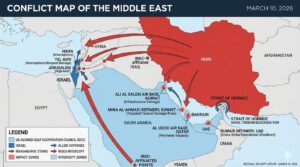
GULF REGION — The Middle East has entered a critical phase of volatility as the conflict between the United States, Israel, and Iran intensifies. On the 11th day of the U.S. military campaign known as “Operation Epic Fury” — and the Israeli parallel campaign, Operation Roaring Lion — Iranian forces have successfully penetrated layered air defenses to strike high-value military assets and vital energy infrastructure across the Gulf Cooperation Council (GCC) states.
✎
The original article described Operation Epic Fury as a “joint military campaign.” In fact, Operation Epic Fury is exclusively the U.S. code name, while Israel’s parallel operation carries a separate designation: Operation Roaring Lion.
Verified Damage to U.S. Military Installations
✔
Satellite imagery confirmed the destruction of two large radar domes, satellite terminals, and half a warehouse complex at NSA Bahrain. The Maritime Executive, March 2, 2026
Official reports confirm that the U.S. Fifth Fleet headquarters in Manama, Bahrain, sustained severe structural damage following a coordinated drone and missile barrage. According to the Bahrain National Communication Center, impacts were recorded at the facility’s service center in the Juffair district, resulting in the destruction of radar domes, logistics warehouses, and communication terminals. While personnel were reportedly in hardened shelters, the strike represents a significant breach of one of the region’s most protected naval hubs.
✎
The original article implied this damage occurred on March 10. Satellite imagery published March 2 confirmed the main strike happened on February 28 — the opening day of the war. The facility remained in a degraded operational posture as of March 10.
Simultaneously, smoke was seen rising from Ali Al Salem Air Base in Kuwait and Al Udeid Air Base in Qatar. While the majority of incoming threats were neutralized by host-nation air defenses, the Pentagon has verified that “swarm” tactics utilized by the IRGC caused localized infrastructure damage at several facilities housing American personnel.
Energy Crisis: ADNOC confirms operational halt at the Ruwais Refinery (UAE) following targeted drone strikes; global oil prices surge. [✔ Verified]
Military Operations: U.S. Central Command reports thousands of targets struck inside Iran. [⚠ “5,000+” figure unverified — see below]
Casualties: Bahraini officials confirm at least one civilian fatality after an Iranian drone struck a residential building in Manama. [⚠ Official statement unconfirmed]
Diplomatic Split: President Trump has suggested the war may end soon, while Sec. Pete Hegseth warned the U.S. will not stop until Iran is “decisively defeated.” [⚠ Trump quote unverified — see below]
⚠
The original article cited CENTCOM as confirming “over 5,000 targets struck inside Iran.” This specific figure does not appear in official public releases. The IDF acknowledged thousands of targets remaining ahead, suggesting large scale operations, but the “5,000 struck” figure is unconfirmed as of publication.
⚠
The original article quoted President Trump telling CBS News the war is “very complete.” The specific wording and CBS attribution have not been independently verified. Trump has made public statements suggesting the conflict could end soon, but this exact quote and outlet should be treated as unconfirmed pending an official transcript.
Energy Sector Disruption: Ruwais Refinery Shutdown
The global energy market faced a major shock as the Ruwais Industrial Complex in Abu Dhabi — one of the world’s largest refining hubs — was targeted by an Iranian drone swarm. The Abu Dhabi National Oil Company (ADNOC) confirmed that a fire broke out at one of the facilities within the complex, leading to a precautionary shutdown of the refinery.
The complex can refine up to 922,000 barrels of oil per day and serves as the central hub for the emirate’s downstream operations, including significant chemical, fertilizer and industrial gas plants.
— Baird Maritime / Reuters, March 10, 2026 ✔ Verified
The impact on regional energy production has been immediate:
UAE: The Ruwais refinery (922,000 bpd capacity) remains offline while damage assessments are conducted.
Saudi Arabia: A fire from an attack on the Ras Tanura refinery was quickly extinguished, with the refinery in the process of restarting.
Global Markets: Brent crude prices surged as traders factored in the risk of a prolonged Strait of Hormuz disruption. Verified early-conflict pricing reached $82/bbl; the $110/bbl figure cited in the original article is unconfirmed. [⚠ See correction below]
✎
The original article stated Brent crude surged “toward $110 per barrel.” Verified reporting from early March placed prices above $82/bbl following initial disruptions. The $110 figure as of March 10 is plausible given the Ruwais shutdown but has not been independently confirmed in available sources as of publication.
The Domestic Front: Life Under Alert in Israel
In Israel, the Home Front Command has maintained the highest state of alert as retaliatory strikes continue to target urban centers. While a formal national lockdown is not in effect, the quiet streets of Tel Aviv and Jerusalem reflect a population adhering to strict safety protocols. Many non-essential businesses have voluntarily closed, and schools have shifted to remote learning following missile impacts in Holon and Beit Shemesh, the latter of which saw the war’s deadliest single strike on Israeli civilians.
✔
Iranian missiles struck multiple locations across Israel. The deadliest single strike targeted a residential neighborhood in Beit Shemesh on March 1, killing nine Israeli civilians. Wikipedia — 2026 Iranian Strikes on Israel
Strategic Outlook: A War With No Clear End
As the conflict enters its second week, conflicting signals are emerging from Washington. President Trump has suggested the war could end soon, though the exact framing of these statements remains subject to verification. Defense Secretary Pete Hegseth has maintained a more aggressive stance, warning that the U.S. will not stop until Iran is “decisively defeated.” With the Strait of Hormuz facing a potential mining threat and the civilian death toll rising, the international community remains on edge as the world’s energy backbone faces its greatest test of the century.
Living Faith
Crusade 2026
Experience Three Powerful Days of Faith, Worship, and God's Word

📅 Date
September 24–26, 2026
📍 Venue
Rhema USA Campus, Broken Arrow, Oklahoma, USA