China’s Military Shake-Up Tests Xi’s Command Over the PLA
Removal of two senior generals deepens questions over Beijing’s evolving military leadership and command structure

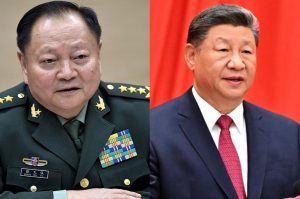
Photo: Wikimedia Commons / Kremlin.ru (CC BY 4.0) & Palácio do Planalto (CC BY 2.0)
China’s national legislature has formally removed Generals Zhang Youxia and Liu Zhenli from their positions on the state Central Military Commission (CMC), deepening a sweeping shake-up of the country’s senior military leadership. The decision, announced by state media following a session of the Standing Committee of the National People’s Congress, marks a major turn in the ongoing restructuring of the People’s Liberation Army (PLA) command structure under President Xi Jinping.
Both generals were placed under official investigation in January for what Chinese authorities described as “suspected serious violations of discipline and law”—the standard official formulation used by Beijing when opening disciplinary probes into senior figures. Their formal removal from state posts came seven months after that initial announcement. Crucially, the action specifically applies to their posts within the state Central Military Commission. Because China operates parallel Communist Party and state CMC bodies, state media announcements concerning the state entity do not automatically mean formal removal from the ruling party’s parallel committee structure.
Before his downfall, Zhang was the senior vice chairman of the CMC and the highest-ranking uniformed officer in China’s military hierarchy, as well as a member of the Communist Party’s elite Politburo. Liu Zhenli served as chief of the CMC Joint Staff Department, which is responsible for military operational planning and coordination.
Zhang was widely regarded as unusually well connected within China’s military and political establishment, owing to his long-standing institutional standing and shared family ties from the revolutionary era. His removal is therefore particularly notable given his seniority and long-observed prominence within the defense elite. The development raises fundamental analytical questions: Is Beijing’s military purge primarily aimed at eliminating corruption and enforcing discipline, or is it fundamentally reshaping the PLA around a new architecture of command and political control?
Beijing has consistently framed the multi-year anti-graft drive as an essential push to purge systemic violations and ensure absolute compliance with party leadership. Outside security analysts note that the campaign has targeted several key echelons across the PLA Rocket Force, equipment procurement divisions, and senior military posts over recent years. The ongoing removals have significantly altered the PLA’s senior command structure, further reducing the number of senior military figures publicly serving at the apex of China’s top defense body.
The leadership shake-up comes as China continues to assert its regional presence around Taiwan and across the South China Sea, raising active questions among international observers regarding how the management restructuring will impact command continuity, strategic decision-making, and long-term modernization efforts.
Going forward, key indicators to monitor include how quickly Beijing names replacement candidates to top command roles, whether corresponding announcements are made regarding party-level appointments, and how the newly streamlined leadership executes ongoing training and operational readiness goals across the military branches.
Living Faith
Crusade 2026
Experience Three Powerful Days of Faith, Worship, and God's Word

📅 Date
September 24–26, 2026
📍 Venue
Rhema USA Campus, Broken Arrow, Oklahoma, USA