Britain’s Invisible Housing Crisis: What the Numbers Don’t Show
Record levels of hidden homelessness, concealed households and overcrowding sit largely outside official statistics even as rough sleeping falls.

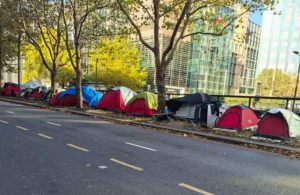
LONDON — Britain’s official homelessness figures tell a story of gradual, hard-won progress: rough sleeping counts in the capital fell 11 percent year-on-year in the first quarter of 2026, and government ministers point to it as evidence that a new national strategy is beginning to work. But beneath that single reassuring metric sits a far larger and largely invisible emergency. More than 134,000 households, including roughly 175,000 children, were living in temporary accommodation in England at the close of 2025—a figure that marked the first quarterly dip in nearly three years, but one still close to the highest level ever recorded.
The temporary accommodation figures, stark as they are, capture only a fraction of the housing distress spreading beneath the surface of official statistics. According to the English Housing Survey’s 2024-25 release, around 1.6 million households in England—6 percent of the total—contained at least one “concealed household”: an additional adult, often grown children or separated partners, who would prefer to live independently but cannot afford to. These households appear in no homelessness register, receive no council support, and are functionally absent from the statistics that shape housing policy, despite representing a population several times larger than the entire temporary accommodation caseload.
We have become totally accustomed to seeing record levels of children growing up in temporary accommodation.
— MATT DOWNIE, CHIEF EXECUTIVE, CRISIS
Deeper still lies the population housing charities describe as “hidden homeless”—people sofa surfing, sleeping in cars, sheds and garages, or cycling between friends’ spare rooms with no fixed address and no formal tenancy. Research conducted by the charity Crisis with Heriot-Watt University, using the long-running Homelessness Monitor programme, estimated that 208,600 households across Great Britain experience some form of hidden homelessness on any given night, an increase of nearly a third since 2020. Because these arrangements leave no statutory paper trail, government figures do not capture them at all; the estimate exists only because campaigners built an independent model to approximate the shortfall in official data.
The financial toll on local government has climbed in step with the human one. Councils spent hundreds of millions of pounds last year housing homeless families in hostels and bed-and-breakfasts alone, and researchers at the London School of Economics, commissioned by Crisis, project that net council spending on the most unsuitable forms of emergency accommodation will reach £1.2 billion by 2026-27, a 63 percent increase in three years. Much of that spending flows toward crisis containment rather than prevention, diverting funds that might otherwise support the early intervention services councils say are needed to stop households falling into homelessness in the first place.
Overcrowding compounds the picture in ways that rarely register in headline coverage. English Housing Survey data show that overcrowding in the social rented sector has risen from 6 percent to 9 percent of households over the past decade, even as overcrowding in owner-occupied housing has fallen. Three percent of all English households are now classified as overcrowded under the bedroom standard, a figure that understates the lived reality in a sector where the fastest-growing segment of demand is for family-sized homes that local authorities are structurally unable to supply at pace.
The government has not been passive in the face of this data. Ministers introduced sweeping reform to the private rented sector through the Renters’ Rights Act, which came into force on 1 May 2026 and abolished Section 21 “no-fault” evictions, converting existing tenancies into rolling agreements and removing landlords’ ability to end a tenancy without stated grounds. The measure followed a National Plan to End Homelessness published in December 2025, backed by £3.5 billion over three years and built around three central pledges: halving long-term rough sleeping, ending the unlawful use of bed-and-breakfast accommodation for families, and shifting the system toward prevention rather than crisis response.
Yet campaigners argue the reforms address symptoms faster than they address scale. Crisis has welcomed the fall in rough sleeping recorded through London’s Combined Homelessness and Information Network for the first quarter of 2026 while cautioning that the underlying temporary accommodation and hidden homelessness figures remain close to record highs. The divergence between a single improving indicator and a broader deteriorating one illustrates a structural weakness in how Britain measures homelessness: the metrics most visible to the public and most frequently cited by ministers are, by design, the ones least representative of where the crisis is actually growing.
What emerges is a housing emergency largely defined by its invisibility. Families doubled up in relatives’ spare rooms, adult children unable to leave the family home, workers cycling between friends’ sofas—none of them show up in a rough sleeper count, and most never reach a council waiting list. Until Britain’s statistical apparatus catches up with the true shape of housing insecurity, the debate over social housing, immigration and welfare eligibility that dominates Westminster risks addressing only the most visible fraction of a much larger and quieter crisis.
Living Faith
Crusade 2026
Experience Three Powerful Days of Faith, Worship, and God's Word

📅 Date
September 24–26, 2026
📍 Venue
Rhema USA Campus, Broken Arrow, Oklahoma, USA