Inside Britain’s Food Bank Economy: Who Is Going Hungry
Employed workers, pensioners, disabled people and single parents now make up the bulk of referrals as housing costs and welfare policy collide

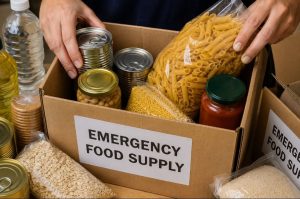
Across Britain, the food bank has quietly stopped being an emergency backstop and become something closer to a permanent fixture of household budgeting. In 2025, food banks in the Trussell network handed out 2.6 million emergency food parcels, 45 percent more than before the pandemic and cost-of-living crisis began. That figure alone tells only part of the story. The more revealing question is not how many parcels moved through Trussell’s doors, but who was standing in line to collect them, and the answer cuts across categories the public still associates with crisis rather than routine: people in work, pensioners, disabled people, single parents and renters squeezed by a housing market that no longer accommodates them.
Employment, once treated as the dividing line between food security and food poverty, no longer functions that way for a meaningful share of referrals. Three in ten people referred to a Trussell food bank in 2024 were living in a working household, up from roughly one in four just two years earlier. The trend reflects a labour market where wages, for a growing minority, are not keeping pace with rent, energy and food costs simultaneously, pushing people who clock in every week into the same referral queues as those who cannot work at all. Trussell’s own factsheet data records the shift as both significant and accelerating.
Older people represent the fastest-moving segment of the data. Parcels distributed to people aged 65 and over more than tripled between 2019 and 2025, climbing from 26,037 to 90,443, a rise of 247 percent that outpaces almost every other demographic tracked. Charities working the frontline attribute the surge to the interaction between fixed pension incomes, rising energy costs and inadequacies in social security support for older claimants, a combination that leaves little room to absorb a bad month. Trussell’s 2025 end-of-year release documents the scale of the increase directly.
Nearly one in three people referred to a UK food bank in 2024 came from a working household — up from roughly one in four just two years earlier.
— TRUSSELL TRUST REFERRAL DATA, 2024
Single parents occupy a disproportionate share of the hardship figures for reasons that are structural rather than incidental. Independent polling by the Food Foundation found that 27.1 percent of single-parent households were experiencing food insecurity in mid-2026, against a national household average closer to one in eight. The pattern tracks with Gingerbread’s long-running research showing 43 percent of children in single-parent families are growing up in poverty, a rate driven by childcare costs, inconsistent child maintenance payments and a benefits system that assumes two incomes are available where often only one exists. The Food Foundation’s July 2026 data set out the disparity in detail.
Disability remains the single strongest predictor of food bank referral of any characteristic measured. Disabled people make up roughly 28 percent of the UK population but accounted for 74 percent of people referred to Trussell food banks in 2024, according to parliamentary research. Delays and gaps in disability-related benefits, combined with the additional day-to-day cost of managing a health condition, mean that even modest income shocks can tip disabled households into needing emergency food support faster than their non-disabled counterparts. The House of Commons Library briefing lays out the referral gap against population share.
Housing costs sit underneath much of this picture as a common thread rather than a separate category. Citizens Advice frontline advisers helped more than 6,600 private renters in England and Wales with housing benefit problems who were then referred on to food banks in 2025/26, a 79 percent increase on just under 3,700 cases four years earlier. The frozen Local Housing Allowance means fewer than 2 percent of privately rented properties listed across Britain are now affordable to someone relying on housing benefit, leaving tenants covering the shortfall from money that would otherwise go on food. Crisis and Citizens Advice published the joint findings in July 2026.
The overall parcel count did fall by 12 percent in 2025 compared with 2024, and food banks themselves credit specific policy interventions rather than a genuine easing of hardship. The uprating of Local Housing Allowance in line with local rents from April 2024, the introduction of the Fair Repayment Rate from April 2025, and the rollout of Breakfast Clubs are each cited as having prevented a larger number of households from needing to turn to a food bank. Trussell is explicit that without these measures, referral numbers would likely have kept climbing rather than levelling off. Trussell’s end-of-year statistics release sets out the causal reasoning behind the dip.
The debate arrives at a specific political moment. Prime Minister Andy Burnham indicated in early August 2026 that his government intends to tighten the conditions attached to receiving benefits, arguing claimants should face firmer expectations to take up work opportunities in exchange for support. The remarks land just as the next Ofgem energy price cap, due in late August, will help determine how much of this winter’s spending gets diverted from food budgets toward heating bills for the same households already relying on food banks. Downing Street’s welfare messaging was reported in detail in early August.
What the 2025 figures describe, then, is not a crisis in retreat but a crisis that has become selectively entrenched: falling in aggregate while deepening sharply among pensioners, disabled people and renters priced out of an affordable tenancy. Government child poverty strategy commitments, including the removal of the two-child benefit limit, are framed by campaigners as a first step rather than a resolution, with an estimated 4.3 million children still projected to remain in poverty by the end of this Parliament on current government projections. Gingerbread’s parliamentary submission sets out the basis for that projection. Whether Britain’s food bank economy shrinks further or simply reorganises around its most exposed groups will depend on decisions still working their way through Parliament.
Living Faith
Crusade 2026
Experience Three Powerful Days of Faith, Worship, and God's Word

📅 Date
September 24–26, 2026
📍 Venue
Rhema USA Campus, Broken Arrow, Oklahoma, USA