China Opens Its Market to Africa in Landmark Zero-Tariff Deal as First Shipment Arrives at Shenzhen Port
Twenty-four tons of South African apples become the first delivery under an expanded duty-free policy covering 53 African nations, as Beijing positions itself as the world's leading champion of trade openness amid rising Western protectionism.

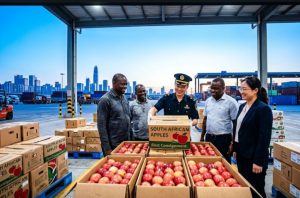
In the early hours of Friday morning, customs officers at Shenzhen’s Shenzhenwan Port cleared 24 metric tons of South African apples — marking the quiet but historic arrival of the first commercial shipment under China’s sweeping new zero-tariff policy covering 53 African nations. The moment was small in scale but enormous in implication: for the first time in modern trade history, a major global economy had unilaterally dismantled import duties for an entire continent.
China’s expanded zero-tariff initiative, which officially came into force on May 1, 2026, extends duty-free market access to all African countries with which Beijing maintains diplomatic relations. The policy covers 53 of the continent’s 54 nations, adding 20 of Africa’s largest and most economically diverse countries — including South Africa, Egypt, Nigeria, Algeria, and Kenya — to a preferential framework that had previously applied only to 33 of the continent’s least-developed economies since December 2024. The sole exclusion is Eswatini, the small southern African kingdom that remains the only country on the continent to maintain formal diplomatic ties with Taiwan rather than Beijing.
The announcement, issued by China’s Customs Tariff Commission of the State Council, sets the new preferential rates for the 20 non-least-developed countries for a two-year window running through April 30, 2028, during which both sides are expected to formalize the arrangement through the China-Africa Economic Partnership for Shared Development agreement — a framework designed to make zero-tariff access a permanent institutional feature of bilateral trade rather than a time-limited concession.
The practical benefits for African exporters are immediate and tangible. Products that previously faced Chinese import tariffs ranging from 8 to 30 percent — including cocoa from Côte d’Ivoire and Ghana, coffee and fresh avocados from Kenya, citrus fruits and wine from South Africa — will now enter the Chinese market without duty. For producers in those countries, the removal of those barriers is expected to lower costs, improve price competitiveness against rival suppliers, and open access to a consumer base of 1.4 billion people that has shown growing appetite for premium imported agricultural goods.
The removal of tariffs lowers the risk for exporters and sends a strong signal that the Chinese market is stable and offers long-term opportunities for African brands.
— RICKY MUKONZA, Associate Professor, Tshwane University of Technology, South Africa
China’s Ministry of Commerce framed the decision as both an economic gesture and a statement of principle. In a formal statement released Wednesday, the ministry said the move demonstrates Beijing’s responsibility as a major power and its commitment to multilateral development at a moment when protectionist sentiment is reshaping global commerce. It arrives in direct contrast to the trajectory of United States trade policy, which under President Donald Trump has imposed successive waves of new import taxes on dozens of countries, including African nations, over the past year.
This shows China’s respect for African countries and its sense of responsibility in driving common development with them.
— TANG XIAOYANG, Dean, Department of International Relations, Tsinghua University
He noted that unlike preferential trade frameworks offered by some Western governments, China’s zero-tariff arrangement carries no requirement for reciprocal market opening and attaches no conditions to African nations’ internal governance or political orientation.
ALSO READ: UAE Announces Withdrawal From OPEC, Reshaping Global Oil Market Dynamics
The backdrop to Friday’s milestone is a bilateral trading relationship that has grown at a pace few observers predicted two decades ago. According to data from China’s General Administration of Customs, total China-Africa trade reached a record $348 billion in 2025 — a figure that represents a 27.5-fold increase from the $3.2 billion equivalent recorded in 2000. China has been Africa’s single largest trading partner for 17 consecutive years. In the first quarter of 2026 alone, bilateral trade climbed 23.7 percent compared to the same period a year earlier, with Chinese imports from Africa rising 14.6 percent — a trajectory the new policy is expected to accelerate.
Business communities on both sides responded with cautious optimism. At the permanent exhibition hall of the China-Africa Economic and Trade Expo in Changsha, which currently displays more than 2,000 varieties of African specialty products, operators said they anticipated a steady increase in the volume and variety of goods arriving from the continent. In Nairobi, officials and trade groups convened to assess how Kenya’s agricultural exporters — already among the most active African participants in the Chinese market — could use the new framework to expand their footprint.
Quality African consumer goods such as Namibian lobsters and Tanzanian mud crabs are entering the area’s market at a faster pace.
— LAM LUNG-ON, President, Greater Bay Area Importers and Exporters Association
He added that the elimination of tariffs would be particularly significant for processed goods, which previously faced a structural disadvantage compared to raw commodities — potentially encouraging African countries to invest in local processing capacity rather than exporting unrefined primary products.
That structural dimension is central to how Chinese analysts and African economists alike are assessing the policy’s long-term potential. Africa’s role in the global supply chain has historically been that of a raw material supplier — exporting oil, minerals, and agricultural commodities in exchange for finished manufactured goods, a pattern that has made it difficult for the continent’s industrial base to develop depth or complexity. Researchers at Beijing’s University of International Business and Economics argued that, combined with Chinese investment and technology transfer, zero tariffs on processed and value-added African goods could provide the incentive structure needed to alter that dynamic.
Not all observers, however, view the policy through an unambiguously positive lens. Thierry Pairault, a China-Africa specialist at France’s National Center for Scientific Research, noted that most of Africa’s largest export categories by volume — crude oil, copper, iron ore, and other minerals — already entered China duty-free under existing commodity trade arrangements. The practical expansion of zero-tariff treatment, in his assessment, applies most meaningfully to agricultural and processed goods, sectors where China’s consumer demand is growing but which represent a relatively modest share of total African exports. He described the initiative, in part, as a geopolitical signal calibrated for maximum symbolic impact at relatively low economic cost to China.
The geopolitical reading of the announcement has gained traction beyond academic circles. Kishore Mahbubani, a prominent Singaporean diplomat and scholar who has written extensively on the shifting balance of global influence, said the timing and structure of China’s move represent a meaningful strategic advantage in Beijing’s relationship with African governments and populations — particularly against the backdrop of rising American tariff barriers. The contrast, he argued, is unlikely to be lost on African leaders navigating between the two largest economies in the world.
There are also structural concerns about the broader trading relationship that the new policy does not, by itself, resolve. The balance of trade between China and Africa remains heavily skewed in China’s favor, with African nations collectively running a significant deficit as Chinese manufactured goods continue to flow onto the continent in large volumes. A number of African governments also carry substantial sovereign debt owed to Chinese state lenders, a financial overhang that complicates assessments of how equitable the partnership truly is.
Chinese officials have acknowledged those concerns while arguing that expanded trade access is part of a longer-term solution. Beijing has pledged to work with African governments on “green lanes” — expedited customs and inspection channels specifically for African agricultural and food imports — and to continue signing bilateral economic partnership agreements with individual countries to lock in zero-tariff access as a permanent feature of trade relations rather than a renewable concession.
South Africa looks forward to working with China in a friendly, pragmatic and flexible manner.
— PARKS TAU, Trade Minister, Republic of South Africa
His remarks captured a tone of measured engagement that characterized official African government responses across the continent as the policy came into force — cautiously welcoming the opening while signaling an intent to negotiate from a position of pragmatic self-interest rather than uncritical alignment.
As customs clearance data from Shenzhen, Shanghai’s Waigaoqiao Port, and other major Chinese entry points began accumulating through Friday — avocados from Kenya, apples from the Cape, other perishables from across sub-Saharan Africa — trade analysts said the first day offered only a glimpse of what the policy might eventually produce. The architecture is now in place. Whether it reshapes Africa’s industrial trajectory or remains primarily a diplomatic statement will depend, experts said, on whether investment, logistics, and domestic African policy reforms follow the tariff reductions into the breach.
Reporting contributed from Beijing, Shenzhen, Nairobi, and Johannesburg. | Published May 1, 2026