The Hormuz Chokepoint: Global Economies Brace as “Dual Blockade” Hardens
With the IRGC restricting Gulf exits and the U.S. Navy blockading Iranian ports, the world confronts its largest energy supply disruption in history — and no clear path back.

L
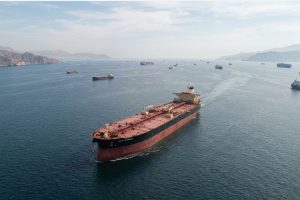
ONDON/SINGAPORE — The global economic machinery is grinding against the friction of a $105 barrel. As the crisis in the Strait of Hormuz enters its third month, the initial shock has hardened into a structural “dual blockade.” With the Iranian Revolutionary Guard Corps (IRGC) restricting Gulf exits and the U.S. Navy blockading Iranian ports since April 13, the world is facing a fundamental reconfiguration of the global order. This isn’t merely a price spike; it is a test of which nations can pivot and which will fracture under the weight of an energy reset.
The impact on global markets remains extreme and highly volatile. As of 04:45 BST on Monday, May 11, 2026, Brent crude is trading at $105.47 per barrel, up over 4% on the day. Its counterpart, WTI (West Texas Intermediate), sits at $99.73. Over the last seven days, Brent has swung violently between $95 and $117, reflecting a market that is pricing in total geopolitical uncertainty. The Strait normally facilitates roughly 27% of global seaborne oil trade and 20% of global liquefied natural gas (LNG); with these flows largely severed, the “just-in-time” supply chain model that defined the last three decades has effectively collapsed.
The world is facing the biggest energy security threat in history.
The International Energy Agency has described the crisis as “the largest supply disruption in the history of the global oil market.” IEA Executive Director Fatih Birol has gone further, warning that the world is facing “the biggest energy security threat in history,” with the agency estimating a loss of around 13 million barrels per day of oil supply. For many global firms, the “energy-risk premium” is no longer a temporary surcharge; it is now the single largest line item on the corporate balance sheet.
ALSO READ: The Temple of Heaven Summit: Trump and Xi Seek a ‘Managed Superpower’ Future Amid Middle East Volatility
For national economies, the effects are bifurcated. Emerging markets in South Asia, heavily reliant on imported energy, are staring down hyper-inflation and energy rationing. Meanwhile, G7 nations are accelerating shifts to renewables and nuclear power as a matter of hard-nosed national security. This crisis is forcing a policy acceleration that has effectively compressed years of energy transition planning into a matter of months, as the cost of hydrocarbon dependency becomes politically unbearable.
The business sector is responding with a massive capital flight toward energy efficiency. Venture capital is pouring into grid-scale battery storage and AI-driven logistics to bypass traditional maritime bottlenecks. For the savvy investor, the “Hormuz Crisis” represents the ultimate pivot point. As traditional industrial giants struggle under the weight of high overheads, a new class of “lean-energy” enterprises is emerging, built to operate in a high-cost, low-carbon reality.
From a diplomatic perspective, the situation is at a critical juncture. On Sunday, May 10, Tehran delivered its formal response to a U.S. peace proposal via Pakistani mediators in Islamabad. While Pakistan remains the primary channel, a wider circle of regional powers — including Qatar, Saudi Arabia, Turkey, and China — have been in constant contact with Iran’s foreign minister in a multi-pronged mediation effort. However, the path to a ceasefire remains treacherous. Late Sunday, President Donald Trump rejected the Iranian counter-terms as “TOTALLY UNACCEPTABLE,” accusing Tehran of “playing games with the United States,” while U.S. Ambassador to the United Nations Mike Waltz stated Washington had laid out a “very clear red line.”
ALSO READ: Global Supply Chain Shock: Middle East Crisis Disrupts Electronics, Energy, and Food Systems
The human element remains the most poignant. In urban centers from Milan to Mumbai, the “Hormuz Tax” is felt at the pump and the grocery checkout. Local retailers across Europe and Asia have reported significant and rapid increases in the cost of basic goods as shipping insurance and fuel surcharges are passed on to consumers. Freight operators across Northern Italy and Central Europe have described the situation as a “quiet catastrophe,” where the absence of warships in their own harbors does not diminish the reality of rising bread prices and the realization that the era of cheap, globalized energy has changed indefinitely.
As we look toward the second half of 2026, the strategic consensus suggests no return to the status quo. Even if a diplomatic breakthrough occurs in Islamabad this week, the “trust deficit” remains. The world has seen how easily the tap can be turned off, and the resulting shift toward decentralized and secured energy systems is now an unstoppable force. This is the era of the “Great Decoupling,” and the winners will be those who treat energy not as a commodity to be imported, but as a strategic asset to be defended.
Living Faith
Crusade 2026
Experience Three Powerful Days of Faith, Worship, and God's Word

📅 Date
September 24–26, 2026
📍 Venue
Rhema USA Campus, Broken Arrow, Oklahoma, USA


