Global Supply Chain Shock: Middle East Crisis Disrupts Electronics, Energy, and Food Systems
Escalating regional tensions are triggering a cascading breakdown across semiconductors, logistics, and agriculture—exposing deep structural dependencies in the global economy.

T
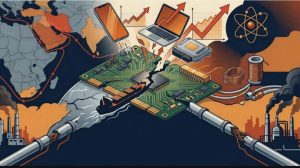
he global technology supply chain is entering a critical stress phase as Middle East tensions escalate from a regional security crisis to a systemic economic disruption. Reuters and industry analysts report that constricted access to resin, copper, and helium is triggering cascading failures across electronics manufacturing, directly impacting the production of the boards that power modern life.
At the core of the disruption is a structural imbalance: while the production of printed circuit boards (PCBs) is largely concentrated in Asia, the petrochemical inputs required for epoxy resins remain heavily dependent on Middle Eastern oil and gas. As these supply lines tighten, PCB prices have reportedly surged by as much as 40% in recent weeks, forcing manufacturers to slow production or accept drastically thinner margins.
The helium market presents an even sharper vulnerability. Qatar, which supplies roughly one-third of the world’s helium, has become a severe bottleneck as the effective closure of the Strait of Hormuz chokes its export routes. Helium is indispensable for the cryogenic cooling required in semiconductor fabrication; without it, the earliest stages of chip production are at risk of a total halt.
Industry analysts describe the current environment as a live “bullwhip effect.” In this scenario, minor upstream disruptions in raw materials are amplified as they move through the supply chain. This results in significant price volatility for consumer goods, with laptops, smartphones, and automotive electronics seeing sharp increases as manufacturers compete for a rapidly shrinking inventory.
Logistics pressures are further compounding the crisis. Security risks have made the Suez Canal untenable for many major carriers, forcing vessels to reroute via the Cape of Good Hope. This detour adds approximately 3,500 nautical miles and up to two weeks to transit times, consuming millions of dollars in additional fuel per voyage.
These operational hurdles, combined with skyrocketing marine insurance premiums, have created a de facto “logistics war tax.” These costs are no longer being absorbed by manufacturers but are being passed directly to consumers through higher retail prices and increased shipping fees for global trade.
ALSO READ: Strain on U.S. Security Architecture as Middle East Deterrence Becomes More Contested
The automotive sector is once again under intense strain. Modern vehicles are essentially “computers on wheels,” and the lack of reliable circuit board supplies is leading to renewed production bottlenecks. Industry insiders warn that these delays are beginning to mirror the severe shortages seen during the post-pandemic recovery.
Beyond the world of electronics, secondary effects are rippling through the broader global economy. The disruption of natural gas flows—critical for nitrogen-based fertilizers—has driven fertilizer prices up by 31% this year. This is feeding directly into rising food costs, with poultry, pork, and vegetable oils all seeing sustained double-digit inflation.
The construction industry is also feeling the pressure. Copper foil and wiring prices have risen by roughly 30% since the start of the year, while surging energy prices—which the World Bank projects will rise 24% globally year-over-year in 2026—are inflating the production costs of cement and steel.
Market outlooks point to a period of sustained volatility characterized by high prices and “shrinkflation”—the practice of reducing product sizes while holding prices steady—as firms attempt to preserve their financial stability. What began as a localized conflict is now exposing a deeper reality: the global economy’s most essential systems remain tightly coupled to Middle Eastern stability.
Living Faith
Crusade 2026
Experience Three Powerful Days of Faith, Worship, and God's Word

📅 Date
September 24–26, 2026
📍 Venue
Rhema USA Campus, Broken Arrow, Oklahoma, USA


