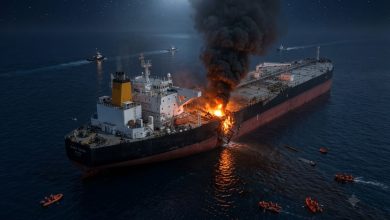
Dover Transfer Underscores Deepening Divide Over US-Iran War
Trump claims public backing for the war as new polling and a Chinese rebuke over the Hormuz blockade suggest otherwise.

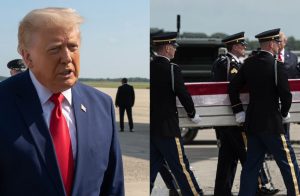
Photo Illustration: AWB News / White House Video
The return of four fallen American service members to Dover Air Force Base has intensified national debate as the military conflict between the United States, Israel, and Iran enters a dangerously volatile phase. Flag-draped transfer cases carrying the remains of 1st Lt. Tyler James Feehan, 25, of Hawaii; Pvt. Isabella Gonzales, 19, of Texas; Sgt. Angel S. Rampersad, 28, of New York; and Sgt. Michael Emmanuel Swinton, 30, of North Carolina, arrived on domestic soil during a solemn dignified transfer. Feehan and Gonzales were killed during an Iranian missile and drone attack on Muwaffaq Salti Air Base in Jordan, where Rampersad had initially been reported missing before being presumed deceased. Swinton was killed in Erbil, Iraq, during a controlled detonation of an Iranian attack drone. President Donald Trump, joined by Defense Secretary Pete Hegseth and senior military leadership, attended the ceremony alongside grieving families, bringing the human and strategic cost of the escalating confrontation into sharp focus.
Despite growing international and domestic calls for de-escalation, Tehran has maintained an uncompromising operational stance. Iranian political and military commanders continue to emphasize that their armed forces remain in absolute readiness to confront foreign intervention through sustained ballistic missile operations, regional proxy networks, and aggressive naval maneuvers around key strategic waterways. Defense officials in Washington and Tel Aviv contend that their ongoing strikes are essential to systematically degrade Iran’s military infrastructure, air defense systems, and regional power projection capabilities.
The root cause of interruptions to navigation through the Strait of Hormuz is the United States and Israel’s illegal military operations against Iran.
— MAO NING, CHINESE FOREIGN MINISTRY SPOKESPERSON
This military gridlock has functionally severed one of the world’s most critical maritime transit corridors, leaving the Strait of Hormuz locked in a severe dual blockade. The Islamic Revolutionary Guard Corps (IRGC) continues to exert strict control over northern shipping routes using sea mines, speedboats, and loitering munitions, while maritime risk analysts estimate a drastic collapse in ocean-going merchant vessel transit compared to pre-war baselines. Simultaneously, U.S. naval forces are conducting active patrols and precision strikes against coastal missile sites to enforce freedom of navigation. Despite intermittent attempts by third-party mediators to broker ceasefires or return to negotiations, the standstill has stranded thousands of mariners and forced global energy logistics to reroute crude oil and liquefied natural gas around Africa’s Cape of Good Hope.
The exchange underscored how rapidly the crisis is escalating beyond a regional conflict into a direct great-power confrontation. In an earlier briefing, Beijing established a firm diplomatic stance, rejecting operational tolls and asserting that unilateral U.S. actions precipitated the crisis. Recently, as fighting reignited over control of the strategic waterway, Chinese Foreign Ministry officials again called on Washington and Tehran to exercise restraint and restore safe passage, advocating for UN-backed diplomatic mediation rather than unilateral operational control over the chokepoint.
Americans don’t want high gasoline prices, but they are not against the war.
Concurrently, the White House faces an undeniable disconnect between its public claims and verified polling data regarding domestic support for the conflict. Speaking to reporters at Joint Base Andrews before traveling to Dover Air Force Base, President Trump claimed that an unnamed poll showed the American public broadly supports his military posture and that opposition is confined to frustration over fuel prices. While average gas prices have receded slightly from springtime peaks, they remain significantly higher than pre-war levels, creating widespread voter dissatisfaction. However, major independent polling directly refutes the administration’s premise: a mid-July Washington Post-Ipsos survey revealed that 68% of Americans believe the war is not worth fighting (with 28% supporting it), an Economist/YouGov survey found 55% favor ending military strikes compared to 27% favoring continuation, and earlier CNN/SSRS polling showed nearly 6 in 10 disapproving of U.S. military action alongside broad opposition to ground deployments. As global economic strains deepen, the gap between administration policy and public consensus remains a central challenge in the evolving conflict.
Living Faith
Crusade 2026
Experience Three Powerful Days of Faith, Worship, and God's Word

📅 Date
September 24–26, 2026
📍 Venue
Rhema USA Campus, Broken Arrow, Oklahoma, USA