No Single Winner Among Nigeria’s Major Languages
Hausa, Yoruba, Igbo and Pidgin each lead on different dimensions of reach

Ask almost any Nigerian which language their country speaks most, and the answer comes fast: Hausa. It is repeated in newspaper explainers, cited in government country-guidance documents used by foreign asylum officials, and stated as settled fact across the internet. The trouble is that almost none of the sources making this claim are actually measuring the same thing — and Nigeria’s own government has not run a census that records language or ethnicity since 2006. Every “most spoken” figure circulating today is an estimate, an extrapolation, or in some cases a private polling company’s household survey mistaken for a national count.
The “Most Spoken” Claim: What Are We Actually Measuring?
The confusion starts with what a given number represents. Some sources count native (first-language) speakers only. Others add second-language speakers who learned the language later, often for trade or administration. Others still are quietly counting ethnic population, not language use at all — a distinction that matters enormously in a country where intermarriage, urban migration, and widespread bilingualism are the norm rather than the exception. A person can belong to the Hausa ethnic group by census classification while speaking Pidgin or English at home and work. A language having the largest estimated population attached to it does not automatically mean it is the language most widely spoken, understood, or used day-to-day across Nigeria. Nigeria’s linguistic geography makes the question considerably more complicated than a single ranking can capture.
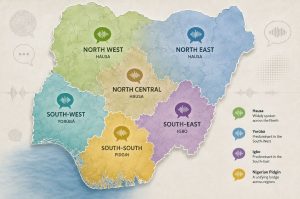
Nigeria’s Linguistic Map: One Country, Many Language Worlds
In much of the North West and North East, Hausa functions as a major lingua franca, despite the region containing numerous ethnic groups beyond the Hausa and Fulani themselves. The North Central zone tells a different story entirely — it is, by most ethnographic accounts, Nigeria’s single most linguistically diverse region. Kwara’s capital, Ilorin, blends Yoruba and northern traditions, and the state’s major ethnic groups include Yoruba, Nupe, Bariba, and Fulani. Kogi, the “Confluence State” where the Niger and Benue rivers meet, is home to the Igala, Ebira, and Okun — a Yoruba subgroup — while Benue is dominated by the Tiv, with Idoma and Igede as significant minorities. Academic linguistic surveys of the zone list Adara, Bassa Nge, Berom, Eggon, Gwari, Igala, Nupe, Tarok, and Tiv among dozens of indigenous languages spoken there, alongside Hausa and Yoruba. The point is not to diminish Hausa’s regional weight — it is to demonstrate why northern population totals cannot simply be converted into nationwide linguistic reach.
Yoruba is overwhelmingly dominant across the South West, where six states — Lagos, Ogun, Osun, Oyo, Ondo, and Ekiti — form its traditional homeland; Igbo plays a broadly comparable role across the South East’s five states. The South South, by contrast, is Nigeria’s zone of greatest ethnic fragmentation, home to dozens of distinct groups with no single dominant indigenous language. It is here that Nigerian Pidgin becomes not a supplement to people’s mother tongues but frequently the primary language of daily cross-community life.
Hausa — The Northern Lingua Franca That Crossed Nigeria’s Borders
Hausa’s real strength is not a single population figure — estimates for combined first- and second-language speakers vary enormously across sources, from roughly 77 million to as high as 200 million, depending on whether they’re counting Nigeria alone or the entire trade-network footprint across the Sahel. What is consistent across every source is geographic reach: Hausa functions as an established trade and communication language across at least ten territories, including Niger, Chad, Cameroon, Sudan, Ghana, Togo, Benin, Burkina Faso, and the Central African Republic, alongside northern Nigeria. It is used extensively in regional media — the BBC, Voice of America, Deutsche Welle, and Radio France Internationale all broadcast in Hausa — and it holds a status few other Nigerian languages can claim: in 2025, Niger made Hausa its sole official language, replacing French entirely. Hausa’s defining characteristic, in other words, is not that it is spoken by more Nigerians than any other language — that claim cannot currently be verified — but that it functions as a genuine cross-border lingua franca across a wide stretch of continental Africa in a way no other Nigerian language does.
Nigerian Pidgin — Nigeria’s Interethnic Language
Nigerian Pidgin has no ethnic homeland in the way Hausa, Yoruba, or Igbo do, which is precisely what makes it distinctive. In the South South especially, communities frequently operate on three linguistic layers at once — an indigenous language at home, Pidgin across ethnic lines, and English in formal settings — rather than abandoning their mother tongues. From there it has spread into the South West and South East, into virtually every Nigerian urban centre, into Nollywood dialogue, into Afrobeats lyrics, and into the everyday speech of the Nigerian diaspora abroad. A National Open University of Nigeria linguistics professor stated in 2025 that Nigerian Pidgin has grown to an estimated 100 to 120 million speakers, making it, by her account, the 14th most spoken language in the world among more than 76 recognised pidgins and creoles globally.
Who built Pidgin’s vocabulary? Linguistic research answers this with more precision than the loose “mix of everything” description usually applied. English supplies Pidgin’s core grammar and much of its vocabulary as the primary lexifier, but the borrowed words that give Pidgin its distinct character come disproportionately from Yoruba — oga (boss, traced by the Oxford English Dictionary itself to a Yoruba root), ashawo, owanbe, and werey among them. Igbo contributes terms including una (you people) and obodo oyibo (white man’s land), and one of Pidgin’s most recognisable words, pikin (child), traces to the Portuguese pequeno, a legacy of sixteenth-century Niger Delta trade contact that predates British colonial presence entirely. Hausa and Arabic-derived terms round out the mix. The result is a language built collaboratively, and disproportionately, by contributions from the very ethnic languages it now helps Nigerians communicate across.
Yoruba — A Language That Travelled Beyond Its Homeland
Yoruba’s Nigerian base is the South West, but its footprint extends further than the regional map suggests — into Kwara, into pockets of Kogi, and into Lagos, where an estimated 60 to 70 percent of residents speak it in a city that functions as the country’s commercial melting pot. Beyond Nigeria’s borders, Yoruba has an established historical presence in Benin and Togo, and smaller trade or migrant communities in Ghana, Côte d’Ivoire, and Sierra Leone — though these vary meaningfully in character, from ancestral populations to more recent merchant settlement, a distinction that matters more than a simple country count.
Yoruba Beyond Africa: The Atlantic Diaspora
This is where Yoruba’s global profile becomes genuinely distinctive, and where the historical record needs careful handling. The transatlantic slave trade carried Yoruba-speaking people to Brazil, Cuba, Trinidad, Haiti, and elsewhere in the Americas, where Yoruba cosmology, ritual vocabulary, and oral tradition survived and evolved into Candomblé and Nagô practice in Brazil and Lucumí/Santería in Cuba, traditions still actively practised today, centuries after the language stopped being most communities’ everyday spoken tongue. This distinction matters: cultural and religious survival is not the same claim as an active Yoruba-speaking population, and it is worth being explicit about that difference. It is also worth correcting a piece of misinformation that circulates persistently online — the claim that Brazil formally adopted Yoruba as an official language and made it a compulsory school subject nationwide. Fact-checkers have confirmed this is false; Yoruba was granted intangible cultural heritage recognition specifically in Rio de Janeiro and Salvador, a meaningful but much narrower status than national curriculum adoption, and Brazil’s sole official language remains Portuguese.
What is not in dispute is Yoruba’s outsized role in Nigeria’s modern cultural exports. Fela Kuti built the foundational sound of Afrobeat on Yoruba proverbs, chant structures, and rhythm; contemporary academic work on Afrobeats describes Yoruba as having achieved global cultural exposure through the genre in a way matched by few African languages. Universities including Harvard, UCLA, SOAS, and the University of Wisconsin–Madison teach Yoruba specifically because of this historical and cultural weight, treating it as a language of serious diasporic and religious-studies interest rather than a purely regional one.
Igbo — A Powerful Modern Diaspora Network
Igbo’s expansion follows a different, more recent pattern. Concentrated in the South East, Igbo communities spread through Nigeria’s other cities after the Nigerian Civil War era, then internationally through late-twentieth and twenty-first century migration. Diaspora population figures vary by source and definition, but Igbo communities are documented in the United States (estimates ranging roughly 117,000 to over 200,000 depending on whether ancestry or language-speaker counts are used), Cameroon, Ghana, Equatorial Guinea, the United Kingdom, and Canada, with concentrations in cities including London, Houston, Atlanta, and the Washington, D.C. area. Even Igbo diaspora organisations themselves acknowledge no reliable global count exists — the World Igbo Congress has called for a dedicated diaspora census, describing current figures as guesswork. This is not a story of Igbo “losing” a competition; it is a different, more recent pattern of expansion than Yoruba’s centuries-old Atlantic trajectory, driven by economic migration rather than forced displacement.
What Does “Global Reach” Actually Mean?
A single ranking cannot capture what these languages are each doing well. A more honest approach measures several dimensions independently: total population, geographical spread, second-language adoption, interethnic use within Nigeria, cross-border presence, diaspora settlement, how long that international presence has existed, cultural and vocabulary influence beyond the language’s own speakers, media export through music and film, and institutional use in education, broadcasting, or religion. Measured this way, no language sweeps every category — and that, itself, is the finding.
The Verdict: There Is No Single Winner
The evidence does not produce one universal champion, because “linguistic reach” was never a single measurement to begin with. Hausa demonstrates extraordinary cross-border reach across continental Africa, reinforced by Niger’s 2025 decision to make it an official language. Yoruba possesses an exceptional historical and cultural footprint across the Atlantic world, built through forced migration centuries ago and sustained today through Afrobeats and Nollywood; it also forms a continuous indigenous presence across the Nigeria–Benin–Togo border and supplies the largest share of indigenous loanwords to Nigerian Pidgin. Nigerian Pidgin has unmatched interethnic reach within Nigeria itself and a rapidly expanding international presence, built collaboratively from the vocabulary of the very languages it bridges. Igbo has developed a substantial modern diaspora network through recent economic migration. English remains the country’s official interregional language by administrative default, not popular preference.
Millions of Nigerians do not speak Hausa, Yoruba or Igbo as a first or everyday language. Each of those three is concentrated in the regions where its ethnic speakers predominate. Nigerian Pidgin, by contrast, has no ethnic homeland and functions as the primary interethnic medium across much of the South and in urban centres nationwide. Because no recent census records language use, claims that any one of the three major ethnic languages is definitively “more widely spoken” than the others across the whole country remain unverifiable. What the available evidence does show is that different languages lead on different dimensions of reach.
The more useful question, then, is not which Nigerian language is “number one” — a question the country’s own data gaps make impossible to answer with confidence — but what kind of reach each language has achieved, where that reach actually exists, and how it got there.
| Language | Nigerian Base | Major Form of Reach | International Footprint | Distinctive Strength |
|---|---|---|---|---|
| Hausa | Northern Nigeria | Regional/interethnic | Sahel, West/Central Africa | Cross-border African lingua franca |
| Yoruba | South West | Ethnic + historical diaspora | West Africa, Americas, Caribbean | Historical/cultural diaspora |
| Igbo | South East | Ethnic + modern diaspora | US, UK, Canada, Cameroon, Ghana | Contemporary global diaspora |
| Nigerian Pidgin | Strongest in South, broad nationally | Interethnic | Growing diaspora/media presence | Cross-ethnic Nigerian communication |
| English | Nationwide | Formal/interregional | Global | Official and international communication |
Living Faith
Crusade 2026
Experience Three Powerful Days of Faith, Worship, and God's Word

📅 Date
September 24–26, 2026
📍 Venue
Rhema USA Campus, Broken Arrow, Oklahoma, USA