Osun Election Exposes the Complexities of Nigeria’s 2027 Politics
Adeleke’s victory, Davido’s mobilisation role and Tinubu’s endorsement reveal why state elections may not predict presidential voting


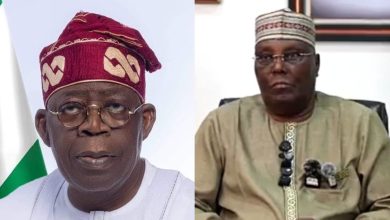
Right: APC candidate Bola Oyebamiji, in white, and ADC candidate Najeem Salam, in brown.
Composite: The AWB News.
Osun State’s Independent National Electoral Commission returning officer declared Governor Ademola Adeleke winner of the August 15 governorship election with 511,067 votes to APC candidate Bola Oyebamiji’s 444,815, a margin of 66,252 votes in an election conducted across the state’s 30 local government areas. Speaking shortly after the declaration, Adeleke described the outcome as “a victory for democracy in Nigeria. A victory for Osun people that stood by me and said, ‘Imole, you have done a lot for us.’” On the surface, this reads as a straightforward incumbent victory. Underneath it sits a considerably stranger political story, one that raises broader questions about how Nigerian politics could be read in the run-up to 2027.
Davido became one of the most prominent figures associated with Adeleke’s re-election campaign. Adeleke’s nephew was formally appointed Head of Youth Mobilisation for the campaign in April and subsequently became a prominent figure in the Imole Youth Mobilisation campaign structure. His involvement went beyond a public endorsement: he occupied a formal campaign role and participated publicly in Adeleke’s youth mobilisation campaign. That distinction matters for what comes next.
Here is the part of the story that has drawn far less attention than it deserves. Adeleke has just defeated APC candidate Bola Oyebamiji, who publicly declared himself President Bola Tinubu’s endorsed candidate for the election — yet Adeleke has repeatedly endorsed Tinubu’s bid for re-election in 2027, reaffirming that position in March and again in May. Those two facts sit uneasily next to each other only if governorship politics and presidential politics are assumed to be the same contest. Adeleke’s own political positioning demonstrates that the two contests can be treated differently by political actors.
THE AWB NEWS ANALYSIS DESK
A governor can defeat a president’s preferred candidate locally while still endorsing that president nationally.
The party arithmetic behind that is unusual. Adeleke won his first term in 2022 on the PDP platform. He announced his move from the PDP to Accord in December 2025, saying he had joined the party on November 6 after weeks of consultations, and subsequently secured its governorship ticket. His departure was followed by a major movement of PDP lawmakers and political figures into Accord, including 25 members of the Osun State House of Assembly and six members of the House of Representatives. The scale of the defections made his move more consequential than a simple change of party label. Neither the PDP nor the Labour Party fielded a candidate in the 2026 election.
What that leaves is a genuinely interesting question rather than an obvious one: did Davido’s mobilisation role actually move votes, or did it mostly move attention? The two are not the same thing. Adeleke’s 2022 victory over Oyetola was 403,371 votes to 375,027, a margin of 28,344, achieved without Davido holding any formal campaign role. This year’s contest, with Davido inside the official structure from April onward, produced a margin more than double that — 66,252, some 37,908 votes larger than his 2022 winning margin. But Adeleke was also an incumbent this time, running against a different opponent, in a race missing the PDP and Labour Party from the ballot. The change in margin therefore cannot be attributed to Davido from the aggregate results alone, because the electoral environment itself was substantially different.
Public reactions to the result have also raised the question of how much electoral weight should be attributed to Davido’s role. Davido’s formal role establishes his participation in the campaign, but the available election results do not establish that his involvement caused Adeleke’s victory. Establishing a causal electoral effect would require evidence capable of separating Davido’s influence from factors such as incumbency, party defections, local political structures, the absence of PDP and Labour Party candidates, campaign organisation and Adeleke’s existing support — evidence that is not yet publicly available in sufficient detail to isolate Davido’s independent electoral effect.
“It’s no victor, no vanquished… Mr President has called me and he has congratulated me. Thank you, Mr President, for making sure democracy lives on.”
Adeleke’s victory over an APC candidate publicly backed by, or presented as endorsed by, the sitting president, while Adeleke simultaneously endorses that president for a second term, shows why governorship results from other states should not automatically be treated as proxies for presidential sentiment in 2027. Adeleke’s political positioning demonstrates that support for a presidential candidate and support for a different party’s governorship candidate can coexist within the same political environment — what Osun’s voters will do in a presidential contest next year remains, for now, unknown. Osun’s combination of a formal celebrity campaign role, major party realignment and Adeleke’s repeated endorsement of Tinubu provides an unusually clear case for examining that distinction.
Living Faith
Crusade 2026
Experience Three Powerful Days of Faith, Worship, and God's Word

📅 Date
September 24–26, 2026
📍 Venue
Rhema USA Campus, Broken Arrow, Oklahoma, USA