Sánchez Faces War, Migration and Family Court Crises
A Ceuta migration surge, a deadly Krasnodar beach strike, and back-to-back convictions in his own family collide in a single turbulent week for Spain's prime minister.

P
edro Sánchez spent the last two weeks of July and the first days of August managing three crises that would strain any government on their own — a mass migration surge into Ceuta, a wave of Ukrainian drone strikes deep inside Russian territory that has drawn Madrid further into the war’s optics, and a set of criminal rulings against his own family. That the three converged inside a ten-day window has turned Spain’s domestic and foreign policy into a single, tightly watched story.
The migration crisis broke first. Spain’s Interior Ministry said close to 50,000 people crossed from Morocco into the Spanish enclave of Ceuta beginning July 30, in what officials and Ceuta’s regional government called an unprecedented surge; at least 57 to 67 people died in the crossing, many drowning or crushed against the breakwater fence at Tarajal beach. Moroccan authorities deployed water cannon at the border on their side, and Rabat’s ambassador to Spain said the influx was “not wanted by the Kingdom of Morocco.” Opposition leader Alberto Núñez Feijóo’s People’s Party accused Sánchez’s government of reacting too slowly and linked the crisis to deteriorating relations with Rabat, while European far-right figures, including French politician Jordan Bardella and members of the Trump administration, cited Ceuta as evidence of failed EU migration policy. By August 4, Madrid had pledged €25 million in emergency funds for migrant minors and said no arrivals would be transferred to the Spanish mainland ahead of an emergency EU interior ministers’ meeting.
Days later, the war in Ukraine produced its own jarring images. A drone strike hit a packed beach in Arkhipo-Osipovka, in Russia’s Krasnodar Krai, on August 3, killing at least six people — three of them children — and injuring dozens more, according to regional governor Veniamin Kondratyev. Moscow blamed Ukraine. Kyiv did not deny launching the drone but said Russian air defenses caused the fatal explosion, a claim that open-source analysts and even the Russian outlet Agentstvo said was consistent with audible gunfire and an abrupt change in the drone’s flight path visible in footage before impact. Neither side’s account has been independently verified in full.
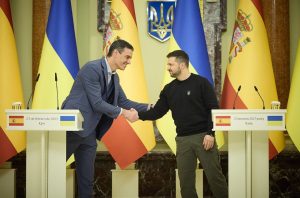
The strike landed at an awkward moment for Spain’s government, which has positioned itself as one of Kyiv’s steadier European backers. Sánchez announced a new €1 billion military aid package for Ukraine in March, bringing Spain’s total bilateral military assistance since 2022 to roughly €3.8–4 billion, financed partly through the EU’s SAFE defense instrument and partly through direct Ministry of Defence contributions, including earlier transfers of Leopard 2A4 tanks. That support has not been without friction inside the alliance: in May, Spain joined Britain, France, Italy and Canada in blocking a NATO proposal, floated by Secretary General Mark Rutte, to standardize how allies count Ukraine aid as a share of GDP — a metric that critics said would have made Spain’s relative contribution look smaller than the headline euro figures suggest.
Meanwhile, Sánchez’s family has supplied the opposition with its own material. On July 14, a court in Badajoz convicted the prime minister’s brother, David Sánchez, a composer and orchestra conductor, of administrative misconduct over a public-sector cultural post prosecutors said was created for him in 2017. He was banned from holding public office for nine years, though acquitted of the more serious influence-peddling charge, and his defense has said it will appeal. Two days later, a Madrid appeals court confirmed that Begoña Gómez, the prime minister’s wife, will stand trial before a popular jury on charges of influence peddling and embezzlement of public funds tied to a university chair, a consultant’s contract, and government contracts awarded to technology companies — while dropping two additional charges, corruption and misappropriation, and ordering her passport returned. Gómez has consistently denied wrongdoing, and Sánchez has repeatedly characterized the investigations — which also touch former allies including ex-PM José Luis Rodríguez Zapatero — as a politically driven campaign by right-wing and far-right actors, a claim the complainant group, Manos Limpias, rejects. A PP spokesperson said Sánchez’s resignation was “long overdue” following the rulings; no trial date has been set for Gómez.
None of the three stories is proof that the others were engineered to distract from it — Sánchez does not control when Ukrainian drones fall on Russian beaches, and the Ceuta crossings track a broader, volatile pattern in Morocco-Spain migration relations that predates his government. But together they illustrate the position Spain’s prime minister occupies heading into the second half of 2026: defending a foreign policy that ties Madrid closely to Kyiv’s war effort, absorbing a migration emergency that has become a rallying point for critics well beyond Spain, and doing both while his own household faces judges. Whether voters treat that as coincidence, mismanagement, or a smear campaign, as Sánchez insists, is likely to define Spanish politics through the next election cycle.
Living Faith
Crusade 2026
Experience Three Powerful Days of Faith, Worship, and God's Word

📅 Date
September 24–26, 2026
📍 Venue
Rhema USA Campus, Broken Arrow, Oklahoma, USA