The Rubio Paradox: Sanctioned US Secretary of State Lands in Beijing for Historic Summit
Diplomatic "Silent Waiver" allows Marco Rubio entry to China despite active 2020 travel ban, marking a historic test of geopolitical pragmatism.

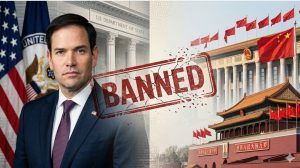
BEIJING — In what is being hailed as the most significant test of diplomatic protocol in decades, U.S. Secretary of State Marco Rubio arrived in Beijing on Wednesday, May 13, 2026. The visit marks a historic anomaly: a sitting American Secretary of State officially traveling to a country that has legally banned him from entering.
The high-stakes summit, where Rubio accompanied President Donald Trump for meetings with President Xi Jinping, placed China in a delicate corner. Since 2020, Rubio has been under active Chinese sanctions, including a strict travel ban. At the time of his first sanctioning, Rubio responded with characteristic wit:
“I don’t want to be paranoid but I am starting to think they don’t like me.”
The Legal Gridlock and the “Pragmatic” Shift
For years, the “Rubio Ban” was a centerpiece of Beijing’s “Wolf Warrior” diplomacy. However, with Rubio’s confirmation as Secretary of State in early 2025, the ban shifted from a symbolic gesture to a pragmatic hurdle. If China refused him entry, they risked a total collapse of communication with the world’s largest economy.
ALSO READ: The Temple of Heaven Summit: Trump and Xi Seek a ‘Managed Superpower’ Future Amid Middle East Volatility
In a recent May 2026 briefing, Chinese Foreign Ministry spokesperson Lin Jian addressed the tension by focusing on the prerequisites for the relationship rather than the individual status of the Secretary. When asked about the coordination of the visit, Lin stated:
“The one-China principle is the prerequisite for a steady, sound, and sustainable China-U.S. relationship. We are in communication with the U.S. side regarding President Trump’s visit, and we hope the U.S. will honor its commitments to make the right choice for world peace.”
A Loaded Agenda: Why Neither Side Can Walk Away
The decision not to reject Rubio’s visit is rooted in mutual dependency. The agenda is dominated by high-stakes global crises, specifically the Strait of Hormuz situation, which has threatened approximately 20% of global oil flow. Rubio confirmed his stance at a White House briefing last week:
“Human rights violations and regional security remain important priorities for this administration. We will raise these issues in the appropriate forums during the upcoming visit.”
Chinese Foreign Minister Wang Yi, following a preparatory phone call with Rubio on April 30, 2026, signaled that “head-of-state diplomacy” remains the stabilizing anchor for the two nations. According to official reports, Wang emphasized:
“Both sides should maintain the hard-won stability, make good preparations for the important agenda for high-level interactions, and explore the building of a strategic, constructive relationship.”
The “Silent Waiver” Protocol
Diplomatic sources suggest that China employed a “silent waiver” for the duration of the visit. Rubio’s entry was processed under a protocol that effectively bypassed the 2020 sanctions without a formal public repeal — achieved through a quiet alteration of the Chinese-character transliteration of his surname.
“This is the ultimate game of geopolitical chicken,” says a senior diplomat familiar with the negotiations. “Neither side wants to look like they are backing down, but both realize that in 2026, the cost of a failed summit is far higher than the cost of a visa.”
As Air Force One touched down in the capital, the world watched to see if the pragmatism of 2026 would finally override the diplomatic grudges of 2020.
Fact-Check & Verification:
The First Sitting US Secretary of State to be Banned From China
Living Faith
Crusade 2026
Experience Three Powerful Days of Faith, Worship, and God's Word

📅 Date
September 24–26, 2026
📍 Venue
Rhema USA Campus, Broken Arrow, Oklahoma, USA