Trump’s FIFA Intervention: How a White House Phone Call Sent Balogun Back Onto the Pitch — and Belgium Sent the U.S. Home
A red card, three presidential calls, and a 4-1 defeat: inside the Balogun reversal that left FIFA's independence in question

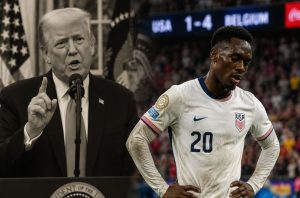
“We’re going to have a full team, and Belgium is going to have a full team… If they beat us, then they can be really proud. The other way, if they beat us I say it was rigged, just like the election was rigged in 2020. But I won’t get into that.”
— President Donald J. Trump, Oval Office Briefing
The 2026 FIFA World Cup has been thrust into an unprecedented geopolitical storm. Following direct behind-the-scenes lobbying by the White House, FIFA took the extraordinary step of reversing a mandatory match ban for star U.S. forward Folarin Balogun ahead of Monday’s high-stakes Round of 16 clash against Belgium. The administrative U-turn sparked a furious international backlash, with European soccer’s governing body (UEFA), the Belgian Football Association, and former FIFA President Sepp Blatter multi-directionally condemning what they view as a dangerous weaponization of sports governance.
Adding fuel to the fire, U.S. President Donald Trump publicly warned that a defeat on the pitch in Seattle would be evidence of a corrupt process, explicitly tying the sporting event to his long-standing domestic political grievances. Speaking to reporters at an Oval Office briefing ahead of kickoff, Trump praised the ruling allowing Balogun to play, before explicitly drawing a parallel to the 2020 presidential race.
Political communications experts view the statement as a classic textbook implementation of narrative insulation. By declaring the system “rigged” before the whistle blows, the president effectively constructs a risk-mitigation framework. A U.S. victory is validated as a heroic triumph against institutional malice; a loss is immediately dismissed not as athletic failure, but as a conspiracy of corrupt external forces. Furthermore, by injecting an “Us vs. Them” dynamic, the rhetoric transforms standard tournament anxiety into a highly mobilized political crusade, placing intense psychological pressure on the match officials and the VAR room.
Anatomy of an Intervention: How the Ban Was Shelved
The crisis began during the United States’ 2-0 Round of 32 victory over Bosnia and Herzegovina in Santa Clara. Brazilian referee Raphael Claus originally assessed no card on the pitch when Balogun planted his foot on the ankle of Bosnian defender Tarik Muharemović. However, following a video assistant referee (VAR) review, Claus dismissed Balogun with a straight red card.
Under Article 66.4 of the FIFA Disciplinary Code, a straight red card triggers a mandatory, unappealable one-match ban. Desperate to keep the tournament’s co-hosts alive with their top-scoring forward on the field, Executive Director of the White House FIFA Task Force Andrew Giuliani and Commerce Secretary Howard Lutnick led a multi-day effort recruiting lawyers and liaising with U.S. Soccer officials, while Secretary of State Marco Rubio publicly backed the push for a review.
The push culminated in at least three direct phone calls from President Trump to FIFA President Gianni Infantino, with Trump labeling the card “horrible” and calling Claus “a little bit suspect if you check his past.” On Sunday, FIFA stunned the international community by executing its historic U-turn, clearing Balogun to play under a loophole in Article 27 of its disciplinary code. The rule allows judicial bodies to fully or partially suspend a sanction for a probationary period of one to four years. The U.S. Soccer Federation was fined $40,000, and Balogun’s ban was made dormant for a twelve-month probationary period. It marks the first time since 1962—when host-nation Chile successfully lobbied for Brazil’s Garrincha to play the final—that a World Cup sending-off did not result in an immediate suspension.
The Global Backlash: ‘Crossing a Red Line’
The administrative maneuvering has left a severe, permanent fracture in the optics of global sports integrity. Within hours of the announcement, UEFA issued a blistering, uncharacteristically blunt statement:
The Royal Belgian Football Association (RBFA) filed an emergency appeal challenging Balogun’s eligibility hours before the match, which FIFA promptly dismissed as “inadmissible” due to standing rules. Belgium coach Rudi Garcia publicly mocked the decision, noting it stood as a singular anomaly in modern World Cup history: “I didn’t know that at the FIFA World Cup the fifth of July is now the first of April and it’s April Fool’s Day.”
The institutional condemnation was amplified by former FIFA President Sepp Blatter, who blasted the current administration on social media:
Infantino Defends the Institutional Divide
Faced with a civil war within sports governance, FIFA President Gianni Infantino issued a firm public defense. While confirming the phone calls with the White House took place, Infantino denied any executive overreach, claiming he merely told Trump that an autonomous judicial track was underway.
Trump later supported Infantino’s version of the timeline, telling reporters, “I don’t believe he made the decision. I think it was a committee.” However, international observers noted that the transparency of that “independent” committee remains deeply compromised by the sequence of public and private executive interventions.
The Moral Dilemma of Sports Equity
The Balogun precedent creates a deeply unsettling moral and ethical landscape for the future of international sports. If heads of state can successfully use diplomatic channels to rewrite disciplinary rules mid-tournament, the meritocratic foundation of the World Cup ceases to exist.
A functioning global rulebook relies entirely on structural consistency—rules must be blind to the geopolitical power of the jersey. Smaller or less influential countries do not possess the diplomatic equity or back-channel executive access to command an audience with the FIFA presidency. By allowing a nation’s sovereign weight to dictate athletic exemptions, international sports governance risks shifting away from a uniform rule of law and turning into a playground of arbitrary political privilege.
By full time at Lumen Field, the scenario Trump had pre-emptively framed as ‘rigged’ had unfolded in stark terms: Belgium defeated the United States 4-1, with Cesar De Ketelaere scoring twice, Hans Vanaken and Romelu Lukaku adding further goals, and Malik Tillman’s 31st-minute strike the lone U.S. reply. Balogun — the player at the center of the controversy — played the full ninety minutes. As the United States exits the tournament at the Round of 16, sports historians and legal scholars are already warning that the true casualty of the 2026 tournament may not be the team that got eliminated, but the baseline institutional trust required to hold a fair global game.
Living Faith
Crusade 2026
Experience Three Powerful Days of Faith, Worship, and God's Word

📅 Date
September 24–26, 2026
📍 Venue
Rhema USA Campus, Broken Arrow, Oklahoma, USA