Pope Leo XIV Calls for Global ‘Disarmament’ of AI in Historic Encyclical
In Magnifica Humanitas, the Pontiff targets automated warfare, data-labeling exploitation, and the ethical blind spots of Silicon Valley's algorithmic race.

This article is written to fully inform — not just notify. In the race for speed, much of modern news reduces complex global events to fragments. At The AWB News, we provide the context, sourcing, history, and analysis needed to understand the full picture, not just the headline.
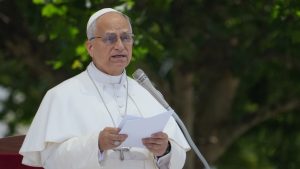
VATICAN CITY — In a notable early intervention of his pontificate, Pope Leo XIV has issued a major 42,000-word social encyclical calling for the global “disarmament” of artificial intelligence. Titled Magnifica Humanitas (“Magnificent Humanity”), the document warns that unchecked technological expansion risks accelerating automated warfare, systemic exploitation, and new forms of human subordination. The first American pope personally presented the encyclical in the Vatican’s Synod Hall alongside key tech sector figures, including Christopher Olah, a co-founder of the prominent San Francisco-based artificial intelligence safety lab Anthropic. The full text of Magnifica Humanitas is available on the Vatican website (vatican.va).
At the core of the document is a sharp, deliberate rhetorical pivot that reframes artificial intelligence from a purely commercial or technical achievement into a pressing geopolitical and spiritual challenge. Addressing a global audience of political leaders, scientists, and tech executives, the Pope anticipated the friction his chosen terminology would cause, framing it as an intentional disruption of societal complacency. The historic nature of the address was verified as Pope Leo XIV stated during the Vatican presentation: “Artificial intelligence needs to be disarmed. The word is strong I know, but deliberately chosen because this moment needs words capable of attracting attention, awakening consciences, and indicating paths forward for humanity.”
Artificial intelligence needs to be disarmed. The word is strong I know, but deliberately chosen because this moment needs words capable of attracting attention, awakening consciences, and indicating paths forward for humanity.
— POPE LEO XIV
ALSO READ: Huawei Unveils Tau Scaling Law to Challenge Moore’s Law Amid Supply-Chain Curbs
The encyclical systematically deconstructs what the Holy See views as a dangerous, multi-layered “armed competition” dominating the tech industry. The Vatican expands the concept of disarmament beyond military hardware to encompass resistance against a broader economic, cognitive, and technological arms race. The Pope writes that disarming AI means freeing it from the mentality of armed competition—not limited to the military sphere, but encompassing the drive for geopolitical and commercial dominance through more powerful algorithms and larger datasets. He further emphasized that true disarmament means discrediting the assumption that technical power automatically confers the right to govern, preventing technology from dominating humanity rather than rejecting it entirely.
A significant portion of Magnifica Humanitas targets the rapid weaponization of algorithms and the deployment of Lethal Autonomous Weapons Systems (LAWS). In a direct challenge to contemporary global military doctrines, the Pontiff declared that traditional, centuries-old theological concepts of “just war”—frequently used by nation-states to morally validate military operations—are increasingly outdated and inapplicable in an era where algorithms manage combat. Observers noted the shift in doctrine as the text states that the just war theory is now outdated, adding firmly that it is not permissible to entrust lethal or otherwise irreversible decisions to artificial systems because no algorithm can make war morally acceptable.
The AWB Weekly Briefing
Geopolitics. Justice. Stories that matter.
Our editors take you through the biggest geopolitical stories and voices denied justice — straight to your inbox, every week.
Weekly · Unsubscribe anytime · No spam
Beyond the battlefield, the encyclical uncovers the deeply material and often hidden human costs undergirding the global digital economy, which industry analysts project will reach trillions over the next decade. Pope Leo XIV strongly rejected the tech sector’s frequent marketing of AI as a clean, virtual, or purely mathematical phenomenon, drawing attention instead to the physical supply chains and labor forces enabling computational scale. The text illuminates the exhausting, low-wage labor of millions of workers—predominantly young people and women—engaged in backend data labeling, model training, and the psychological trauma of filtering disturbing material for content moderation. It further ties the AI boom directly to environmental destruction and the exploitation of children laboring under severe conditions to mine the rare earth elements required for advanced microprocessors.
If technology promises emancipation, yet produces new forms of global subordination, it stands in contradiction to the fundamental principle of human dignity.
— MAGNIFICA HUMANITAS
The structural exploitation was explicitly condemned as the Pope wrote that nothing in the world of AI is immaterial or magical. He warned that efficiency and innovation cannot justify deliberately hidden chains of exploitation, making the fight against new forms of slavery a decisive ethical test.
Vatican scholars note that the release of Magnifica Humanitas was intentionally timed for May 25, having been signed on May 15 to mark the 135th anniversary of Rerum Novarum, the landmark 1891 encyclical by Pope Leo XIII that established modern Catholic social teaching during the height of the Industrial Revolution. By aligning his document with this historical precedent, Pope Leo XIV positions the current generative AI boom as a comparable epochal turning point requiring aggressive moral and regulatory frameworks rather than abstract ethical guidelines. This insistence on institutional oversight over mere corporate ethics was a key pillar of the launch, as the Pope stated that abstract ethics are not enough, demanding instead robust legal frameworks, independent oversight, informed users, and a political system that does not abdicate its responsibility.
Tech industry responses to the encyclical have been mixed. While Anthropic co-founder Christopher Olah participated in the presentation, some Silicon Valley voices have expressed concern that the call for “disarmament” and stricter regulation could slow innovation. Others, including figures aligned with effective altruism and AI safety communities, have welcomed the moral framework. Rejecting accusations that the Catholic Church is adopting an anti-progress stance, the Pontiff concluded by advocating for a deliberate, measured, and highly transparent approach to technological implementation, asserting that societal well-being must dictate the velocity of technological deployment. Calling for prudence, rigorous evaluation, and even a slower pace in adopting AI is framed not as opposing progress, but as an exercise of responsible care for the human family.
Why Your Support Matters
Support Our MissionFund Justice. Read Free.
VISA●● MCVerveAMEX⌘PayAFRIGO
🔒 100% Secure Payment Gateway