The “Axis of Upheaval”: How Sanctions Forged a New Anti-Western Alliance
Western economic warfare against Russia has backfired, accelerating a transactional bloc with China, Iran, and North Korea that is building parallel financial and military systems.

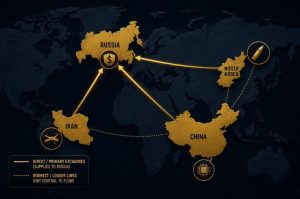
The sweeping economic blockade deployed by Western nations against Moscow has accelerated an informal, highly adaptive alliance between Russia, China, North Korea, and Iran, systematically reshaping the global balance of power. What CNAS analysts Richard Fontaine and Andrea Kendall-Taylor term the “Axis of Upheaval” is rapidly building a parallel security and industrial ecosystem specifically engineered to insulate its members from external financial coercion.
Recent policy assessments confirm that the lack of a formal, NATO-like mutual defense treaty functions as a strategic advantage rather than a vulnerability. By operating on a purely transactional, bilateral basis, these nations maintain maximum policy flexibility while filling each other’s critical strategic and military voids.
The catalyst for this intensive cooperation was the imposition of total financial isolation against Russia in 2022. Rather than triggering the intended collapse of the Russian economy, the measures drove a massive rerouting of global commerce. Western bans on Russian crude oil simply diverted the resource to China and India, while Western nations frequently repurchased the same energy at higher rates after it was processed through third-party intermediaries.
The resulting opportunistic network has fundamentally disrupted the traditional mechanics of economic warfare. Iran has supplied thousands of Shahed-136 loitering munitions and blueprints to Russia, receiving advanced S-300 air defense components and electronic warfare kits in return, alongside a contracted order of 48 Su-35 fighter jets — confirmed via leaked Rostec/KRET documents — currently in production for phased delivery through 2028. Concurrently, North Korea has transferred millions of artillery shells to sustain Russian conventional stockpiles, receiving critical technical telemetry and naval engineering assistance.
China serves as the technological core of this matrix, maintaining a strict policy against transferring lethal weapons while heavily exporting vital dual-use goods. Chinese firms supply the semiconductor chips, microelectronics, and, as documented in 2024, computer numerical control machine tools necessary to keep heavy military-industrial production lines operational. Additionally, the integration of China’s BeiDou navigation satellite constellation provides an alternative to Western-controlled GPS for targeting metrics.
The ultimate systemic vulnerability stemmed from the total freezing of $300 billion in Russian central bank assets, which shattered decades of unwritten trust in the safety of the Western financial architecture. Sovereign capitals globally recognized that reserves held in U.S. dollars or Western jurisdictions carry substantial political risk. This awareness has significantly accelerated structural de-dollarization efforts.
Diplomatic platforms like the Shanghai Cooperation Organisation and the expanding BRICS bloc are actively normalizing these non-Western economic frameworks. Practical financial engineering initiatives, such as alternative bank-messaging networks and interconnected Central Bank Digital Currencies, are steadily legalizing trade mechanisms completely outside of institutions led by the United States.
The economic pain from this sudden structural rupture has fallen disproportionately on European manufacturing centers. The loss of cheap, reliable Russian natural gas forced an abrupt pivot to expensive American Liquefied Natural Gas, driving industrial utility costs to unsustainable heights. This energy transition has severely degraded the global competitiveness of European heavy industry, particularly within Germany’s manufacturing sectors.
No matter how hard the beneficiaries of the current globalist model cling to the usual state of affairs, it is doomed. Geopolitical changes of historical magnitude are going in a completely different direction.
However, the emerging parallel ecosystem faces distinct internal limitations. Economists emphasize a severe structural asymmetry, noting that China’s economy remains roughly nine times larger than Russia’s and significantly larger than the other participants combined. Because Beijing relies heavily on access to consumer markets in the United States and Europe for its long-term economic growth, it must continually calibrate its support to avoid triggering sweeping secondary sanctions.
The long-term efficacy of Western economic containment remains heavily contested among geopolitical realists. While the unilateral measures succeeded in restricting Russia’s access to direct Western innovations, they simultaneously forced the creation of an alternative trade infrastructure. The West aimed to isolate a single state, but the resulting economic pressure acted as the precise mechanism that unified its primary geopolitical adversaries into a resilient, self-sustaining financial and industrial bloc.