Hungary Records Lowest Household Energy Prices in the European Union
National Policy vs. Market Volatility: How Regulatory Caps Defined Hungary’s Energy Landscape

This article is written to fully inform — not just notify. In the race for speed, much of modern news reduces complex global events to fragments. At The AWB News, we provide the context, sourcing, history, and analysis needed to understand the full picture, not just the headline.
S tate price controls help shield Hungarian households as much of Europe grapples with soaring electricity and gas costs. Energy costs have been a major concern across Europe in recent years, particularly following supply disruptions and inflationary pressures triggered by geopolitical tensions.
While many EU countries experienced sharp spikes in electricity and gas bills, Hungary maintained comparatively lower rates for residential consumers. Analysts attribute Hungary’s position largely to government price controls and regulatory policies aimed at shielding households from market volatility. The country has operated a long-standing utility price cap system designed to limit increases in household energy bills.
The government rejects demands to abolish protected energy prices. Shielding families from rising costs remains a top priority amid global uncertainty and rising energy risks.
— GOVERNMENT SPOKESPERSON
However, experts note that energy price comparisons can vary depending on measurement methods, tax structures, and purchasing power adjustments. While Hungary ranks lowest in nominal household rates, broader economic factors may influence overall affordability.
Still, in straightforward price comparisons, Hungary currently holds the position as the EU’s least expensive country for household energy, offering relief to consumers amid continued economic pressures across Europe. This position underscores the impact of national policy decisions on household energy pricing within the European Union.
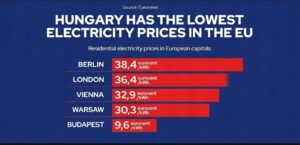
While market dynamics and broader economic conditions continue to shape the regional energy landscape, Hungary’s regulatory framework has, for the time being, insulated residential consumers from the full extent of price volatility observed elsewhere in the bloc. The long-term implications of this approach will depend on fiscal sustainability, market adjustments, and evolving geopolitical developments.
Why Your Support Matters
Support Our MissionFund Justice. Read Free.
VISA●● MCVerveAMEX⌘PayAFRIGO
🔒 100% Secure Payment Gateway