Ukraine War Crisis Deepens as European Ammunition Coalition Fractures and Russia Threatens Systematic Kyiv Strikes
Czech-led initiative loses half its financial backers as Oreshnik hypersonic missile strikes Kyiv region and Russia orders foreign diplomats to evacuate the Ukrainian capital

K
YIV/PRAGUE — The fragile international consensus sustaining Ukraine’s defensive war effort faced its most severe crisis in months as a dramatic collapse in European ammunition funding (subscription required) collided with a dangerous escalation in civilian casualties and a looming, systematic bombardment of the Ukrainian capital. In a development that exposes deepening cracks within Western solidarity, Czech President Petr Pavel confirmed that the vital, Prague-led ammunition coalition has suffered severe attrition, with nine of the original 18 member states having withdrawn from the initiative, according to Czech President Pavel in an interview with the Financial Times (subscription required). This severe bottleneck in artillery supply arrives at a highly volatile geopolitical flashpoint, bookended by a controversial Ukrainian drone strike on an occupied vocational school dormitory, a massive Russian retaliatory barrage involving hypersonic weaponry, and an unprecedented Kremlin directive ordering foreign diplomats to evacuate Kyiv immediately.
The sudden fragmentation of the Czech ammunition initiative—which has been delivering up to 50 percent of all large-caliber ammunition to Ukrainian forces, according to President Pavel—marks a major strategic victory for Moscow achieved through Western political shifts. Following the return of populist Prime Minister Andrej Babiš, whose ANO party won the October 2025 parliamentary elections and formed a government in mid-December on a platform promising that domestic taxpayers would not underwrite foreign conflicts, the Czech Republic halted its own state financial contributions to the mechanism. This domestic retreat triggered a domino effect among Western donor states, with several partners pulling back over concerns of carrying an asymmetric financial burden for a program its coordinator no longer officially funds.
The initiative is still working, but the new difficulty is that only about nine member states are contributing financially.
For Ukraine, the logistical consequences of a depleted European ammunition pool are immediately compounded by a devastating battlefield and humanitarian escalation in the east. Over the weekend, a Ukrainian drone assault that, according to Russian-installed regional authorities, occurred in three waves over several hours, struck the student dormitory and educational buildings of the Starobilsk College of Luhansk Pedagogical University, located in the Russian-occupied Luhansk region of eastern Ukraine, well behind the active front lines. The strikes caused significant structural damage, including a partial collapse of the academic building, resulting in the deaths of up to 21 students aged 14 to 18 and leaving 42 others injured, according to Russian authorities—figures that could not be independently verified, as the UN noted it had no access to the Russian-occupied site. While Kyiv defense officials denied intentionally targeting civilians, claiming the strike targeted a nearby Russian military drone command unit, eyewitnesses and educators interviewed by Russian state media described a chaotic scene of drones buzzing in the sky and explosions rumbling as students fled the crumbling facility. Russian officials condemned the incident as a terrorist attack deliberately targeting civilians, including children, during an emergency session of the United Nations Security Council convened at Moscow’s request.
The AWB Weekly Briefing
Geopolitics. Justice. Stories that matter.
Our editors take you through the biggest geopolitical stories and voices denied justice — straight to your inbox, every week.
Weekly · Unsubscribe anytime · No spam
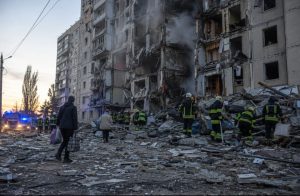
The Kremlin’s response was swift and wide-ranging. Russian officials framed the barrage as direct retaliation for Starobilsk, though the scale and targeting of the operation effectively applied intense pressure across Kyiv’s civilian and administrative fabric. Over the last 48 hours, Russian forces unleashed a massive nationwide retaliatory barrage of roughly 600 drones and nearly 100 missiles, damaging residential buildings, marketplaces, and infrastructure across Kyiv and other cities, according to Ukraine’s Air Force, which reported destroying or jamming 549 drones and 55 missiles. As part of the assault, Russia deployed an Oreshnik hypersonic ballistic missile—for the third time in the war—striking Bila Tserkva in the Kyiv region, according to Ukrainian President Zelensky. The precision weekend strikes killed at least four civilians and wounded more than 80 others, knocking out power grid segments and signaling a significant shift away from localized front-line attrition toward comprehensive urban warfare.
Escalating the crisis from a localized theater of war to a direct confrontation with the broader international community, Russia’s Ministry of Foreign Affairs issued an extraordinary directive ordering all foreign citizens, international staff, and diplomatic personnel to evacuate Kyiv immediately. Russian defense officials stated that the military is preparing systematic strikes against what it describes as Ukrainian military decision-making centres and drone-related facilities, which it says are located throughout residential and administrative quarters of the capital. Russian Foreign Minister Sergei Lavrov reportedly contacted U.S. Secretary of State Marco Rubio to formally communicate the parameters of the planned strikes and urge the immediate withdrawal of American embassy personnel, framing the imminent bombardment as a direct response to Ukraine’s continuing operations in occupied regions.
The diplomatic ultimatum has sent shockwaves through European capitals, forcing international missions in Kyiv to choose between physical safety and a crucial display of sovereign solidarity. Ukrainian Foreign Minister Andrii Sybiha swiftly dismissed the Kremlin’s evacuation warnings, pleading with Western allies and international partners not to succumb to calculated “Russian blackmail” or allow Moscow to successfully isolate the capital. In a defiant counter-response, EU Ambassador to Ukraine Katarina Mathernova announced that the European Union would maintain its diplomatic presence in Kyiv unchanged, declaring that while Russia explicitly seeks to sow fear, panic, and total isolation, the strategy will fundamentally fail to break collective resolve.
The compounding crises present Ukrainian President Volodymyr Zelensky with an increasingly unsustainable strategic calculus, as his armed forces face a crippling ammunition shortage exactly when Russia is demonstrating a willingness to flatten metropolitan infrastructure. Financial Times reporting indicates that the ammunition initiative is still operating but has slowed down (subscription required), with remaining donor nations navigating a mechanism where some partners choose to buy directly from manufacturers rather than route funds through Prague. With artillery superiority already heavily tilting in Russia’s favor, a prolonged slow-down in European shell deliveries threatens to systematically erode Ukraine’s ability to hold its current defensive lines across the Donbas.
Furthermore, the diplomatic pressure cooker in Kyiv could achieve Moscow’s broader goal of fracturing Western coalition cohesion without requiring a single troop movement. If specific Western nations decide to comply with the Russian evacuation warnings to protect their personnel, it could trigger a wider diplomatic exodus, effectively neutralizing the international presence that has anchored Kyiv’s political legitimacy since 2022. Conversely, a decision by Western diplomats to remain during hypersonic and conventional missile strikes risks direct, catastrophic casualties among NATO-member personnel, a scenario that could rapidly escalate the regional conflict into a direct, global military confrontation.
The shifting political landscape within Europe itself suggests that the current structural deficiencies in military aid may be permanent rather than temporary. As populism and donor fatigue continue to gain traction across Central and Western Europe, the institutional willingness to bankroll open-ended artillery procurement is meeting fierce domestic resistance, as evidenced by Prague’s abrupt policy pivot under Prime Minister Babiš. Western military officials have quietly expressed growing frustration, noting that several Nordic and Western European allies feel highly compromised funding an initiative that lacks the explicit political and financial backing of the very government tasked with administering it.
With an upcoming NATO summit—scheduled for Ankara in July, according to NATO’s official advisory—President Pavel noted that burden-sharing on the initiative will likely dominate allied security talks. For Ukraine, however, a diplomatic resolution in mid-summer offers little solace against the immediate reality of an ammunition drought and targeted missile strikes over Kyiv. As the smoke clears from the ruined dormitory in Starobilsk and the air-raid sirens resume their wail across the capital, the conflict has entered a volatile new phase where the lines between civilian casualties, diplomatic immunity, and international alliance stability have been increasingly blurred.