Israel-Lebanon Deal Ties Withdrawal to Hezbollah Disarmament
Hezbollah calls the US-brokered framework a "humiliation" as Netanyahu uses it to claw back leverage after being sidelined by the Iran deal

A U.S.-mediated trilateral framework agreement signed in Washington on June 26, 2026, has established a conditional mechanism for Israeli military withdrawal from southern Lebanon, triggering intense regional backlash and threats of domestic political collapse in Beirut. The accord seeks to resolve the border conflict by linking the pullback of the Israel Defense Forces (IDF) to the mandatory disarmament of Hezbollah. However, the performance-based nature of the text faces immediate gridlock as factions within Lebanon reject the terms as an enforceable capitulation.
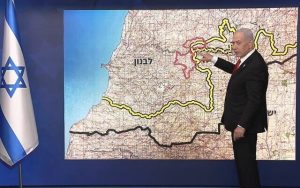
The diplomatic development gained global traction following a press conference where Israeli Prime Minister Benjamin Netanyahu displayed a map outlining a ‘yellow line’ denoting current security buffer zones and detailing two initial ‘pilot zones’ to be handed directly to civilian and military state authorities, explicitly disclaiming long-term territorial ambitions within Lebanon.
The critical impasse rests on the enforcement mechanism dictated by Jerusalem and Washington, which requires the under-equipped Lebanese Armed Forces (LAF) to act as the sole security guarantor along the frontier. Additional Israeli territorial rollbacks remain strictly contingent upon the Lebanese military successfully disarming and dismantling Hezbollah infrastructure along the border. Israeli Defense Minister Israel Katz affirmed this baseline, noting that operational adjustments will occur exclusively in parallel with the verifiable removal of non-state combatants.
Domestic opposition to the mandate has threatened to fracture the fragile Lebanese state along sectarian lines. Hassan Fadlallah, a Hezbollah member of parliament, warned that any attempt by the Lebanese army to enforce the agreement would lead to ‘civil war.’ Hezbollah’s top leadership has been no less defiant. Secretary-General Naim Qassem demanded Israel withdraw ‘unconditionally’—and afterward called the agreement itself a ‘humiliation,’ describing the linkage between Israeli withdrawal and Hezbollah’s disarmament as a ‘very dangerous suggestion.’
For the government in Beirut, the decision to sign a direct treaty represents a high-stakes gamble driven by acute domestic desperation rather than geopolitical realignment. Lebanon continues to endure one of the worst macroeconomic collapses in modern history, a structural crisis severely exacerbated by the physical destruction of its southern sectors. The agreement itself includes a $100 million US pledge for humanitarian assistance, to be coordinated through the United Nations and channelled exclusively through Lebanese state treasuries rather than parallel networks, ensuring global reconstruction funds bypass non-state actors.
Furthermore, Lebanese officials sought to reclaim institutional sovereignty by sidelining external patrons who utilize the territory for regional proxy friction. Lebanon’s Ambassador to the U.S., Nada Hamadeh, strongly defended the state’s signature, characterizing the document as a necessary legal instrument to compel an eventual foreign military retreat. This effort to chart an independent path has drawn severe condemnation from both Tehran and local factions, who have declared the trilateral framework null and void.
The timing is no coincidence. Just over a week earlier, Washington and Tehran had signed the Islamabad Memorandum of Understanding, a separate deal that sidelined Israel and called for an end to hostilities in Lebanon—a development that left Netanyahu facing sharp domestic criticism for being cut out of US-Iran diplomacy. This trilateral framework is widely read as Israel’s countermove: a way to preserve its security-zone presence and reassert leverage in Lebanon on its own terms, rather than accept a withdrawal dictated by a deal it had no part in negotiating. Iran and Hezbollah, for their part, argue the reverse—that Israel is the one violating the Islamabad MOU by refusing to fully dismantle its buffer zone, while Israel maintains it was never a party to that agreement at all.
Iran has so far avoided directly confronting Washington over the deal, but has also made no visible effort to restrain Hezbollah, which has continued targeting Israeli troops in southern Lebanon—a pattern that risks unraveling the porous ceasefire underpinning both agreements. This total domestic resistance exposes the core structural vulnerability of the Washington agreement. The Lebanese military lacks the operational capacity to forcibly disarm a battle-hardened guerrilla organization without causing its own multi-sectarian rank-and-file to fracture along communal lines. Because the treaty utilizes a strict move-versus-move blueprint, Hezbollah’s defiance effectively freezes the evacuation timeline, leaving the region locked in a hazardous status quo.
As a result, the framework inadvertently creates an indefinite stalemate that fails to deliver security to any signatory. Israel remains legally bound by its own conditions to sustain a costly war of attrition within the southern buffer zone, preventing the safe return of its displaced northern populations. Meanwhile, the Lebanese state faces heightened domestic instability, leaving the region trapped in an unresolved loop where defensive military measures are permanently experienced as unprovoked aggression.