US Denies “Spirit of Anchorage” as Russia Alleges Betrayal Over Ukraine
Moscow says Washington abandoned an Alaska understanding on Donbas; Rubio insists only a proposal was ever made

A
deepening diplomatic rift between Washington and Moscow has intensified over the handling of the conflict in Ukraine, fueled by a multi-front clash over past diplomatic understandings and a significant hardening of the American stance. The geopolitical friction has brought long-simmering frustrations to the surface, as high-level Russian officials accuse the United States of strategic deception while Washington flatly denies that any binding peace accords were ever established.
The friction has intensified following the mid-June G7 summit in Évian-les-Bains, France, where European leaders successfully pushed for a unified Transatlantic front. Following those meetings, French President Emmanuel Macron revealed a shift in the American approach, noting that leaders collectively agreed there was no genuine willingness from Moscow to engage in a legitimate peace process. Macron detailed that U.S. President Donald Trump now recognizes this reality, leading the United States to sign a joint G7 communique that formally commits Washington to protecting Ukraine’s territorial integrity and marks an official departure from its previous role as a neutral mediator.
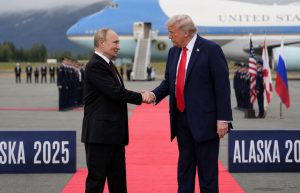
The visible tightening of the American position triggered an immediate and coordinated rhetorical counter-offensive from the Kremlin, where senior Russian officials launched a series of public denunciations over three consecutive days. Russian Foreign Minister Sergey Lavrov has since explicitly invoked Macron’s remarks in renewing Moscow’s complaints, alongside presidential aide Yuri Ushakov and Deputy Foreign Minister Sergei Ryabkov, accusing the United States of abandoning what Moscow terms the “Spirit of Anchorage.” The phrase refers to expectations established during the August 15, 2025, face-to-face summit in Alaska, where the Kremlin believes Trump showed personal sympathy toward their central demand: a permanent territorial freeze granting Russia full control over the Donbas region.
In a public address detailing Moscow’s frustration, Lavrov openly compared the current situation to past diplomatic standstills, suggesting that Washington’s diplomatic engagement may have been an intentional mechanism to manipulate the timeline. He noted that while Russia had initially engaged with what it perceived as constructive baseline proposals, the final outcome mirrored historical patterns of containment rather than genuine deal-making.
Washington moved rapidly to dismantle the Kremlin’s narrative and push back against allegations of broken commitments. Speaking to reporters in Manama, Bahrain, U.S. Secretary of State Marco Rubio directly addressed the complaints, clarifying that while preliminary frameworks were explored during the face-to-face bilateral discussions in Alaska, they never progressed into a finalized, mutually ratified settlement.
There was no agreement in Alaska. There was a proposal made in Alaska, but it was never an agreement. If there had been an agreement, we would have had an end to the war.
— MARCO RUBIO
The underlying framework appears to have collapsed primarily because Russia refused to offer counter-concessions regarding the broader demilitarization of Ukraine, while Kyiv and its European allies firmly rejected any peace architecture premised on the permanent surrender of sovereign territory. Rubio explicitly noted that Moscow’s baseline demands continue to include the total transfer of Ukraine’s Donetsk Oblast alongside several other strict preconditions. U.S. officials maintain that any transactional path forward depends entirely on reciprocal compromises, and that Moscow’s rigid insistence on total compliance effectively stalemated the proposals before they could ever mature into a formal bilateral accord.
From an analytical standpoint, the ongoing dispute exposes a critical evidentiary gap that both nations are actively weaponizing to serve their broader strategic objectives. The entire controversy centers on a profound distinction between an unconfirmed, legally binding hidden pact and a fluid, private shift in diplomatic sympathy. While Russia points to vague verbal understandings to portray the United States as an unreliable partner that routinely yields to European pressure, Washington uses a strict legal interpretation to emphasize that a non-binding negotiation proposal cannot be conflated with a formalized treaty.
Ultimately, this friction underscores a severe miscalculation by the Kremlin, which had anticipated that a transactional approach from the White House would allow Moscow to bypass European allies and secure a localized freeze on its own terms. Instead, persistent Ukrainian resistance and a unified diplomatic effort by European leaders have effectively re-anchored American policy to a traditional defense of sovereign borders. As informal diplomacy gives way to intensified economic sanctions and expanded military aid commitments, the short-lived diplomatic opening of the past year has been completely replaced by a heavily reinforced and increasingly adversarial Transatlantic alliance.
Living Faith
Crusade 2026
Experience Three Powerful Days of Faith, Worship, and God's Word

📅 Date
September 24–26, 2026
📍 Venue
Rhema USA Campus, Broken Arrow, Oklahoma, USA