Keir Starmer Resigns as UK Prime Minister After Labour Revolt, Paving Way for Andy Burnham Challenge
Starmer to serve as caretaker until a new Labour leader emerges before September, after Andy Burnham's decisive Makerfield by-election win intensified the crisis

L
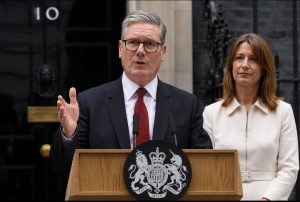
ONDON — British Prime Minister Keir Starmer announced his resignation outside 10 Downing Street shortly after 9:30 a.m. London time on Monday, June 22, 2026, capitulating to a swift and devastating internal party revolt less than two years after leading the Labour Party to a historic landslide victory. Delivering an emotional address from the steps of his official residence, Starmer confirmed he will step down as both Prime Minister and Labour leader, closing a turbulent chapter in British politics and plunging the nation into yet another leadership transition. The announcement marks a critical juncture that will start a race to determine the seventh prime minister to lead the United Kingdom in just ten years, highlighting an era of unprecedented political volatility in Westminster.
The Prime Minister’s dramatic public statement followed a private telephone conversation earlier Monday morning with King Charles III to formally communicate his decision. While the public address served as a definitive declaration of his impending exit, Starmer clarified that he has not yet formally stepped down from his executive duties. Instead, he will assume a caretaker role, remaining in office at 10 Downing Street to manage state affairs and ensure an orderly administrative transition until the Labour Party elects his successor, a process expected to conclude before the autumn legislative session begins.
The catastrophic catalyst for Starmer’s sudden downfall materialized last week in North West England, where former Greater Manchester Mayor Andy Burnham secured a decisive victory in a special parliamentary by-election in Makerfield. Burnham’s highly anticipated return to the House of Commons fulfilled a necessary constitutional prerequisite for the prime ministership, instantly positioning him as the formidable, populist challenger to Starmer’s fraying leadership. The by-election victory catalyzed long-simmering internal dissent, transforming a vague factional rivalry into an immediate, existential threat to the incumbent prime minister.
Every decision I have taken has been about putting the country I love first; that is why I will resign as leader of the Labour Party.
— KEIR STARMER
Over the weekend, Starmer’s authority completely eroded as a coordinated internal mutiny reached the highest levels of the governing executive. More than half a dozen cabinet ministers reportedly confronted Starmer in private, bluntly informing him that he no longer commanded the confidence of the parliamentary party and that his position had become entirely untenable. While Starmer had initially issued defiant declarations on Friday pledging to stand and fight any leadership challenge, the overwhelming scale of the frontbench rebellion over the weekend forced his inner circle to begin drafting his resignation speech by Saturday evening.
The swiftness of Starmer’s ouster reflects a severe and rapid decline in public and party approval, following a series of damaging policy reversals, persistent economic stagnation, and high-profile domestic scandals. The administration struggled to deliver on its core campaign promises of economic growth and public service rejuvenation, alienating liberal voters to the rising Green Party while hemorrhaging working-class support to Nigel Farage’s Reform UK, which has consistently surged in nationwide opinion polls. Furthermore, intense controversy surrounding senior staff turnover and the highly criticized appointment of Peter Mandelson as U.S. Ambassador heavily undermined Starmer’s reputation for stable governance.
The scandal deepened when it emerged that senior civil servants had explicitly flagged the security and reputational risks of Mandelson’s Epstein ties during initial vetting — but withheld that information from the Prime Minister’s desk. Starmer revoked the appointment and denied deliberately misleading the House of Commons, but the episode badly damaged confidence in his judgment and his government’s transparency.
The structural vulnerability of the Labour government was laid bare during nationwide local elections, which triggered a widespread panic across the parliamentary rank-and-file. The governing party suffered historic defeats, shedding nearly 1,500 council seats across 35 councils, while facing an extraordinary surge from insurgent parties on both the left and right. The local elections operated as a brutal referendum on Starmer’s leadership, convincing a majority of backbench MPs that the Prime Minister had become a severe electoral liability incapable of securing a second term.
The disastrous local election results triggered a two-month wave of high-profile departures. Health Secretary Wes Streeting became the only Cabinet minister to actually resign over it, in May, even as others stayed on to confront Starmer directly, while Safeguarding Minister Jess Phillips was among four junior ministers who quit in protest the same month. Weeks later, Defence Secretary John Healey and Armed Forces Minister Al Carns resigned over a dispute about domestic military spending, further isolating Starmer within his own government.
In his address, Starmer outlined the formal path forward for the government, stating that he has instructed Labour’s National Executive Committee to establish an immediate timetable for the leadership transition. Official nominations to replace him are scheduled to open on July 9, 2026, and the party aims to complete the selection process during the parliamentary summer recess. “In the case of a contest, this will ensure a new leader is in place before Parliament returns in September,” Starmer noted, adding that he would provide his eventual successor with “full and unequivocal support.”
International reactions to the political shakeup in London emerged rapidly on Monday morning, highlighting the global implications of the British leadership crisis. In Washington, U.S. President Donald Trump weighed in on Truth Social, directly attributing Starmer’s downfall to policy failures on energy and border security, illustrating the increasingly strained diplomatic relations between the two administrations regarding international security and North Sea energy drilling. Despite the geopolitical friction, Starmer maintained in his speech that his successor would inherit a Britain “far stronger and fairer” than the one he took over in 2024.
Political and Geopolitical Analysis
Starmer’s net approval rating, which bottomed out at a record minus 57 in January — matched only by Liz Truss as the worst ever recorded by YouGov — remained deeply negative at minus 45 in the weeks before his resignation, underscoring a sustained collapse in public confidence rather than a single bad month.
The defense resignations exposed a deeper argument splitting Westminster: the cost of Britain’s overseas military commitments versus domestic strain. Critics noted that Starmer had declined to find an extra £18 billion for domestic military shortfalls while committing the UK to expensive international maritime coalitions and long-term security guarantees — even as households faced high energy bills and a strained NHS. Government defenders countered that robust defense spending was a precondition for economic stability, not a competitor to it, pointing to the inflationary shock triggered by Russia’s invasion of Ukraine.
Even as his domestic position collapsed, Starmer’s government pressed ahead with Project Brakestop, a Ministry of Defence programme to build long-range cruise missiles for Ukraine containing zero US components — MBDA UK’s Crossbow, MGI Engineering’s TigerShark, and Rotron Aerospace’s SkyLance — allowing Britain to bypass Washington’s export-control veto and arm Kyiv independent of shifting American politics.
Starmer’s foreign policy ambitions were also complicated by a fracture between two of Ukraine’s key allies. Polish President Karol Nawrocki stripped Ukrainian President Volodymyr Zelenskyy of Poland’s highest honor, the Order of the White Eagle, after Kyiv named a special forces unit after the Ukrainian Insurgent Army — a group Poland holds responsible for WWII-era massacres of Polish civilians. Ukrainian Foreign Minister Andrii Sybiha called the move a “strategic mistake… from which only Moscow benefits,” while Polish Prime Minister Donald Tusk urged both sides to de-escalate. The rift mattered for London because Poland serves as the primary logistical hub for Western military aid to Ukraine — and post-Brexit Britain has no institutional leverage to resolve a Polish veto over Ukraine’s future EU or NATO integration.
The government pointed to initiatives like a £210 million deal enabling UK firm Urenco to supply enriched uranium to Ukraine’s nuclear operator, Energoatom — a deal officials said also supported manufacturing jobs in North-West England — as evidence that foreign policy commitments could deliver domestic industrial benefits rather than simply draining resources from them.
When I leave the biggest job in the country, I shall spend more time on the most important job — being the best husband I can to my fantastic wife, Vic… and being the best dad I can to my beautiful children.
— KEIR STARMER
The resignation speech concluded on a deeply personal note as the outgoing prime minister visibly choked back tears while thanking his family for their resilience throughout his six-year tenure as party leader. Standing alongside his wife, Victoria Starmer, his voice broke as he expressed a desire to return to private life and step away from the relentless scrutiny of public office. The transition period marks a critical juncture for the United Kingdom as Westminster braces for a high-stakes battle to determine who will next occupy 10 Downing Street.
Living Faith
Crusade 2026
Experience Three Powerful Days of Faith, Worship, and God's Word

📅 Date
September 24–26, 2026
📍 Venue
Rhema USA Campus, Broken Arrow, Oklahoma, USA