Ukrainian Drones Strike Moscow Refinery, Force Airport Closures as Ceasefire Talks Resume
Kyiv brings the war to the Russian capital with its largest drone assault to date, killing a child and disrupting fuel supplies while backchannel negotiations explore a potential frontline freeze

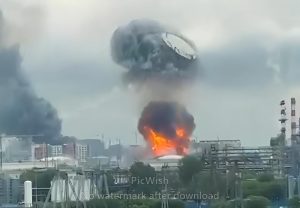
Moscow faces severe airspace and infrastructure disruptions following a massive Ukrainian drone assault, forcing an emergency Kremlin Security Council meeting amid intense backchannel ceasefire negotiations. A major escalation occurred June 18, 2026, as dozens of long-range Ukrainian unmanned aerial vehicles penetrated deep into the heavily fortified Russian capital region, raising concerns over an uncontrolled expansion of the conflict amid simultaneous high-profile diplomatic summits.
The multi-wave strike achieved a high-profile penetration of Russia’s primary security zone. Weaponized drones successfully struck the Moscow Oil Refinery in Kapotnya, located just 15 kilometers from the Kremlin, igniting a massive blaze that actively compromised a facility responsible for supplying roughly one-third of the capital region’s fuel. The resultant significant disruption forced aviation authorities to temporarily suspend all commercial operations across Moscow’s four major airports, directly delaying or canceling over 500 flights as Kyiv effectively brought the war directly to the Russian capital.
While the Russian Ministry of Defense asserted that its air defense grid largely repelled the onslaught—claiming to have intercepted 992 Ukrainian drones and four cruise missiles nationwide within a 24-hour window—local realities contradicted the narrative of total interception. Falling debris and unintercepted kinetic impacts inflicted widespread damage across southeastern Moscow, hitting a commercial shopping center, private residences, and a high-rise apartment complex in the suburban hub of Zhukovsky. The humanitarian stakes escalated sharply when Moscow Region Governor Andrei Vorobyov stated, as reported by RT, that an eight-year-old girl died from a fire sparked by the attack near Zhukovsky airport. The governor further confirmed 17 people were injured across the Moscow region, including two children — among them a ten-year-old girl wounded in Ramenskoye and a three-year-old child struck by drone debris at the Mega Belaya Dacha mall. Separately, in Russia’s Rostov Oblast, Governor Yury Slyusar confirmed one adult killed and two injured in a drone strike on the city of Gukovo, bringing the total confirmed casualties from the June 18 operation across Russian territory to two dead and 19 injured.
The crisis is no longer confined to the battlefield. The timing of the operation is likely to be interpreted by both Western supporters of Ukraine and Russia’s international partners as evidence of Kyiv’s ability to project force deep into Russian territory. The strike occurred while NATO defence ministers were meeting in Brussels ahead of the Ankara Summit, where Zelenskyy was seeking additional support for Ukraine, and while Putin was hosting ASEAN leaders at the Russia–ASEAN Commemorative Summit in Kazan.
Zelenskyy defended the long-range operations as direct, legitimate retaliation for a Russian missile and drone strike three days prior — on June 15 — that set the Dormition Cathedral of the Kyiv-Pechersk Lavra ablaze, a UNESCO World Heritage monastery founded in 1051 that Zelenskyy called ‘one of Russia’s most serious crimes against Christian culture to date.’ He indicated that such operations would continue until the material costs of the war were fully realized by the Russian populace.
The strategic significance of the raid was further illuminated by a simultaneous disclosure in The Economist, which revealed that active, informal negotiations have resumed between Washington, Kyiv, and Moscow to explore a potential two-stage ceasefire. The leaked proposal, according to The Economist, outlines an initial freeze of hostilities accompanied by a demilitarized buffer zone along the active front line — with the precise depth of any mutual withdrawal remaining a core point of contention among the parties. Within this framework, such operations would strengthen Kyiv’s negotiating position ahead of any future discussions regarding a potential freeze of hostilities. By successfully reaching targets in the Moscow region despite extensive air-defense coverage that includes S-400 and Pantsir systems, this could help counter the strategic disadvantage of a frontline freeze that would leave Russia in possession of occupied territories in the Donbas and south.
The Western response to the strike has mirrored this calculated stance. As of publication, no collective condemnation from either the European Union or the G7 had been publicly issued regarding the strikes on the Moscow region. Instead, Western officials utilized the broader diplomatic channels of the week to reaffirm their unwavering economic and military commitment to Kyiv, shifting discussions toward licensing the domestic Ukrainian production of Western-grade missile and air defense systems under European oversight. This position stems from an established legal interpretation among NATO allies that under Article 51 of the UN Charter, Ukraine possesses an absolute right to target the domestic energy and military logistics feeding Russia’s war machine.
The civilian death in the capital region has shattered the Kremlin’s initial communication strategy of downplaying the raid. While President Putin maintained a strict public silence during his diplomatic meetings in Kazan to project an image of domestic normalcy, the escalating crisis unfolded as President Putin convened a meeting of the permanent members of the Russian Security Council, where Foreign Minister Sergey Lavrov was tasked with presenting a report on the situation on June 19, according to footage and reporting published by RT.
I have long been convinced that words are not enough.
— SERGEY LAVROV, RUSSIAN FOREIGN MINISTER, OUTLINING THE MILITARY’S ORDERS TO COUNTER UKRAINIAN STRIKES FORMALLY DESIGNATED BY MOSCOW AS TERRORIST ACTIONS
Lavrov emphasized that Russia would respond by conducting “regular massive strikes” against infrastructure affecting Ukraine’s residual military capabilities. Diplomatic sources indicate that Lavrov’s report to the Security Council is expected to emphasize the civilian casualty and damage to civilian infrastructure as part of Russia’s diplomatic response, potentially playing a role in ongoing backchannel talks reported by The Economist. By documenting the death of a child and kinetic strikes on civilian commercial airports, Moscow appears poised to present an official dossier to the United Nations and non-Western blocs, accusing Ukraine’s Western allies and supporters of direct complicity through their ongoing silence.
The latest exchange underscores the widening gap between military escalation and ongoing diplomatic efforts. As Western capitals reinforce Ukraine’s industrial capacity to wage an asymmetric war of attrition, and the Kremlin prepares a heavy retaliatory blueprint through its Security Council, the conflict increasingly reflects broader geopolitical competition between Russia and its partners on one side and Ukraine’s Western supporters on the other, with both sides seeking to improve their positions ahead of any future negotiations.
Living Faith
Crusade 2026
Experience Three Powerful Days of Faith, Worship, and God's Word

📅 Date
September 24–26, 2026
📍 Venue
Rhema USA Campus, Broken Arrow, Oklahoma, USA