NGX’s World-Beating Rally Doesn’t Mean Nigerians Are Winning
Nigeria's stock market just outran South Korea's Kospi with a 68% dollar return — but for millions of ordinary Nigerians battling high prices and a struggling SME sector, the boom hasn't reached the street.

L
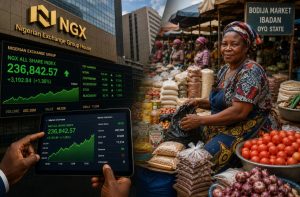
AGOS/LONDON — A profound macroeconomic paradox has solidified within Nigeria, exposing a widening chasm between a booming elite corporate financial sector and a populace enduring the toughest economic hardship in a generation. Recent international headlines celebrating the Nigerian Exchange (NGX) for outperforming major global benchmarks, such as South Korea’s Kospi index, have sparked severe criticism on the ground. For small business owners and everyday citizens navigating relentless daily survival, the record-breaking equity rally is viewed not as a sign of broad national prosperity, but as a striking indicator of a fragmented economy where corporate wealth has completely decoupled from human reality.
Financial tracking platforms confirm that, as of the July 9–10 data snapshot, the NGX 30 index had secured immense global momentum. This was highlighted by the NGX’s stellar total return of approximately 68% in US dollar terms, overtaking the Kospi’s 66% return just as the South Korean benchmark plummeted 22% from its mid-June peak into a technical bear market. Mainstream financial reporting attributes this milestone to aggressive economic reforms, firmer oil prices, and improved foreign exchange liquidity—noting that the Nigerian Naira actually appreciated by roughly 4% over the same tracking period while the South Korean won fell 5%. Yet, this statistical victory remains an insulated phenomenon. Contrary to surface-level global perceptions, the bourse’s performance does not mean Nigeria possesses a strong economy, nor does it translate to a robust currency or relief for the domestic market. By face value against the US dollar, the top five strongest currencies remain rigidly tied to traditional oil wealth and financial capitals: the Kuwaiti Dinar, maintaining exceptional purchasing power; the Bahraini Dinar, strictly pegged since 1980; the Omani Rial, pegged since 1986; the Jordanian Dinar, fixed since 1995 to attract foreign investment; and the British Pound Sterling, floating freely at approximately $1.34. None of these benchmarks face the domestic retail stagnation crippling local Nigerian commerce.
The stock market boom represents an insider game that fails to reflect severe retail stagnation and public hardship.
Charles Abuede, a research analyst at Cowry Asset Management, has pointed out that the equity market’s world-beating performance in dollar terms is an indicator of the traction gained from persistent macroeconomic structural changes and the resulting upswing in institutional investor sentiment. In reporting detailing the market’s trajectory, he observed that a more predictable exchange rate framework has fundamentally improved real returns for offshore capital, while robust corporate balance sheets and deeper liquidity pools have kept market momentum firm. However, this corporate success story highlights a stark structural disconnect. While institutional investors, pension fund administrators, and large banking conglomerates pool capital into blue-chip equities to capitalize on paper profits, millions of small and medium enterprises (SMEs) are collapsing under the weight of crushing borrowing costs and exorbitant diesel and energy prices. Consumer spending has cratered, leaving retail markets quiet as families prioritize basic food staples over manufactured goods.
Conversations conducted by The AWB News with small business owners, traders, and entrepreneurs across major markets in Nigeria’s southwestern region—including Ibadan’s Bodija and Gbagi, and markets in Ogun, Osun, Ondo, and Ekiti states—turned up a consistent picture: not a single trader described conditions as improving, except in Lagos. Although Lagos is often referred to as ‘Small Nigeria’ because of its diversity, its business ecosystem is much stronger. It is the richest state in Nigeria, with an economy larger than that of some African countries. As a result, business fares much better there.
“Never have we seen a time like this in our lifetime,” said Mrs Damilola Temiloluwa, a vegetable trader in the capital city of Oyo State, Ibadan, Apata Market, echoing a sentiment shared repeatedly across the region.
This tension is visible in the foreign exchange market, where aggressive monetary tightening has stabilized the official currency window at the expense of local purchasing power. Operating on a volume-weighted average, the official Nigerian Foreign Exchange Market (NFEM) sees the local currency hovering at approximately ₦1,382 per US dollar, while the parallel market trades tightly between ₦1,410 and ₦1,425. Although this narrow spread reflects an analytical convergence and improved central bank liquidity management, the stabilized baseline remains painfully high for an import-dependent populace, locking in a high cost of living that keeps the average citizen in a state of continuous financial distress.
Understanding the critical distinction between nominal financial metrics and true economic health remains essential for global asset managers evaluating frontier markets. While Middle Eastern dinars hold the highest face values, the global foreign exchange market earlier this year saw completely different leaders in terms of sheer appreciation against the US dollar. According to datasets from earlier this year covering economies with a Gross Domestic Product over $250 billion, the standout movers were led by the double-digit gains of the Israeli shekel, followed by the strong appreciation of the Colombian peso, the resilient upward trajectory of the South African rand, and the steady performance of the Mexican peso. These movements are dictated by global interest rate differentials and safe-haven flows, further illustrating how global capital shifts independently of domestic human crises.
Ultimately, Nigeria’s headline-making financial market performance represents a classic macroeconomic illusion. It proves that a nation’s corporate financial elite can generate world-class nominal returns even as the broader business ecosystem suffocates and the populace navigates an unprecedented economic storm, serving as a reminder that a soaring stock market index is never a substitute for an affordable cost of living.