A Tale of Two Summits: Trump Gets Trade, Putin Gets a Strategic Alliance
Consecutive state visits expose Xi Jinping's strategy of managing Washington as a commercial partner while partnering with Moscow to challenge Western financial dominance.

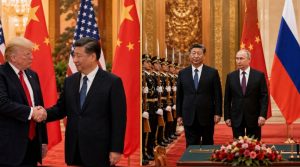
Beijing has successfully orchestrated a masterclass of rapid-fire diplomatic theater, navigating back-to-back state visits from the presidents of the world’s two largest nuclear powers and revealing a stark divergence in how China manages its chief strategic rival versus its deepest ideological ally. The mid-May 2026 visit by U.S. President Donald Trump, aimed at defusing critical trade tensions and securing Middle East stability, was followed days later by a sweeping, red-carpet summit with Russian President Vladimir Putin. Taken together, the consecutive summits expose a deliberate strategy by Chinese President Xi Jinping to accommodate Washington’s transactional commercial demands while simultaneously cementing a structural, long-term alliance with Moscow designed to challenge Western hegemony.
The initial diplomatic push culminated in mid-May as President Trump wrapped up his historic state visit to Beijing—his first trip to China since his previous term in 2017. Facing acute domestic economic pressures and a volatile standoff in the Middle East, Trump sought what administration officials termed a “truce” to stabilize highly fractured ties, emerging with a framework for a “constructive U.S.-China relationship of strategic stability.” Driven by the immediate necessity of leveraging China’s position as Iran’s largest trading partner to pressure Tehran and reopen the Strait of Hormuz, Trump prioritized immediate geopolitical guardrails and tangible market victories over broader structural overhauls.
While the U.S.-China summit noticeably lacked a formal joint communiqué, it successfully institutionalized bilateral management by chartering two government-to-government bodies: the U.S.-China Board of Trade and the U.S.-China Board of Investment. These frameworks provided the backdrop for a sweeping package of commercial commitments, headlined by Beijing’s approval of an initial purchase commitment for 200 American-made Boeing aircraft, alongside an anticipated supply of 400 to 450 GE Aerospace engines. Furthermore, China agreed to secure at least $17 billion per year in U.S. agricultural products through 2028, restored market access for more than 400 U.S. beef facilities, and pledged to lift restrictions on critical rare earth minerals, handing Trump a series of high-profile economic talking points.
ALSO READ: The Karaganov Doctrine: Inside Moscow’s Dangerous Shift Toward Nuclear Brinkmanship in Europe
However, the transactional nature of the American visit stood in sharp contrast to the profound institutional chemistry displayed during President Putin’s subsequent arrival, a meeting characterized by state media commentators as akin to “going to a friend’s house.” Marking the 25th anniversary of the foundational Sino-Russian Treaty of Friendship, Xi and Putin utilized the encounter to extend their bilateral commitments and project absolute ideological solidarity. Unlike the rigid protocol and damage-control diplomatic dance that defined the American delegation’s stay, the Sino-Russian summit focused entirely on deepening structural integration and executing a coordinated push against what both leaders termed Western “unilateralism and hegemonic thinking.”
The message is clearly one that China maintains friendship and strategic partnership with whichever power it likes, and the USA is just one of them.
— STEVE TSANG, DIRECTOR OF THE SOAS CHINA INSTITUTE
The centerpiece of Putin’s visit was the formal signing of 40 separate bilateral agreements that geopolitical analysts view as a direct blow to the heart of American global financial leverage. Most notably, Russian Finance Minister Anton Siluanov confirmed that more than 99 percent of their trade is now conducted entirely in rubles and yuan, effectively insulating an economic turnover approaching $240 billion from Western banking sanctions and the SWIFT network. This aggressive drive toward de-dollarization was paired with a reported 35 percent surge in Russian oil exports to China, alongside formal joint commitments to accelerate construction of Russian-designed reactor units at the Xudapu nuclear power plant and expand logistics corridors via the Arctic’s Northern Sea Route.
The AWB Weekly Briefing
Geopolitics. Justice. Stories that matter.
Our editors take you through the biggest geopolitical stories and voices denied justice — straight to your inbox, every week.
Weekly · Unsubscribe anytime · No spam
The profound divergence between a dollar-denominated trade truce with Washington and a virtually de-dollarized, integrated partnership with Moscow has sparked immediate alarm across the political spectrum in Washington. Mainstream lawmakers on Capitol Hill blasted the joint Sino-Russian declaration—particularly sections criticizing Trump’s proposed “Golden Dome” missile defense framework—warning that Beijing is effectively milking the United States for economic concessions while systematically bankrolling Russia’s state apparatus. Progressive and moderate Democrats joined the chorus of criticism, arguing that Trump’s elaborate praise of Xi during his stay allowed Beijing to outmaneuver the United States by securing temporary economic relief before launching a structural assault on the global financial system.
In a striking departure from standard Washington rhetoric, President Trump publicly downplayed the strategic implications of the Putin-Xi alliance upon his return, telling reporters that he had been fully briefed on the matter and framing the meeting as “a good thing.” From the White House’s transactional vantage point, the administration’s core objectives were met through the secured agricultural quotas, Boeing procurement orders, and back-door diplomatic guarantees to de-escalate the Iran crisis. Furthermore, Trump introduced a significant shift in U.S. positioning by directly characterizing pending multi-billion-dollar weapons sales to Taipei as a “very good negotiating chip” for Washington in its ongoing dealings with Beijing, adding to regional uncertainty regarding the baseline of long-term American support.
Behind the political rhetoric, technical experts at the U.S. Treasury Department are quietly assessing the viability of the Russia-China parallel financial architecture, with officials projecting confidence that the strategy will ultimately induce a “yuan trap” for Moscow. American financial strategists emphasize that by abandoning the dollar, Russia has rendered itself entirely dependent on a tightly controlled currency that cannot be easily converted or spent globally, creating a highly asymmetric relationship heavily weighted in Beijing’s favor. Washington maintains that alternative, gray-market payment networks remain far more expensive, less liquid, and significantly higher risk than the dollar-based ecosystem, betting that the broader Global South will ultimately reject a restrictive, Beijing-controlled financial alternative.
The sequence of the dual summits allowed Beijing to send an unmistakable geopolitical message to the international community regarding its hierarchy of alliances. By binding Trump to specific commercial commitments while offering Putin comprehensive, systemic treaties, China has demonstrated that it views Washington as a volatile trading partner to be carefully managed, but regards Moscow as its true partner in rewriting the global rules of engagement. The creation of independent financial corridors and joint megaprojects serves notice that the Sino-Russian alignment is migrating from a marriage of convenience into a deeply institutionalized bloc capable of weathering Western economic penalties.
As the dust settles on this extraordinary month of diplomacy, the international community is left with a concrete roadmap for a multi-polar diplomatic calendar. President Xi has accepted an official invitation for a reciprocal state visit to Washington D.C. in September 2026, which will be quickly followed by highly anticipated face-to-face encounters with both Trump and Putin at the APEC Summit in Shenzhen this November and the G20 Summit in Miami this December. For Washington, the challenge moving forward will be leveraging its newly formed Board of Trade to enforce Chinese market compliance while simultaneously deploying secondary sanctions to prevent Beijing’s parallel financial system from breaking the back of Western economic leverage.
Living Faith
Crusade 2026
Experience Three Powerful Days of Faith, Worship, and God's Word

📅 Date
September 24–26, 2026
📍 Venue
Rhema USA Campus, Broken Arrow, Oklahoma, USA


