Kumamoto Quake Death Toll Hits 30, Tests Kyushu’s Tech Hub
Rescuers race the 72-hour window in Kumamoto as TSMC, Toyota, and Honda assess damage and Kumamoto Castle cracks anew

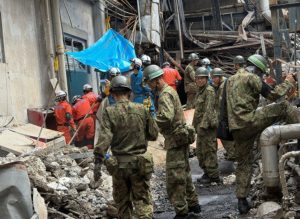
Emergency rescue crews, police units, and Japan Self-Defense Forces intensified search-and-recovery operations across Kyushu following a powerful earthquake that struck Kumamoto Prefecture on Tuesday afternoon. The shallow seismic event, occurring at a depth of 10 kilometers along the active Hinagu Fault at 4:27 p.m. local time, was registered at a magnitude 7.1 by the Japan Meteorological Agency (JMA), though the U.S. Geological Survey later revised the official designation to M6.8. The shock triggered localized tsunami advisories, widespread utility shutdowns, and emergency industrial suspensions across southern Japan. While initial fears of a broader oceanic hazard prompted rapid alerts across the Pacific, official telemetry confirmed that primary destruction remains localized to central Kyushu.
Japanese disaster management officials confirmed that the casualty count, as of Thursday morning, has reached 30 fatalities, with at least 63 injured—including six in serious condition—in figures expected to update as search efforts continue. Heavy tactical rescue operations remain focused on Kashima, where part of the Aeon Mall complex collapsed following a suspected gas leak explosion shortly after the primary tremor, as well as in Yatsushiro, where severe structural failures were reported at an industrial paper mill.
There are still people awaiting rescue, and time is of the essence. We will mobilize every resource on the ground to aim for the rescue and saving of as many lives as possible.
— SANAE TAKAICHI, PRIME MINISTER OF JAPAN
In a poignant echo of the region’s seismic history, Kumamoto Castle suffered fresh structural collapse when a section of its historic stone wall crumbled under the intense shaking. The landmark, which underwent years of painstaking restoration following the devastating 2016 Kumamoto earthquakes, once again stands as a dramatic symbol of the region’s vulnerability and resilience as municipal heritage teams conduct emergency damage evaluations.
Immediately following the main shock, JMA issued coastal tsunami advisories for the Ariake and Yatsushiro seas, instructing waterfront residents to evacuate to higher ground. The advisory was rescinded hours later after sea-level sensors verified no destructive wave activity. Simultaneously, the U.S. Pacific Tsunami Warning Center confirmed no basin-wide tsunami threat existed. Japan’s automated J-Alert early-warning network successfully broadcast notifications seconds before primary shaking arrived, enabling high-speed Kyushu Shinkansen bullet trains to engage emergency braking and prevent derailments.
Public infrastructure and nuclear safety protocols were activated immediately. The Nuclear Regulation Authority inspected regional facilities—including both the Sendai and Genkai nuclear power plants—confirming zero operational abnormalities or elevated radiation levels. Utility providers intentionally shut off gas connections to roughly 9,500 households in high-impact zones to prevent secondary fires, while municipal centers established shelters for over 9,000 evacuees facing severe summer heat. Seismologists have recorded nearly 190 aftershocks as of Thursday morning, with officials warning that strong secondary quakes remain a threat.
The earthquake caused immediate ripples through commercial supply chains across Kyushu, Japan’s microchip manufacturing hub known as “Silicon Island.” Semiconductor giant TSMC evacuated its flagship Kumamoto plant immediately after the quake, later reporting no major structural damage and commencing a gradual operational restart. In the automotive sector, Toyota suspended operations across three Fukuoka assembly facilities—Miyata, Kokura, and Kanda—to inspect supply lines, while Honda temporarily halted production at its Kumamoto motorcycle plant after quake-triggered fire sprinklers caused localized indoor flooding.
Despite industrial pauses, macroeconomic fallout appears contained. Early financial evaluations from catastrophe modeling firm Euler ILS Partners estimate insured losses between $3.0 billion and $4.5 billion, a manageable threshold for global reinsurance markets. Unlike the 2011 Tohoku disaster, structural damage to deep-water ports and major arterial highways remains light, suggesting broader macroeconomic impacts will remain temporary.
In rural areas across central Kumamoto, horizontal ground displacement in Yatsushiro reached as much as 87 centimeters according to monitoring stations from Japan’s Geospatial Information Authority (GSI). This extensive crustal movement contributed to surface ruptures in nearby agricultural fields, damaging terraced farmland and irrigation piping while road closures hampered regional logistics.
Infrastructure recovery continues to advance as rail operators partially restore Kyushu Shinkansen service along cleared northern segments. Government officials maintain that stringent structural building codes and automated early-warning infrastructure played an essential role in preventing far greater casualties across southern Japan.