The Fog of Fact: Inside Moscow’s Unverified Twin Claims on the Ukraine War
Front-line control disputes and asymmetric casualty claims reveal a deep narrative struggle as diplomacy stalls

M
OSCOW/KYIV — In the span of 24 hours, Russia issued two sweeping claims about the state of its war with Ukraine — one battlefield, one statistical — both unverified, both disputed, and both delivered through the same channel that has defined Moscow’s wartime communications strategy: direct reports to President Vladimir Putin, amplified through state media, with no independent confirmation attached.
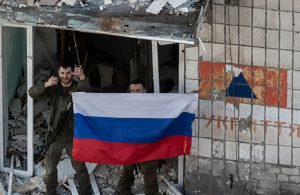
On July 3, General Valery Gerasimov, Chief of the General Staff of Russia’s Armed Forces, told Putin that Russian forces had captured Kostiantynivka, a fortified city in Ukraine’s Donetsk region long considered one of the last major defensive anchors in what military analysts call Ukraine’s “fortress belt.” Putin, visiting a command post to receive the report, called the city “a key transport and large industrial centre of Donbas” and praised its capture as a strategic achievement. Russia’s Defence Ministry released Telegram images it said showed Russian soldiers holding national flags amid damaged buildings in the city.
Ukraine’s response was immediate and specific. President Volodymyr Zelensky rejected the claim outright the following day, calling it “another Russian lie” intended to manufacture a news narrative. Ukraine’s General Staff went further, stating that units of the 19th Army Corps were continuing active defensive operations within the town and its approaches — a direct, on-the-record contradiction of Moscow’s account. Reuters, which first reported Gerasimov’s briefing, stated plainly that it could not independently verify either side’s version of events on the ground.
If Kostiantynivka were under Russian control, then perhaps Putin would have no problem meeting me there to find a diplomatic way to finally end this war.
— VOLODYMYR ZELENSKY, JULY 4, 2026
The dispute over Kostiantynivka is not new in character, even if its stakes are unusually high. Russia’s military has for months reported partial control over sections of the city, one of several fortified towns — alongside Sloviansk and Kramatorsk — that together form the core of Ukraine’s remaining defensive infrastructure in Donetsk. Analysts have noted that a confirmed Russian capture of the city would open a path for further advances toward that fortified network, making the claim, true or not, strategically significant simply by being made. Gerasimov told Putin that Russian forces were simultaneously closing in on Lyman, roughly 70 kilometers north, which he described as carrying “key logistical and strategic importance for further advances.”
Putin used the same appearance to dismiss Ukrainian battlefield statements more broadly, describing them as part of “an information campaign in which it puts on display supposed successes” — an accusation Kyiv has leveled back at Moscow with near-identical language. The exchange illustrates a wartime information environment in which neither side’s battlefield claims can be taken at face value, and in which independent verification — from journalists, satellite imagery analysts, or international observers — lags well behind the claims themselves.
A second claim, delivered the same week by a different Russian official, follows a similar pattern. At a Moscow briefing, Rodion Miroshnik, the Russian Foreign Ministry’s Ambassador-at-Large, said that Russia had returned 20,354 bodies of Ukrainian soldiers to Kyiv over the past year through official exchange mechanisms, compared with 627 Russian soldiers’ remains returned by Ukraine over the same period. Miroshnik characterized the disparity as definitive proof of the war’s actual toll: “This is the true ratio of those killed on the battlefield, a fact neither Kiev nor Brussels is willing to discuss.”
The figures themselves are, at minimum, accurately reported — TASS’s transcript of the briefing matches the numbers now circulating in Russian and pro-Russian outlets almost verbatim. What has not happened is independent verification. No neutral body — not the United Nations, not the International Committee of the Red Cross, which typically facilitates such exchanges, and not the Ukrainian government — has confirmed these specific figures. They originate solely from Russia’s Foreign Ministry, delivered at a briefing whose stated purpose was to argue that Kyiv is sustaining catastrophic losses.
More significant than the numbers themselves is the interpretive leap built into how they were presented. Body-exchange counts are shaped by which side physically controls the terrain where remains can be recovered, the pace and politics of negotiated exchanges, and logistical capacity — not simply by how many soldiers died on each side. Military analysts and humanitarian organizations that track prisoner and remains exchanges have long cautioned against treating such ratios as a proxy for total battlefield casualties, precisely because recovery access is itself a function of front-line control rather than a neutral sampling of the dead. Presenting a 32-to-1 body-return disparity as “the real casualty ratio” collapses that distinction, converting a logistics statistic into a casualty claim without the underlying verification such a claim would require.
Taken together, the two claims reflect a consistent pattern in how Moscow has managed wartime information throughout the conflict’s fifth year: high-confidence, high-specificity assertions — a captured city, a precise body count — delivered through state channels with no independent path to verification, timed to coincide with stalled diplomacy. Both claims emerged in the same week that Zelensky’s month-old open letter proposing a direct meeting with Putin remains unanswered, and as U.S.-brokered peace negotiations, led by Steve Witkoff and Jared Kushner, remain paused amid the broader regional fallout from the Iran conflict. Neither side has an incentive, in this environment, to concede ground on the narrative of who is winning — which is precisely why claims like these require attribution, not adoption, when reported.
For now, both claims stand exactly where they were made: as statements by a belligerent government, contested or unconfirmed by the other side, and unverified by any neutral party. What can be said with confidence is narrower than either government’s framing — that Russia’s military and diplomatic apparatus made two separate, significant claims about the war’s trajectory in the same week, and that Ukraine disputes at least one of them directly and has not been asked to confirm or deny the other.