Transactional Deterrence: Trump’s Shift to Poland Exposes Deeper Fiscal and Geopolitical Rifts
How Middle East operational costs and a widening diplomatic feud with Berlin forced an unexpected realignment of U.S. forces on NATO's eastern flank.

T
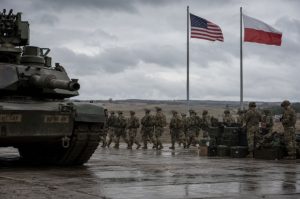
ransatlantic security architecture faced a profound realignment this week as a rapid succession of military drawdowns and sudden deployments exposed a deeply transactional shift in American foreign policy. On Thursday, May 21, 2026, President Donald Trump bypassed standard Pentagon channels to announce via Truth Social that the United States would deploy an additional 5,000 troops to Poland. This unexpected declaration fundamentally reversed a directive issued just days prior, leaving both NATO allies and high-ranking U.S. defense officials scrambling to reconcile the commander-in-chief’s personal diplomatic maneuvers with the military’s current operational realities. The sudden pivot has triggered intense debate across European capitals regarding the reliability of Washington’s long-standing security guarantees during a period of acute global instability.
Compounding these geopolitical shifts is a severe domestic resource crunch driven by the soaring costs of U.S. operations in the Middle East. According to the independent Iran War Cost Tracker, the total financial drain of the U.S. campaign against Iran has surpassed $65.3 billion, fueled by an intensive operational burn rate. A recent Pentagon report to Congress revealed that the first six days of Operation Epic Fury alone carried an $11.3 billion price tag, with ongoing operations consuming an estimated $1 billion per day. The heavy reliance on costly precision guided munitions, including Tomahawk cruise missiles and advanced naval interceptors like the SM-3 and SM-6 to neutralize layered air defenses, has severely depleted the military’s unbudgeted emergency reserves and forced a critical reassessment of global asset allocation.
This financial strain is further exacerbated by significant material and infrastructure losses detailed in a recent Congressional Research Service report. The document confirmed that 42 U.S. aircraft were lost or heavily damaged during the 40 days of intense bombardment preceding the April ceasefire, including 24 MQ-9 Reaper drones, multiple F-15E Strike Eagles, and an F-35A Lightning II that suffered ground-fire damage—a loss quickly seized upon for propaganda value by Iranian Foreign Minister Abbas Araghchi. Furthermore, Iranian retaliatory ballistic missile strikes caused extensive infrastructure damage to key regional hubs, disabling a $1.1 billion early warning radar system at Al-Udeid Air Base in Qatar and damaging critical installations in Bahrain, Saudi Arabia, and Kuwait. As the U.S. Senate advances a war powers resolution to curb further expenditures, the Pentagon is forced to treat its remaining deployments as a scarce resource, pulling forces from traditional strongholds to fund new theater adjustments.
This global resource crunch provided the strategic backdrop for a widening diplomatic fracture between Washington and Berlin, directly converting fiscal strain into a tool for geopolitical leverage. At the beginning of May, Secretary Pete Hegseth confirmed plans to withdraw 5,000 active-duty U.S. troops from Germany over a six-to-twelve-month period, effectively reducing the American military footprint in Germany by roughly 14 percent. The decision served as a direct political retaliation following a sharp public dispute between President Trump and German Chancellor Friedrich Merz. Merz had openly criticized Washington’s execution of the war against Iran, asserting that the U.S. failed to properly consult its European allies prior to launching the campaign on February 28, and later remarking that Washington was facing diplomatic humiliation at the negotiating table. The administration responded by targeting Germany’s troop presence while preserving indispensable logistical hubs like Ramstein Air Base and Landstuhl Regional Medical Center.
ALSO READ: NATO Fractures Deepen as Rutte’s Ukraine Funding Mandate Stalls Against Major Economies
This initial drawdown plan, however, directly contradicted the broader integration strategy that military planners had spent weeks implementing across Northern Europe. Only days before the President’s social media announcement, the Pentagon halted the scheduled deployment of approximately 4,000 personnel from the Army’s 2nd Armored Brigade Combat Team, 1st Cavalry Division, who were originally bound for Polish bases. Chief Pentagon spokesman Sean Parnell had previously characterized the dynamic as a temporary structural delay intended to reduce the number of active Brigade Combat Teams in Europe from four down to three. This consolidation was part of a broader administration strategy to trim personnel from the European theater, a logistical shift that U.S. Air Force Gen. Alexus Grynkewich, commander of U.S. European Command and NATO’s Supreme Allied Commander Europe (SACEUR), explicitly outlined to reporters during a Brussels press conference on May 19, just two days before the President’s post upended the narrative.
By contrast, the decision to reward Poland with an influx of American forces underscores a highly personalized approach to international alliances. In his social media announcement, Trump explicitly tied the deployment to the “successful election” of Poland’s conservative nationalist President, Karol Nawrocki, an ally whom Trump had previously endorsed during his campaign last year. By explicitly linking American military asset allocation to foreign electoral outcomes, the administration has signaled that security commitments are no longer absolute guarantees derived from decades-old treaties, but are instead, as critics argue, a form of geopolitical currency traded based on explicit diplomatic alignment. While nations like Germany, Spain, and Italy face drawdown threats for restricting airspace or withholding naval support in the blockaded Strait of Hormuz, Warsaw is being positioned—in the administration’s own framing—as a model ally.
Based on the successful Election of the now President of Poland… the US will be sending an additional 5,000 Troops to Poland.
— DONALD J. TRUMP
The shifting of American forces closer to the Russian periphery carries profound geographic and strategic implications. Unlike Germany, which sits comfortably insulated behind the buffer of Central Europe, Poland shares a direct 232-kilometer border with Kaliningrad, a heavily fortified Russian exclave wedged between Poland and Lithuania, which features a 210-kilometer land frontier alongside a 22-kilometer maritime segment across the Vistula Lagoon. Poland also shares a lengthy eastern border with Belarus, Russia’s closest military partner. This immediate proximity places any expanded U.S. presence practically on Moscow’s doorstep, altering the delicate balance of friction along NATO’s eastern flank. The geographic reality means that American forces operating out of Polish facilities are positioned inside a vital strategic corridor that both Moscow and NATO view as a primary potential flashpoint.
The AWB Weekly Briefing
Geopolitics. Justice. Stories that matter.
Our editors take you through the biggest geopolitical stories and voices denied justice — straight to your inbox, every week.
Weekly · Unsubscribe anytime · No spam
Military analysts emphasize that this expanded presence is structured as a “tripwire” defense rather than a frontline combat wall. The bulk of the 10,000 U.S. troops stationed in Poland operate out of inland installations such as Camp Kościuszko in Poznań—the forward headquarters for the U.S. Army’s V Corps—as well as logistics and air hubs in Powidz and Żagań. By placing American personnel safely back from the immediate frontier but well within the zone of any potential territorial incursion, Washington ensures that any localized conflict would immediately involve U.S. casualties. This integration is designed to strip an American president of the choice to opt out of a regional crisis, effectively forcing a superpower retaliation and serving as an ultimate deterrent against foreign aggression.
However, this tripwire strategy faces mounting skepticism from realist foreign policy scholars who question whether the deployment invites more danger than it deters. Critics argue that a few thousand additional soldiers cannot serve as a physical shield against a nuclear-armed neighbor equipped with advanced supersonic and hypersonic missile systems. From this perspective, pushing foreign military assets closer to Russian territory risks backing a rival superpower into a defensive corner, significantly increasing the probability of a catastrophic miscalculation or a minor border skirmish escalating out of control. Proponents of this view suggest that smaller frontline nations would achieve greater long-term stability through careful diplomatic balancing and economic pragmatism rather than hosting the heavily armed assets of a rival superpower.
This skepticism feeds into a broader, more fundamental question regarding the ultimate reliability of the American security umbrella in the event of a worst-case scenario. Under the “America First” doctrine, there is palpable domestic resistance to entering a major conflict over regional disputes, a sentiment amplified by Vice President JD Vance’s ongoing assertions that European nations must take primary responsibility for their own defense rather than treating the U.S. military as a permanent blank check. Critics point out that no American administration would willingly jeopardize its own major metropolitan areas in a strategic escalation to avenge a foreign territory. This underlying tension leaves Warsaw betting heavily that the presence of U.S. troops will successfully prevent a conflict from ever starting, as a failure of that bluff would yield devastating consequences.
Living Faith
Crusade 2026
Experience Three Powerful Days of Faith, Worship, and God's Word

📅 Date
September 24–26, 2026
📍 Venue
Rhema USA Campus, Broken Arrow, Oklahoma, USA


