Armenia Deploys Advanced French Artillery as Russia Threatens Gas Cutoff Ahead of Elections
As French CAESAR systems debut on the streets of Yerevan, Moscow unleashes a sweeping economic and energy counter-offensive ahead of crucial parliamentary elections.

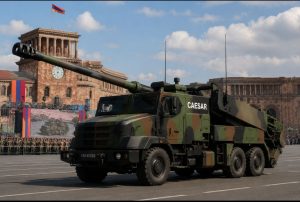
YEREVAN — A major geopolitical realignment solidified in the South Caucasus as Armenia publicly showcased advanced French military hardware during its Republic Day events, raising intense regional friction and triggering a sweeping economic counter-offensive from Moscow ahead of Armenia’s pivotal parliamentary elections. The public debut of French-supplied CAESAR self-propelled artillery systems in the streets of Yerevan marks the most visible fracture to date in Armenia’s historic security alliance with Russia. This rapid defense diversification has drawn sharp rebukes from both Moscow and Baku, fueling a wave of regional disinformation regarding a Western troop deployment while testing the limits of Armenia’s absolute economic dependence on Russian energy and trade networks.
The tensions come at a highly sensitive moment as Armenia prepares for crucial parliamentary elections. While unverified claims circulating on social media alleged that France was deploying combat battalions to directly intervene in the vote, international observers and defense analysts confirm the reality remains strictly bound to logistical contracts and hardware procurement rather than foreign boots on the ground. The rumor mill has nevertheless intensified, framed by geopolitical rivals as a provocative Western encroachment into a region traditionally managed by Moscow.
Russia’s response to Armenia’s westward turn has shifted rapidly from rhetorical warnings to tangible, punitive economic enforcement. Russian Energy Minister Sergei Tsivilev sent an official letter to Yerevan warning that Moscow may unilaterally suspend or terminate the landmark 2013 bilateral agreement that provides Armenia with heavily subsidized natural gas, petroleum products, and rough diamonds. The Kremlin noted that Armenia’s declared aspiration to seek European Union accession directly endangers preferential trade frameworks. Kremlin spokesman Dmitry Peskov reinforced the stance, noting that Armenia’s current gas pricing structure would transition to standard global market rates if the country exits the Eurasian Economic Union. Armenia currently relies on Russia for roughly 85% of its natural gas, purchasing it at a highly subsidized rate of $177.5 per 1,000 cubic meters compared to European market baselines that have hovered near $550–$633.
Armenian Prime Minister Nikol Pashinyan immediately pushed back against Moscow’s energy pressure, explicitly stating his confidence that solutions would be found through Armenia’s institutional standing inside the Eurasian Economic Council. Pashinyan publicly argued that Armenia had navigated similar behind-the-scenes Russian contract disputes before, stating that ‘people weren’t even aware of them’ — and expressed confidence the same outcome was achievable now through his dual membership in the Eurasian Economic Intergovernmental Council and Supreme Economic Council.
Simultaneously, Russian agricultural regulator Rosselkhoznadzor announced a sweeping, temporary ban on the import of fresh Armenian tomatoes, cucumbers, peppers, and strawberries, citing sudden phytosanitary safety violations. The agricultural restrictions follow previous targeted border delays affecting Armenian brandy, flowers, and mineral water at the crucial Lars checkpoint. This economic squeeze serves as a severe warning to the Armenian electorate regarding the immediate domestic costs of cutting ties with Moscow.
ALSO READ: Nigerian Medical Brain Drain: UK PLAB Pipeline
Today we present to you the new army of the Republic of Armenia – with new weaponry, new uniforms, and a new ideology. The core of that ideology is the following: the army’s sole mission is the defense of the internationally recognized sovereign territory of the Republic of Armenia.
— NIKOL PASHINYAN, PRIME MINISTER OF ARMENIA
The statement represented Armenia’s clearest public signal yet that its armed forces are oriented strictly toward its internationally recognized borders — not the recovery of lost territory.
The strategic rupture between Yerevan and Moscow traces back to the aftermath of the 2023 Azerbaijani military operation that restored full control over Nagorno-Karabakh. Armenian Prime Minister Nikol Pashinyan fundamentally froze relations with the Russian-led Collective Security Treaty Organization (CSTO), openly declaring that relying entirely on Russia for national security was a strategic mistake after Russian forces and peacekeepers declined to militarily intervene. Seeking an immediate counterweight to Azerbaijan’s military dominance, Pashinyan pivoted toward Paris, culminating in a comprehensive strategic partnership.
For France, the defense deals in the Caucasus offer an opportunity to project power and secure new markets for Western defense contractors like KNDS and Airbus. The geopolitical maneuvering carries distinct echoes of the wider global competition between Paris and Moscow, particularly after France suffered a series of severe geopolitical defeats in West Africa’s Sahel region. In nations like Mali, Burkina Faso, and Niger, long-standing French military and economic networks were systematically dismantled and replaced by Russian security forces and state mining concessions. By heavily arming Armenia with advanced radars and howitzers, Paris is directly challenging Russian influence in its historic sphere.
However, many economists and regional realists warn that Armenia is undertaking a high-stakes strategic realignment. Unlike the resource-drained African states that sought to sever exploitative post-colonial ties with Paris, Armenia has historically built deep structural dependencies on economic benefits provided by Moscow. Shifting to Western defense dependencies does nothing to solve Armenia’s structural reliance on Russian-owned electrical grids, pipelines, and export markets. Furthermore, European nations face their own fiscal constraints, with the World Bank noting that Armenia itself urgently requires structural economic reforms to withstand external shocks.
Russia has argued that CSTO mutual defense clauses were never triggered because Pashinyan himself had formally recognized Karabakh as Azerbaijani territory — a justification Armenian officials and legal analysts have strongly disputed. As voters prepare to head to the ballot box, Armenia faces an acute national dilemma. The country must decide whether French military promises and European integration commitments are worth the looming regional pressure and structural leverage retained by a disgruntled former protector. Armenia, however, has already begun diversifying: Azerbaijani fuel imports arrived in December 2025 and have since cut petrol prices by up to 15%, while Iran continues to supply 15% of Armenia’s gas needs — suggesting the structural picture, while daunting, is not entirely static.