High-Seas Standoff: French Special Forces Board Russian Shadow Tanker Tagor
Backed by UK military support, the helicopter-borne raid exposes a critical legal backdoor in international waters over sanctions enforcement.

A
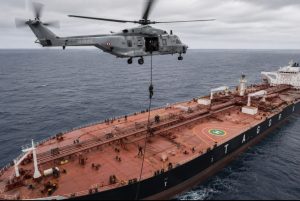
major geopolitical escalation occurred Sunday morning as French naval forces, backed by British military support, intercepted and boarded a blacklisted Russian shadow fleet oil tanker in international waters, intensifying the maritime friction between Western allies and Moscow over sanctions evasion. The high-stakes operation, executed more than 400 nautical miles west of Brittany, France, underscores a shift toward direct physical enforcement of economic blockades against vessels funding Russia’s military operations. By targeting a vessel utilizing fraudulent African flags, Western coalition forces have exposed a critical legal flashpoint in international waters where economic warfare meets global maritime law.
The 252-meter tanker, identified as the Tagor, was intercepted on May 31, 2026, after departing from the Arctic port of Murmansk in northwestern Russia. While satellite tracking data indicated the ship had recently been digitally broadcasting its location under a Madagascar flag, French commandos descending from helicopters discovered the vessel was physically flying a Cameroonian flag. Maritime safety authorities have classified the discrepancy as a textbook case of “flag-hopping”—the practice of rapidly changing registrations mid-voyage to hide identity, mask ownership, and avoid international tracking systems.
French President Emmanuel Macron verified the joint military action, framing the interception as a necessary step to uphold international law. “It is unacceptable for ships to circumvent international sanctions, violate the law of the sea, and fund the war that Russia has been waging against Ukraine for more than four years,” Macron stated in an official announcement. The French Maritime Prefecture confirmed the *Tagor* is currently being escorted to a secure domestic anchorage point for comprehensive document verification and judicial review.
It is unacceptable for ships to circumvent international sanctions, violate the law of the sea, and fund the war that Russia has been waging against Ukraine for more than four years.
— EMMANUEL MACRON
The Kremlin reacted with immediate diplomatic hostility, severely condemning the joint European operation. Russian officials characterized the military boarding in international waters as a flagrant breach of maritime sovereignty, calling the interception “illegal” and “bordering on international piracy.” The legal tension is not purely rhetorical—international maritime law scholars have long debated whether unilateral sanctions enforcement on the high seas, absent a UN Security Council mandate, constitutes a legitimate extension of jurisdiction or a precedent with destabilizing implications for freedom of navigation.
ALSO READ: Armenia Deploys Advanced French Artillery as Russia Threatens Gas Cutoff Ahead of Elections
Under the United Nations Convention on the Law of the Sea, the high seas are strictly governed by the principle of exclusive flag-state jurisdiction, meaning only the country registering a ship has policing authority. However, Western coalition forces relied on a legal backdoor within UNCLOS Article 110, which grants navies a “right of visit” if there is reasonable suspicion that a vessel is effectively stateless or flying a fraudulent flag. By exploiting the *Tagor’s* conflicting Cameroonian and Madagascan identities, France and the United Kingdom successfully bypassed the structural paralysis of the UN Security Council, where Russia maintains a permanent veto.
The AWB Weekly Briefing
Geopolitics. Justice. Stories that matter.
Our editors take you through the biggest geopolitical stories and voices denied justice — straight to your inbox, every week.
Weekly · Unsubscribe anytime · No spam
Moscow’s choice of flag was not random—it was a geopolitical calculation. By routing the *Tagor* under Madagascar’s registration, Russian-linked operators were banking on Western hesitation to trigger a diplomatic crisis with a newly courted African government. Throughout early 2026, Moscow has aggressively cultivated the new Malagasy junta—supplying weapons, military instructors, and Africa Corps personnel—in a bid to transform the island into a logistics foothold in the Indian Ocean, even as Antananarivo hedges with simultaneous overtures to Washington.
This flag transition appears to have been executed poorly, leaving a legal vulnerability French intelligence moved to exploit. The boarding quickly escalated when the Tagor’s Russian captain actively refused to comply with initial orders, forcing French special forces to physically take control of the bridge. Paris was highly motivated to execute the high-risk strike, simultaneously disrupting Russia’s sanctions-busting infrastructure and reasserting strategic visibility across an African maritime corridor where French influence has faced sustained and accelerating pressure.
The confrontation marks a shift, analysts suggest, from bureaucratic evasion toward more openly confrontational maritime posturing. In recent months, credible reports have indicated Russia deployed naval assets to escort sanctioned tankers through the English Channel, raising concerns over potential high-seas confrontations. By executing the air-and-sea drop on the *Tagor* while it cruised without an active combat escort, France and the United Kingdom have signaled a willingness to enforce strict compliance on vulnerable transit routes.
Despite the heavy military deployment, early inspections revealed the massive vessel was virtually empty of cargo, bound for the port of Limbe, Cameroon, according to French maritime authorities. Prior detentions have produced varied outcomes—from multimillion-euro fines to criminal prosecution in absentia—building a legal precedent designed to make shadow fleet operations increasingly costly and legally precarious. Taken together, France’s four interceptions in nine months represent something more than sanctions enforcement — they are a live-fire test of whether the international legal order can be meaningfully defended on the high seas without multilateral consensus. The verdict is still being written, one boarded tanker at a time.
Living Faith
Crusade 2026
Experience Three Powerful Days of Faith, Worship, and God's Word

📅 Date
September 24–26, 2026
📍 Venue
Rhema USA Campus, Broken Arrow, Oklahoma, USA