Diplomatic Disarray in Kyiv: False Evacuation Rumors Mask Growing Western Friction
As Russia threatens strikes on "decision-making centers," a mistaken report of a U.S. withdrawal exposes fraying trans-Atlantic communication and Washington's strategic silence at the UN.

T
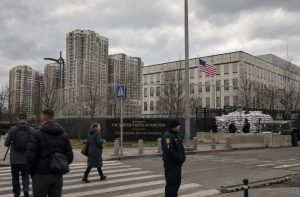
he United States Embassy in Kyiv remains fully operational, maintaining its presence in the capital amid Russian threats of escalating strikes against the city. Yet the speed with which a false rumor of an American evacuation spread through Western diplomatic circles on Thursday raised questions about trans-Atlantic communication and Washington’s posture toward the conflict. The episode began on Thursday morning when European Union foreign policy chief Kaja Kallas told reporters on the sidelines of an EU meeting in Cyprus that Washington had pulled its personnel. “What we heard from Ukraine yesterday was that all the embassies stayed except one,” Kallas said. “All the Europeans stayed. America left.”
The assertion raised immediate questions regarding Western unity as the capital braced for intensified bombardment. However, within hours, the U.S. State Department and Ukrainian officials denied the claim. The U.S. Embassy in Kyiv issued a statement on X, formerly Twitter, declaring: “The U.S. Embassy is open. There are no changes to our operations and reports otherwise are false.” Ukrainian Foreign Ministry spokesperson Heorhii Tykhyi backed the American denial, stating that the rumor was entirely untrue. By Thursday afternoon, the European Union’s diplomatic service edited Kallas’s official transcript on its website, removing the references to the United States and appending a correction note regarding the diplomatic presence in Kyiv.
The U.S. Embassy is open. There are no changes to our operations and reports otherwise are false.
— U.S. EMBASSY IN KYIV
ALSO READ: Ukraine War Crisis Deepens as European Ammunition Coalition Fractures and Russia Threatens Systematic Kyiv Strikes
The origin of the misunderstanding appears connected to concurrent personnel movements and communication gaps. Diplomats confirmed that the acting U.S. Ambassador to Ukraine, Chargé d’Affaires Julie S. Davis, had traveled to the western city of Lviv over the weekend for a long-scheduled event. At the same time, Dmytro Lytvyn, a communications adviser to Ukrainian President Volodymyr Zelensky, noted that some American personnel had temporarily shifted locations during a large-scale Russian missile barrage on Sunday night. This movement of personnel, which American and Ukrainian officials described as routine, was apparently misconstrued by some European officials as a permanent, unilateral evacuation.
The AWB Weekly Briefing
Geopolitics. Justice. Stories that matter.
Our editors take you through the biggest geopolitical stories and voices denied justice — straight to your inbox, every week.
Weekly · Unsubscribe anytime · No spam
The broader context involves a phone call on Sunday between Russian Foreign Minister Sergey Lavrov and U.S. Secretary of State Marco Rubio. Earlier on May 25, the Russian Foreign Ministry had issued a public statement recommending that foreign states evacuate diplomatic staff from Kyiv immediately. On the call, Lavrov referenced that advisory. Rubio subsequently said he relayed Lavrov’s message directly to President Trump. According to readouts from both sides, Lavrov informed Rubio that the Russian military would begin targeting “decision-making centers” and military-industrial command posts in Kyiv.
The Kremlin framed the planned escalation as retaliation for a Ukrainian drone strike on Starobilsk in occupied Luhansk Oblast. Russia claimed the strike killed 21 people in a college dormitory, including children. Ukraine’s military said it targeted the headquarters of Russia’s elite Rubikon drone unit and called Russia’s civilian casualty claims “misleading.” The dispute over the nature of the target remains unresolved. Russia proceeded with its escalation announcement regardless, offering no diplomatic alternatives or conditions to halt the planned assault. Instead, Lavrov issued an unconditional warning that anyone choosing to remain must avoid proximity to administrative and military infrastructure.
If Russia follows through on its statements, the strategic and humanitarian consequences could be significant. In Russian military doctrine, language targeting “decision-making centers” typically refers to government ministries, presidential offices, and intelligence headquarters located in the central districts of Kyiv. While the Ukrainian government has long established decentralized and subterranean command structures to maintain operational continuity, high-yield precision strikes in central Kyiv would likely cause significant civilian casualties and damage to nearby residential neighborhoods, historic landmarks, and remaining foreign diplomatic outposts.
Furthermore, the targeting of administrative hubs introduces risks of direct escalation between Russia and Western states. While nearly 50 United Nations member states signed a joint statement condemning Russia’s threats against diplomatic missions and embassies in Kyiv, several EU nations have responded by summoning their local Russian ambassadors to protest the warnings. The United States was not among the signatories. A strike affecting a foreign embassy or killing Western diplomatic staff choosing to remain in Kyiv could trigger a significant escalatory cycle. U.S. officials have said the decision to keep the embassy active reflects Washington’s commitment to Ukraine amid an escalating Russian strike campaign against the capital.