Inside the Fall of Tulsi Gabbard: How the Iran War Ended America’s Top Spy Chief
Between a personal family health crisis and severe West Wing friction over Iran strategy, the administration's most polarizing reformer prepares an early exit.

This article is written to fully inform — not just notify. In the race for speed, much of modern news reduces complex global events to fragments. At The AWB News, we provide the context, sourcing, history, and analysis needed to understand the full picture, not just the headline.
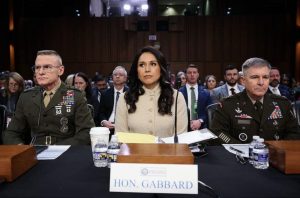
Photo: AWB News / CBS Video
The resignation of Director of National Intelligence Tulsi Gabbard, announced Friday, May 22, 2026, marks a pivotal moment for the second Trump administration, revealing significant tension between ideological anti-interventionism and the assertive foreign policy demands of the administration. Formally, Gabbard’s departure is framed as a personal family decision. In her official resignation letter to President Donald Trump, she stated that she is stepping away to care for her husband, Abraham Williams, following his diagnosis with an extremely rare form of bone cancer. “At this time, I must step away from public service to be by his side and fully support him through this battle,” Gabbard wrote in the document published by PBS NewsHour, establishing an effective departure date of June 30, 2026. The exit concludes a 16-month tenure that began with her swearing-in ceremony in February 2025.
Publicly, the White House has maintained a supportive and amicable posture, attempting to ensure a dignified departure for one of its most high-profile loyalists. President Trump quickly took to Truth Social to praise her performance and validate his decision, writing, “Unfortunately, after having done a great job, Tulsi Gabbard will be leaving the Administration on June 30th. Her wonderful husband, Abraham, has been recently diagnosed with a rare form of bone cancer, and she, rightfully, wants to be with him…” As reported by Oregon Public Broadcasting, Trump confirmed that Aaron Lukas, the Principal Deputy Director of National Intelligence, will step in as acting director. However, beneath this public posture of cordiality, deep fractures within the intelligence apparatus suggest a forced departure. While senior officials quickly denied mainstream reports that Gabbard was pushed out, intelligence insiders indicate she faced systemic pressure to step down after months of policy rifts regarding the administration’s military escalation against Iran.
At this time, I must step away from public service to be by his side and fully support him through this battle.
— TULSI GABBARD
The primary fault line that defined a turning point in Gabbard’s tenure was her foundational identity as an anti-interventionist, a stance that repeatedly placed the Iraq War veteran at loggerheads with a White House pursuing an assertive military strategy in the Middle East. This ideological mismatch culminated during the Senate Intelligence Committee’s annual global threats hearing on March 18, 2026, an event viewed by some Washington analysts as the beginning of the end for her leadership. While the broader intelligence community’s formal assessment identified China, Russia, North Korea, and Iran as an adversarial axis, Gabbard’s own prepared written testimony contained a notable contradiction. As outlined in comprehensive coverage by Al Jazeera, she noted that Iran’s nuclear enrichment capabilities had been “obliterated” by U.S. airstrikes in 2025 and that Tehran had made “no effort since then to try to rebuild.” Realizing this undermined the administration’s public justification of an imminent Iranian nuclear threat, Gabbard deflected from her prepared remarks during her opening presentation, a move that immediately drew congressional scrutiny.
ALSO READ: Russia Moves to Authorize Extraterritorial Military Force Against Foreign Judicial Prosecutions
The ensuing cross-examination by Democratic Senator Jon Ossoff of Georgia during the hearing revealed deep-seated internal tensions under her watch. When questioned by Ossoff on whether her agency truly assessed an imminent nuclear threat from Iran, in an exchange that observers described as tense, Gabbard testified that the intelligence community assessed that Iran “maintained the intention to rebuild” before adding that it was not her agency’s responsibility to “determine what is and is not an imminent threat,” declaring that “the only person who can determine what is and is not an imminent threat is the President.” This assertion drew swift condemnation from lawmakers who pointed out that identifying and contextualizing national security threats is the core statutory mandate of the DNI. Critics argued that by subordinating objective intelligence data to executive decree, Gabbard alienated career intelligence professionals.
The AWB Weekly Briefing
Geopolitics. Justice. Stories that matter.
Our editors take you through the biggest geopolitical stories and voices denied justice — straight to your inbox, every week.
Weekly · Unsubscribe anytime · No spam
This public unraveling followed an earlier pattern of reversals that had already impacted her standing within the intelligence community. In March 2025, Gabbard had testified to Congress that Iran was not actively building a nuclear weapon and that Supreme Leader Ayatollah Khamenei had not reauthorized the program. When President Trump publicly disputed her findings, asserting that Iran was “very close” to a bomb, Gabbard rapidly walked back her position on national television, claiming the media had “misconstrued” her words. This reversal did not restore her standing within the administration; instead, reports indicate she was progressively sidelined from Trump’s inner circle, facing deep divisions over the administration’s active posture in the region, including her notable exclusion from the operation that captured former Venezuelan President Nicolás Maduro.
Internal administrative frustrations further impacted Gabbard’s standing within the West Wing, where officials raised concerns about operational mishaps under her leadership. Her signature mandate was to act as an institutional reformer, a mission she pursued by launching transparency directives. However, this process faced structural challenges; the release of over 63,000 pages of John F. Kennedy assassination files resulted in an administrative failure when private citizen data, including Social Security numbers, was accidentally leaked to the public domain. The friction grew following the high-profile resignation of Joe Kent, the director of the National Counterterrorism Center, who left in protest of the Iran war. White House sources indicated that Trump had questioned advisers about replacing Gabbard after she refused to publicly denounce Kent for his insubordination.
Despite criticism of her tenure and her apparent political isolation within the administration, Gabbard’s supporters view her 16-month stint as a significant achievement against entrenched institutional bureaucracy. In their view, she advanced government accountability by engineering an unprecedented level of institutional transparency. Acting on direct administrative priorities, Gabbard oversaw the declassification of more than half a million pages of government records, including historical files concerning the disputed Trump-Russia investigation and the assassination of President John F. Kennedy. Furthermore, acting on executive orders, Gabbard stripped the security clearances of 37 former intelligence officials who had signed the controversial 2020 letter labeling the Hunter Biden laptop story as Russian disinformation, while also revoking access for former Obama- and Biden-era figures including Antony Blinken, Hillary Clinton, and John Brennan.
Gabbard also moved to structurally alter what she characterized as a politicized bureaucracy, instituting changes that reshaped the ODNI workforce. She dissolved the leadership of the National Intelligence Council, referred several internal intelligence officials to the Department of Justice for criminal prosecution over unauthorized media leaks, and under the framework of her “ODNI 2.0” restructuring directive initiated a plan to downsize total ODNI personnel by 40 percent, saving over $700 million annually. While civil liberties advocates cheered the unprecedented pace of historical disclosures, institutional critics countered that her rapid personnel changes and partisan declassifications risked compromising core intelligence-gathering protocols.
Gabbard’s exit makes her the latest in a series of high-profile Cabinet-level departures—following former Homeland Security Secretary Kristi Noem, former Attorney General Pam Bondi, and former Labor Secretary Lori Chavez-DeRemer—highlighting a pattern of departures among the “MAGA disruptors” initially brought in to shake up Washington. Her trajectory mirrors that of tech billionaire Elon Musk, who departed his post at the Department of Government Efficiency (DOGE) in May 2025 after a 130-day stint marked by policy disputes over a federal spending bill. Both Musk and Gabbard entered their roles with sweeping mandates to alter federal agencies, only to find their personal ideologies incompatible with the realities of governance and the shifting priorities of the President.
This compounding wave of departures has turned the spotlight onto Robert F. Kennedy Jr., the Secretary of Health and Human Services (HHS), though current indicators suggest his standing appears more secure. Unlike Gabbard, whose non-interventionism conflicted with Trump’s active military objectives, Kennedy’s ongoing institutional reform efforts against the pharmaceutical industry, corporate food interests, and federal health regulators remain more closely aligned with the administration’s core domestic agenda. Kennedy continues to operate with presidential backing, recently generating headlines across public health networks by summarily firing the top leadership of the U.S. Preventive Services Task Force. While Gabbard’s husband’s health crisis provided an exit from an administration where she had faced mounting pressure, her departure underscores the ongoing tension between disruptive policy mandates and established institutional structures.
Why Your Support Matters
Support Our MissionFund Justice. Read Free.
VISA●● MCVerveAMEX⌘PayAFRIGO
🔒 100% Secure Payment Gateway